

Modeling of Coastal Waves and Hydrodynamics 27.3 Coupled and Nested Techniques 605
Part C | 27.3
nonlinear shallow water equations with different finitedifference algorithms.
Successful simulation of tsunami propagation and
accurate prediction of the arrival time and wave height
at different locations rely on a correct estimate of the
earthquake fault plane mechanism. Interplate faults in
subduction zones are responsible for most of the large
tsunamis in history. For interplate fault ruptures, the resulting seafloor displacement can be estimated approximately using linear elastic dislocation theory [27.64,
65]. For more sophisticated fault models, non-uniform
stress-strength fields (faults with various kinds of barriers, etc.; [27.66]) are expected, so the actual seafloor
displacement may be very irregular. Once the seafloor
displacement has been determined, the initial ocean free
surface profile is assumed to take the same configuration, based on the assumptions that the upward seafloor
movement is impulsive and seawater is incompressible.
For a given source region condition specified by either the initial free surface elevations or a time history
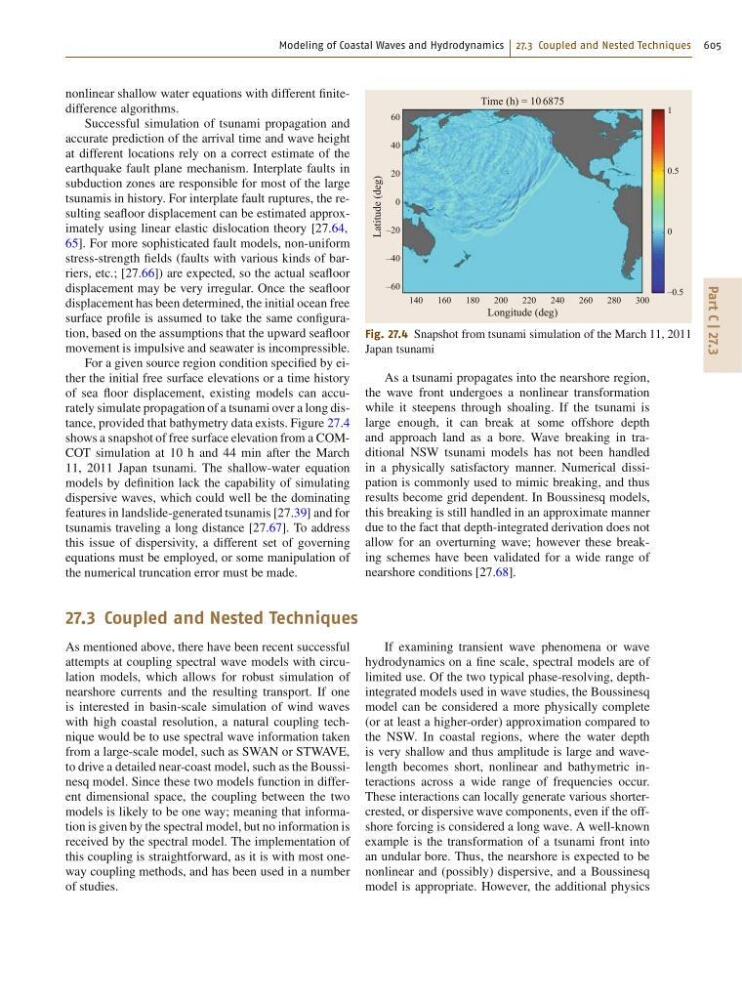
of sea floor displacement, existing models can accurately simulate propagation of a tsunami over a long distance, provided that bathymetry data exists. Figure 27.4
shows a snapshot of free surface elevation from a COMCOT simulation at 10 h and 44 min after the March
11, 2011 Japan tsunami. The shallow-water equation
models by definition lack the capability of simulating
dispersive waves, which could well be the dominating
features in landslide-generated tsunamis [27.39] and for
tsunamis traveling a long distance [27.67]. To address
this issue of dispersivity, a different set of governing
equations must be employed, or some manipulation of
the numerical truncation error must be made.
Longitude (deg)
Time (h) = 10 6875
Latitude (deg)
140
160
180
200
220
240
260
280
300
60
40
20
0
–20
–40
–60
1
0.5
0
–0.5
Fig. 27.4 Snapshot from tsunami simulation of the March 11, 2011
Japan tsunami
As a tsunami propagates into the nearshore region,
the wave front undergoes a nonlinear transformation
while it steepens through shoaling. If the tsunami is
large enough, it can break at some offshore depth
and approach land as a bore. Wave breaking in traditional NSW tsunami models has not been handled
in a physically satisfactory manner. Numerical dissipation is commonly used to mimic breaking, and thus
results become grid dependent. In Boussinesq models,
this breaking is still handled in an approximate manner
due to the fact that depth-integrated derivation does not
allow for an overturning wave; however these breaking schemes have been validated for a wide range of
nearshore conditions [27.68].
27.3 Coupled and Nested Techniques
As mentioned above, there have been recent successful
attempts at coupling spectral wave models with circulation models, which allows for robust simulation of
nearshore currents and the resulting transport. If one
is interested in basin-scale simulation of wind waves
with high coastal resolution, a natural coupling technique would be to use spectral wave information taken
from a large-scale model, such as SWAN or STWAVE,
to drive a detailed near-coast model, such as the Boussinesq model. Since these two models function in different dimensional space, the coupling between the two
models is likely to be one way; meaning that information is given by the spectral model, but no information is
received by the spectral model. The implementation of
this coupling is straightforward, as it is with most oneway coupling methods, and has been used in a number
of studies.
If examining transient wave phenomena or wave
hydrodynamics on a fine scale, spectral models are of
limited use. Of the two typical phase-resolving, depthintegrated models used in wave studies, the Boussinesq
model can be considered a more physically complete
(or at least a higher-order) approximation compared to
the NSW. In coastal regions, where the water depth
is very shallow and thus amplitude is large and wavelength becomes short, nonlinear and bathymetric interactions across a wide range of frequencies occur.
These interactions can locally generate various shortercrested, or dispersive wave components, even if the offshore forcing is considered a long wave. A well-known
example is the transformation of a tsunami front into
an undular bore. Thus, the nearshore is expected to be
nonlinear and (possibly) dispersive, and a Boussinesq
model is appropriate. However, the additional physics