

Part C | 27.2
604 Part C Coastal Design
dimensional RANS equations are coupled with the
k-" turbulence closure and the volume of fluid (VOF)
method for tracking free-surface position. This and
similar models can adequately resolve the wave breaking process and its interactions with the seabed. An
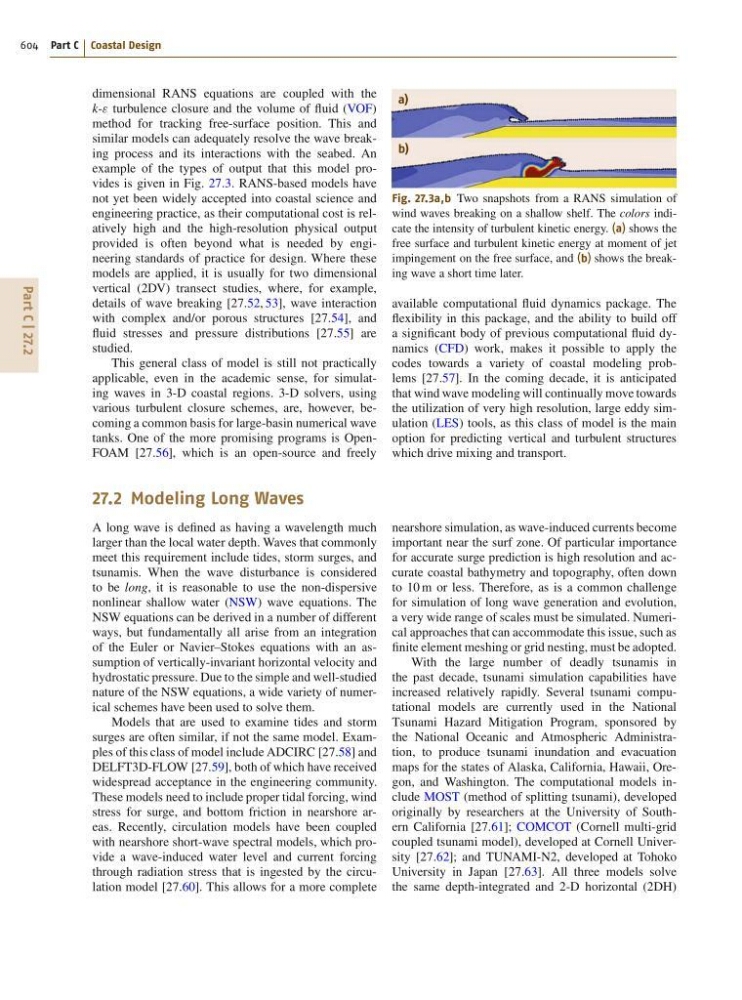
example of the types of output that this model provides is given in Fig. 27.3. RANS-based models have
not yet been widely accepted into coastal science and
engineering practice, as their computational cost is relatively high and the high-resolution physical output
provided is often beyond what is needed by engineering standards of practice for design. Where these
models are applied, it is usually for two dimensional
vertical (2DV) transect studies, where, for example,
details of wave breaking [27.52, 53], wave interaction
with complex and/or porous structures [27.54], and
fluid stresses and pressure distributions [27.55] are
studied.
This general class of model is still not practically
applicable, even in the academic sense, for simulating waves in 3-D coastal regions. 3-D solvers, using
various turbulent closure schemes, are, however, becoming a common basis for large-basin numerical wave
tanks. One of the more promising programs is OpenFOAM [27.56], which is an open-source and freely
a)
b)
Fig. 27.3a,b Two snapshots from a RANS simulation of
wind waves breaking on a shallow shelf. The colors indicate the intensity of turbulent kinetic energy. (a) shows the
free surface and turbulent kinetic energy at moment of jet
impingement on the free surface, and (b) shows the breaking wave a short time later.
available computational fluid dynamics package. The
flexibility in this package, and the ability to build off
a significant body of previous computational fluid dynamics (CFD) work, makes it possible to apply the
codes towards a variety of coastal modeling problems [27.57]. In the coming decade, it is anticipated
that wind wave modeling will continually move towards
the utilization of very high resolution, large eddy simulation (LES) tools, as this class of model is the main
option for predicting vertical and turbulent structures
which drive mixing and transport.
27.2 Modeling Long Waves
A long wave is defined as having a wavelength much
larger than the local water depth. Waves that commonly
meet this requirement include tides, storm surges, and
tsunamis. When the wave disturbance is considered
to be long, it is reasonable to use the non-dispersive
nonlinear shallow water (NSW) wave equations. The
NSW equations can be derived in a number of different
ways, but fundamentally all arise from an integration
of the Euler or Navier–Stokes equations with an assumption of vertically-invariant horizontal velocity and
hydrostatic pressure. Due to the simple and well-studied
nature of the NSW equations, a wide variety of numerical schemes have been used to solve them.
Models that are used to examine tides and storm
surges are often similar, if not the same model. Examples of this class of model include ADCIRC [27.58] and
DELFT3D-FLOW [27.59], both of which have received
widespread acceptance in the engineering community.
These models need to include proper tidal forcing, wind
stress for surge, and bottom friction in nearshore areas. Recently, circulation models have been coupled
with nearshore short-wave spectral models, which provide a wave-induced water level and current forcing
through radiation stress that is ingested by the circulation model [27.60]. This allows for a more complete
nearshore simulation, as wave-induced currents become
important near the surf zone. Of particular importance
for accurate surge prediction is high resolution and accurate coastal bathymetry and topography, often down
to 10 m or less. Therefore, as is a common challenge
for simulation of long wave generation and evolution,
a very wide range of scales must be simulated. Numerical approaches that can accommodate this issue, such as
finite element meshing or grid nesting, must be adopted.
With the large number of deadly tsunamis in
the past decade, tsunami simulation capabilities have
increased relatively rapidly. Several tsunami computational models are currently used in the National
Tsunami Hazard Mitigation Program, sponsored by
the National Oceanic and Atmospheric Administration, to produce tsunami inundation and evacuation
maps for the states of Alaska, California, Hawaii, Oregon, and Washington. The computational models include MOST (method of splitting tsunami), developed
originally by researchers at the University of Southern California [27.61]; COMCOT (Cornell multi-grid
coupled tsunami model), developed at Cornell University [27.62]; and TUNAMI-N2, developed at Tohoko
University in Japan [27.63]. All three models solve
the same depth-integrated and 2-D horizontal (2DH)