

Modeling of Coastal Waves and Hydrodynamics 27.1 Wind Wave Modeling 603
Part C | 27.1
Despite the success of the modified Boussinesq
equations in intermediate water depth, these equations
are still restricted to weak nonlinearity. As waves approach the shore, the wave height increases due to shoaling, until they eventually break. The wave height to water depth ratios associated with this physical process violates the weakly nonlinear assumption. This restriction
can be readily removed by eliminating the weak nonlinearity assumption [27.37, 38]. Numerical implementations of the highly-nonlinear, Boussinesq-type equations include FUNWAVE (fully nonlinear Boussinesq
wave model) [27.38] and COULWAVE (Cornell University long and intermediate wave model) [27.39]. These
models have been applied to a wide variety of topics, including rip and longshore currents [27.40, 41],
wave runup [27.42], wave–current interaction [27.43],
and wave generation by underwater landslides [27.42],
among many others. Boussinesq models are steadily becoming a practical engineering tool. Directional, random spectra can readily be generated by the models,
which capture nearshore evolution processes, such as
shoaling, diffraction, refraction, and wave–wave interactions, with very high accuracy. The applicability of
the Boussinesq models is limited by the fact that the
models are fundamentally inviscid. The dissipation processes, such as breaking and bottom friction, must be
parameterized in traditional Boussinesq models.
Recently, a number of non-traditional Boussinesq
approaches have been developed, with the goal of including horizontal vorticity explicitly in the flow field.
An attempt to include these dynamics under a breaking
wave is found in [27.44], with further advances given
in [27.45]. Integrated within a Boussinesq-type derivation, the stream function equation is used to determine
the vertical variation of the velocity. This allows the
inclusion of the vorticity generated by breaking. The
breaking terms that appear as corrections to the momentum balance are a function of the amount of vorticity
generated during the breaking process. This vorticity
is obtained from the solution to the vorticity transport
equation and has been shown to capture the flow field
dynamics under a spilling breaker.
A similar attempt was made by Kim et al. [27.46]
who included the viscous effects of a bottom shear, and
the associated rotationality, directly in a Boussinesqtype derivation. While this leads to a far more complex
equation model, it includes the physics necessary to
simulate boundary shear and the complete coupling of
these effects with a nonlinear, dispersive wave field.
This model can predict the friction-induced changes to
the vertical profile of velocity under weakly unsteady
flow and can thereby provide good estimates of internal
kinematics. It is also able to translate the bottomcreated horizontal vorticity into a vertical vorticity field.
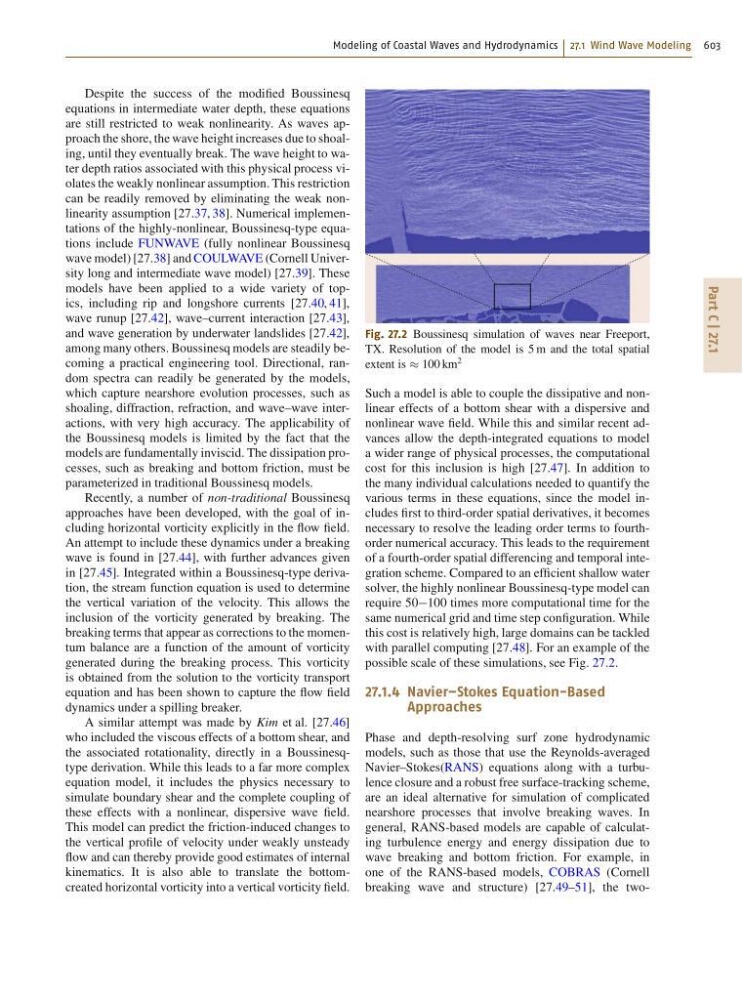
Fig. 27.2 Boussinesq simulation of waves near Freeport,
TX. Resolution of the model is 5 m and the total spatial
extent is 100 km
2
Such a model is able to couple the dissipative and nonlinear effects of a bottom shear with a dispersive and
nonlinear wave field. While this and similar recent advances allow the depth-integrated equations to model
a wider range of physical processes, the computational
cost for this inclusion is high [27.47]. In addition to
the many individual calculations needed to quantify the
various terms in these equations, since the model includes first to third-order spatial derivatives, it becomes
necessary to resolve the leading order terms to fourthorder numerical accuracy. This leads to the requirement
of a fourth-order spatial differencing and temporal integration scheme. Compared to an efficient shallow water
solver, the highly nonlinear Boussinesq-type model can
require 50100 times more computational time for the
same numerical grid and time step configuration. While
this cost is relatively high, large domains can be tackled
with parallel computing [27.48]. For an example of the
possible scale of these simulations, see Fig. 27.2.
27.1.4 Navier–Stokes Equation-Based
Approaches
Phase and depth-resolving surf zone hydrodynamic
models, such as those that use the Reynolds-averaged
Navier–Stokes(RANS) equations along with a turbulence closure and a robust free surface-tracking scheme,
are an ideal alternative for simulation of complicated
nearshore processes that involve breaking waves. In
general, RANS-based models are capable of calculating turbulence energy and energy dissipation due to
wave breaking and bottom friction. For example, in
one of the RANS-based models, COBRAS (Cornell
breaking wave and structure) [27.49–51], the two-