

Elements of Physical Oceanography 2.5 Wind-Forced Ocean Processes 29
Part A | 2.5
These considerations apply directly to oceanic
stresses at the air–ocean and ocean–sediment interfaces.
For example, dimensional considerations allows us to
estimate sea surface stress according to is estimated as
a function of the
w D constant a W
2
15 ;
(2.11)
where W 15 is the wind velocity at 15 m above the
sea surface – the elevation of many ship and buoy
anemometers.
To determine the constant in (2.11) we first define a friction velocity u
such that D a u
2 . Then
consider the surface layer of turbulent winds near the
sea surface – or boundary layer – with a time average
wind profile that decreases from a maximum at the top
of the boundary layer to near zero at the sea surface
(Fig. 2.24).
It can be shown that the mean velocity profile u.z/
in a constant stress turbulent boundary layer can be
described in terms of a friction velocity u
and Von
Karman’s constant k o D 0:4 according to
u.z/ D
u
k o
ln
z C z o
z o
;
(2.12)
where z o is a parameter related to ocean surface roughness. This form of the boundary layer mean velocity is
the so-called Log Profile. This formulation permits us to
compute u
and z o from the observations of u.z/ so that
the unknown constant in an expression for wind stress
can be determined. Typically
w D 2:6 10
3
a W
2
15
(2.13)
for density units g cm
3 and wind units m s
1 .
The wind stress exerted on the sea surface can be expressed in terms of the direction of the wind vector W
and is proportional to the square of the wind speed according to the relation
w D a C D jWjW ;
(2.14)
where a is the air density and C D is a drag coefficient.
2.5.2 Earth Rotation Effects
Earth rotation plays a central role in the physics (as
viewed in our earthly rotating – hence accelerating
frame of reference) of many of the most important
atmospheric and ocean flows, (which have variability
time scales exceeding 1=2 day). Earth rotation (rate
D ˝) influences ocean flow through the effects of the
V
CF = pfVn
n
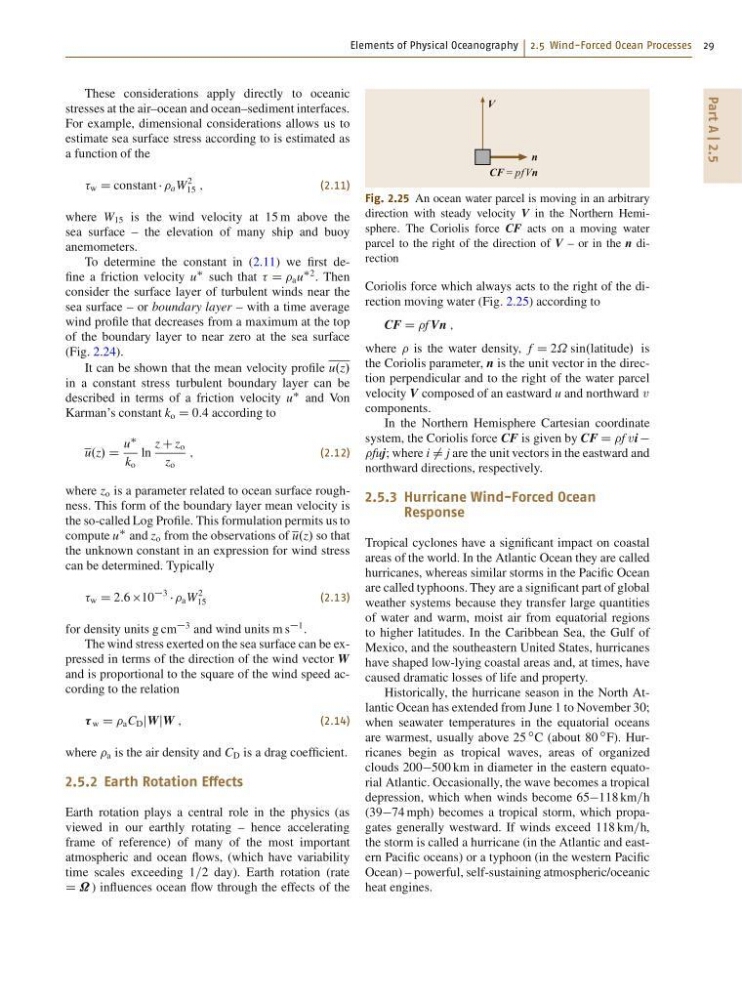
Fig. 2.25 An ocean water parcel is moving in an arbitrary
direction with steady velocity V in the Northern Hemisphere. The Coriolis force CF acts on a moving water
parcel to the right of the direction of V – or in the n direction
Coriolis force which always acts to the right of the direction moving water (Fig. 2.25) according to
CF D f Vn ;
where is the water density, f D 2˝ sin.latitude/ is
the Coriolis parameter, n is the unit vector in the direction perpendicular and to the right of the water parcel
velocity V composed of an eastward u and northward v
components.
In the Northern Hemisphere Cartesian coordinate
system, the Coriolis force CF is given by CF D f v i
fuj; where i ¤ j are the unit vectors in the eastward and
northward directions, respectively.
2.5.3 Hurricane Wind-Forced Ocean
Response
Tropical cyclones have a significant impact on coastal
areas of the world. In the Atlantic Ocean they are called
hurricanes, whereas similar storms in the Pacific Ocean
are called typhoons. They are a significant part of global
weather systems because they transfer large quantities
of water and warm, moist air from equatorial regions
to higher latitudes. In the Caribbean Sea, the Gulf of
Mexico, and the southeastern United States, hurricanes
have shaped low-lying coastal areas and, at times, have
caused dramatic losses of life and property.
Historically, the hurricane season in the North Atlantic Ocean has extended from June 1 to November 30;
when seawater temperatures in the equatorial oceans
are warmest, usually above 25
ı C (about 80
ı F). Hurricanes begin as tropical waves, areas of organized
clouds 200500 km in diameter in the eastern equatorial Atlantic. Occasionally, the wave becomes a tropical
depression, which when winds become 65118 km=h
(3974 mph) becomes a tropical storm, which propagates generally westward. If winds exceed 118 km=h,
the storm is called a hurricane (in the Atlantic and eastern Pacific oceans) or a typhoon (in the western Pacific
Ocean) – powerful, self-sustaining atmospheric/oceanic
heat engines.
Part A | 2.5
These considerations apply directly to oceanic
stresses at the air–ocean and ocean–sediment interfaces.
For example, dimensional considerations allows us to
estimate sea surface stress according to is estimated as
a function of the
w D constant a W
2
15 ;
(2.11)
where W 15 is the wind velocity at 15 m above the
sea surface – the elevation of many ship and buoy
anemometers.
To determine the constant in (2.11) we first define a friction velocity u
such that D a u
2 . Then
consider the surface layer of turbulent winds near the
sea surface – or boundary layer – with a time average
wind profile that decreases from a maximum at the top
of the boundary layer to near zero at the sea surface
(Fig. 2.24).
It can be shown that the mean velocity profile u.z/
in a constant stress turbulent boundary layer can be
described in terms of a friction velocity u
and Von
Karman’s constant k o D 0:4 according to
u.z/ D
u
k o
ln
z C z o
z o
;
(2.12)
where z o is a parameter related to ocean surface roughness. This form of the boundary layer mean velocity is
the so-called Log Profile. This formulation permits us to
compute u
and z o from the observations of u.z/ so that
the unknown constant in an expression for wind stress
can be determined. Typically
w D 2:6 10
3
a W
2
15
(2.13)
for density units g cm
3 and wind units m s
1 .
The wind stress exerted on the sea surface can be expressed in terms of the direction of the wind vector W
and is proportional to the square of the wind speed according to the relation
w D a C D jWjW ;
(2.14)
where a is the air density and C D is a drag coefficient.
2.5.2 Earth Rotation Effects
Earth rotation plays a central role in the physics (as
viewed in our earthly rotating – hence accelerating
frame of reference) of many of the most important
atmospheric and ocean flows, (which have variability
time scales exceeding 1=2 day). Earth rotation (rate
D ˝) influences ocean flow through the effects of the
V
CF = pfVn
n
Fig. 2.25 An ocean water parcel is moving in an arbitrary
direction with steady velocity V in the Northern Hemisphere. The Coriolis force CF acts on a moving water
parcel to the right of the direction of V – or in the n direction
Coriolis force which always acts to the right of the direction moving water (Fig. 2.25) according to
CF D f Vn ;
where is the water density, f D 2˝ sin.latitude/ is
the Coriolis parameter, n is the unit vector in the direction perpendicular and to the right of the water parcel
velocity V composed of an eastward u and northward v
components.
In the Northern Hemisphere Cartesian coordinate
system, the Coriolis force CF is given by CF D f v i
fuj; where i ¤ j are the unit vectors in the eastward and
northward directions, respectively.
2.5.3 Hurricane Wind-Forced Ocean
Response
Tropical cyclones have a significant impact on coastal
areas of the world. In the Atlantic Ocean they are called
hurricanes, whereas similar storms in the Pacific Ocean
are called typhoons. They are a significant part of global
weather systems because they transfer large quantities
of water and warm, moist air from equatorial regions
to higher latitudes. In the Caribbean Sea, the Gulf of
Mexico, and the southeastern United States, hurricanes
have shaped low-lying coastal areas and, at times, have
caused dramatic losses of life and property.
Historically, the hurricane season in the North Atlantic Ocean has extended from June 1 to November 30;
when seawater temperatures in the equatorial oceans
are warmest, usually above 25
ı C (about 80
ı F). Hurricanes begin as tropical waves, areas of organized
clouds 200500 km in diameter in the eastern equatorial Atlantic. Occasionally, the wave becomes a tropical
depression, which when winds become 65118 km=h
(3974 mph) becomes a tropical storm, which propagates generally westward. If winds exceed 118 km=h,
the storm is called a hurricane (in the Atlantic and eastern Pacific oceans) or a typhoon (in the western Pacific
Ocean) – powerful, self-sustaining atmospheric/oceanic
heat engines.