

Part A | 2.5
28 Part A Fundamentals
nonlinearities and subsequent wave-breaking as indicated at position 4 and wave run-up onto the beach
front in position 5 in Fig. 2.19. It is noted that wave
trains that approach the beach obliquely never fully
align with the beach front. This asymmetry leads to the
generation of an alongshore current in the direction indicated in Fig. 2.21. This alongshore current plus the
zig–zag motion of the wave run-up transport beach material (sand in many situations) along shore as indicated.
This is a dynamic longshore sand transport process under which a steady-state beach persists as long as the
up-coast sand supply exists.
Of course, the wave run-up must return to the ocean.
This return flow is concentrated in narrow rapidly
moving offshore moving currents called rip currents
(Fig. 2.22).
2.5 Wind-Forced Ocean Processes
2.5.1 Frictional Effects
Surface winds apply stress to the ocean surface to
generate upper ocean currents and produce turbulent
mixing. This process of transferring momentum to the
ocean currents occurs through a complex process involving the generation of surface waves. In contrast,
less complex stress-related processes remove momentum from near-bottom ocean flows and dissipate it as
heat. Thus, ocean stress in the ocean mediates the vertical transport of horizontal momentum in the ocean.
The normal expression for fluid stress, in which
horizontal stress is proportional to the local vertical
gradient of horizontal velocity, is given by
D
@u
@z
;
(2.9)
in which is the coefficient of molecular viscosity.
However, is too small for this relation to accurately
define momentum transport (and thus stress and dissipation) in a turbulent ocean. Thus, we must incorporate
turbulent eddy viscous effects into our consideration of
momentum transfer in the ocean.
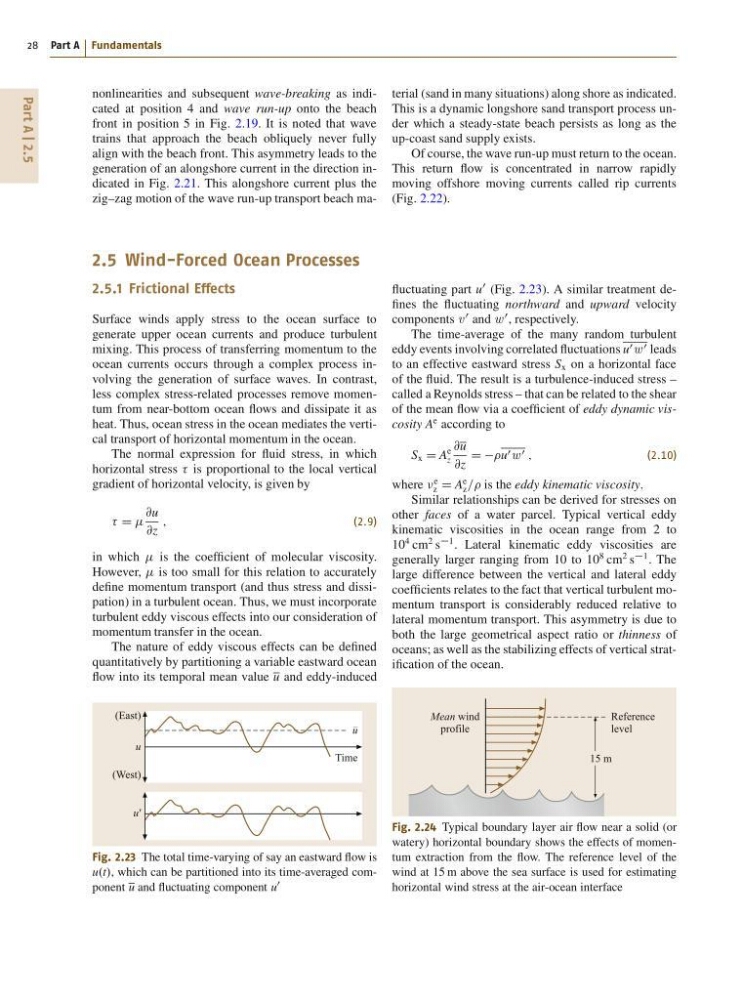
The nature of eddy viscous effects can be defined
quantitatively by partitioning a variable eastward ocean
flow into its temporal mean value u and eddy-induced
Time
(East)
(West)
u
u –
u′
Fig. 2.23 The total time-varying of say an eastward flow is
u.t/, which can be partitioned into its time-averaged component u and fluctuating component u
0
fluctuating part u
0 (Fig. 2.23). A similar treatment defines the fluctuating northward and upward velocity
components v
0 and w
0 , respectively.
The time-average of the many random turbulent
eddy events involving correlated fluctuations u 0 w 0 leads
to an effective eastward stress S x on a horizontal face
of the fluid. The result is a turbulence-induced stress –
called a Reynolds stress – that can be related to the shear
of the mean flow via a coefficient of eddy dynamic viscosity A
e according to
S x D A
e
z
@u
@z
D Du 0 w 0 ;
(2.10)
where
e
z D A
e
z == is the eddy kinematic viscosity.
Similar relationships can be derived for stresses on
other faces of a water parcel. Typical vertical eddy
kinematic viscosities in the ocean range from 2 to
10
4 cm
2 s
1 . Lateral kinematic eddy viscosities are
generally larger ranging from 10 to 10
8 cm
2 s
1 . The
large difference between the vertical and lateral eddy
coefficients relates to the fact that vertical turbulent momentum transport is considerably reduced relative to
lateral momentum transport. This asymmetry is due to
both the large geometrical aspect ratio or thinness of
oceans; as well as the stabilizing effects of vertical stratification of the ocean.
Reference
level
Mean wind
profile
15 m
Fig. 2.24 Typical boundary layer air flow near a solid (or
watery) horizontal boundary shows the effects of momentum extraction from the flow. The reference level of the
wind at 15 m above the sea surface is used for estimating
horizontal wind stress at the air-ocean interface
28 Part A Fundamentals
nonlinearities and subsequent wave-breaking as indicated at position 4 and wave run-up onto the beach
front in position 5 in Fig. 2.19. It is noted that wave
trains that approach the beach obliquely never fully
align with the beach front. This asymmetry leads to the
generation of an alongshore current in the direction indicated in Fig. 2.21. This alongshore current plus the
zig–zag motion of the wave run-up transport beach material (sand in many situations) along shore as indicated.
This is a dynamic longshore sand transport process under which a steady-state beach persists as long as the
up-coast sand supply exists.
Of course, the wave run-up must return to the ocean.
This return flow is concentrated in narrow rapidly
moving offshore moving currents called rip currents
(Fig. 2.22).
2.5 Wind-Forced Ocean Processes
2.5.1 Frictional Effects
Surface winds apply stress to the ocean surface to
generate upper ocean currents and produce turbulent
mixing. This process of transferring momentum to the
ocean currents occurs through a complex process involving the generation of surface waves. In contrast,
less complex stress-related processes remove momentum from near-bottom ocean flows and dissipate it as
heat. Thus, ocean stress in the ocean mediates the vertical transport of horizontal momentum in the ocean.
The normal expression for fluid stress, in which
horizontal stress is proportional to the local vertical
gradient of horizontal velocity, is given by
D
@u
@z
;
(2.9)
in which is the coefficient of molecular viscosity.
However, is too small for this relation to accurately
define momentum transport (and thus stress and dissipation) in a turbulent ocean. Thus, we must incorporate
turbulent eddy viscous effects into our consideration of
momentum transfer in the ocean.
The nature of eddy viscous effects can be defined
quantitatively by partitioning a variable eastward ocean
flow into its temporal mean value u and eddy-induced
Time
(East)
(West)
u
u –
u′
Fig. 2.23 The total time-varying of say an eastward flow is
u.t/, which can be partitioned into its time-averaged component u and fluctuating component u
0
fluctuating part u
0 (Fig. 2.23). A similar treatment defines the fluctuating northward and upward velocity
components v
0 and w
0 , respectively.
The time-average of the many random turbulent
eddy events involving correlated fluctuations u 0 w 0 leads
to an effective eastward stress S x on a horizontal face
of the fluid. The result is a turbulence-induced stress –
called a Reynolds stress – that can be related to the shear
of the mean flow via a coefficient of eddy dynamic viscosity A
e according to
S x D A
e
z
@u
@z
D Du 0 w 0 ;
(2.10)
where
e
z D A
e
z == is the eddy kinematic viscosity.
Similar relationships can be derived for stresses on
other faces of a water parcel. Typical vertical eddy
kinematic viscosities in the ocean range from 2 to
10
4 cm
2 s
1 . Lateral kinematic eddy viscosities are
generally larger ranging from 10 to 10
8 cm
2 s
1 . The
large difference between the vertical and lateral eddy
coefficients relates to the fact that vertical turbulent momentum transport is considerably reduced relative to
lateral momentum transport. This asymmetry is due to
both the large geometrical aspect ratio or thinness of
oceans; as well as the stabilizing effects of vertical stratification of the ocean.
Reference
level
Mean wind
profile
15 m
Fig. 2.24 Typical boundary layer air flow near a solid (or
watery) horizontal boundary shows the effects of momentum extraction from the flow. The reference level of the
wind at 15 m above the sea surface is used for estimating
horizontal wind stress at the air-ocean interface