

Elements of Physical Oceanography 2.4 Surface Gravity Waves 27
Part A | 2.4
Fig. 2.21 Waves that approach the beach obliquely approach generates a longshore current in the surf zone. The
wave-breaking suspends beach material (usually sand) that
is transported in the surf zone by the longshore current;
while the repeated wave run-up cycles also transport sand
in the same longshore direction (after [2.10]) I
decrease. Since the number of waves in the shoreward
propagating wave train are conserved, the wave period T remains constant. Thus from a rearranged (2.5)
T D
L
p
gh
;
(2.6)
the wavelength L must also decrease. For an idealized
beach with straight coastline and parallel isobaths, the
wave power per unit length of the shoreward propagating wavefront – given by
P D
1
8
gH
2 c g D
1
8
gH
2
p
gh
(2.7)
is constant. Thus from a rearranged (2.7)
H
2
D
 8P
g 3=2
Ã
h
1=2
;
(2.8)
we conclude that for shoreward propagating waves H
must also increase! As a result, the wave slope which
is proportional to H=L will increase to the point where
Airy wave theory no longer applies.
At this stage, wave crests or fronts are generally
propagating obliquely to the orientation of the beach
(Fig. 2.20). The wavefronts are bent or refracted as the
inshore end of the wavefront encounters even shallower
water first and slows relative to the rest of the wave –
bringing the wavefront into better alignment with the
beach.
In the example of waves impinging on a straight
beach (Fig. 2.20 – upper), by the refraction distorts
the waves (and corresponding wave rays or orthogonals) so that the wave energy flux (energy/length/unit
time) is reduced from its deep water value. Wave refraction near irregular coastlines (Fig. 2.20 – center)
leads to distortion of the wavefronts. Thus the ray paths,
or orthogonals indicating the direction of wave energy
propagation, are also distorted. In the case of a point of
land the equidistant rays in deep water are seen to converge on the point thereby concentrating wave energy
there relative to other parts of the coastline. The opposite is true for a bay.
As the wave propagates shoreward, wave slopes
generally increase and eventually lead to significant
Beach
Longshore current
Path of
underwater particles
Direction of swell
in deep water
Paths of sand particles on beach face
Beach face
Rip current
Beach
a)
b)
C
D
D
Long shore
current
S u rf
z o n e
Low
wave crest
High
wave crest
C = Converging longshore current
D = Diverging longshore current
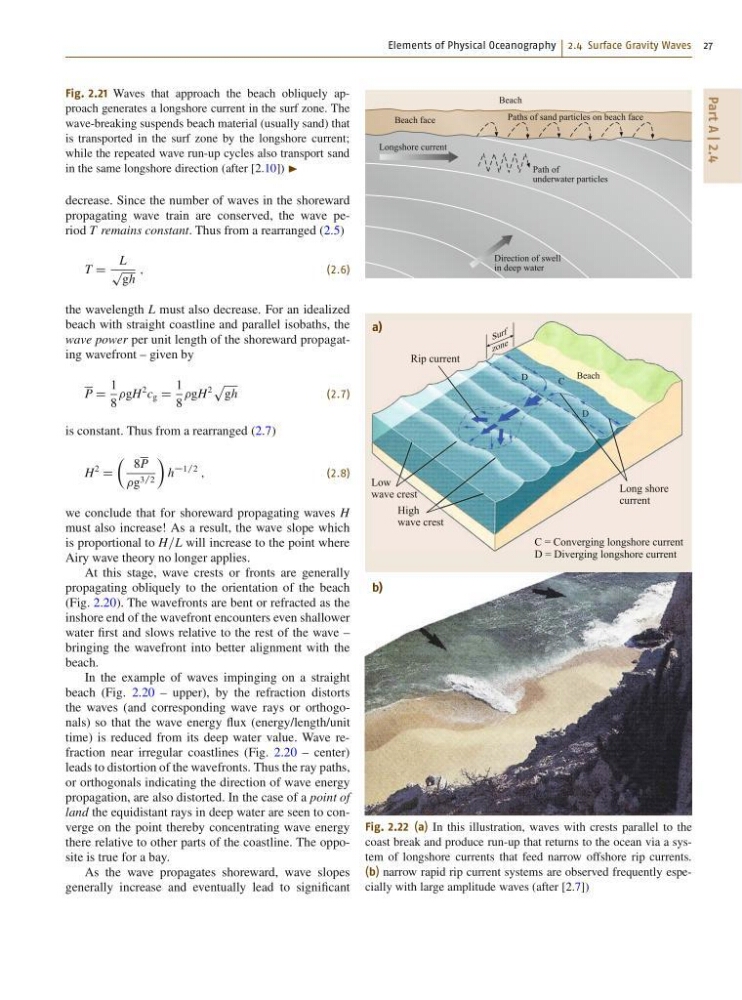
Fig. 2.22 (a) In this illustration, waves with crests parallel to the
coast break and produce run-up that returns to the ocean via a system of longshore currents that feed narrow offshore rip currents.
(b) narrow rapid rip current systems are observed frequently especially with large amplitude waves (after [2.7])
Part A | 2.4
Fig. 2.21 Waves that approach the beach obliquely approach generates a longshore current in the surf zone. The
wave-breaking suspends beach material (usually sand) that
is transported in the surf zone by the longshore current;
while the repeated wave run-up cycles also transport sand
in the same longshore direction (after [2.10]) I
decrease. Since the number of waves in the shoreward
propagating wave train are conserved, the wave period T remains constant. Thus from a rearranged (2.5)
T D
L
p
gh
;
(2.6)
the wavelength L must also decrease. For an idealized
beach with straight coastline and parallel isobaths, the
wave power per unit length of the shoreward propagating wavefront – given by
P D
1
8
gH
2 c g D
1
8
gH
2
p
gh
(2.7)
is constant. Thus from a rearranged (2.7)
H
2
D
 8P
g 3=2
Ã
h
1=2
;
(2.8)
we conclude that for shoreward propagating waves H
must also increase! As a result, the wave slope which
is proportional to H=L will increase to the point where
Airy wave theory no longer applies.
At this stage, wave crests or fronts are generally
propagating obliquely to the orientation of the beach
(Fig. 2.20). The wavefronts are bent or refracted as the
inshore end of the wavefront encounters even shallower
water first and slows relative to the rest of the wave –
bringing the wavefront into better alignment with the
beach.
In the example of waves impinging on a straight
beach (Fig. 2.20 – upper), by the refraction distorts
the waves (and corresponding wave rays or orthogonals) so that the wave energy flux (energy/length/unit
time) is reduced from its deep water value. Wave refraction near irregular coastlines (Fig. 2.20 – center)
leads to distortion of the wavefronts. Thus the ray paths,
or orthogonals indicating the direction of wave energy
propagation, are also distorted. In the case of a point of
land the equidistant rays in deep water are seen to converge on the point thereby concentrating wave energy
there relative to other parts of the coastline. The opposite is true for a bay.
As the wave propagates shoreward, wave slopes
generally increase and eventually lead to significant
Beach
Longshore current
Path of
underwater particles
Direction of swell
in deep water
Paths of sand particles on beach face
Beach face
Rip current
Beach
a)
b)
C
D
D
Long shore
current
S u rf
z o n e
Low
wave crest
High
wave crest
C = Converging longshore current
D = Diverging longshore current
Fig. 2.22 (a) In this illustration, waves with crests parallel to the
coast break and produce run-up that returns to the ocean via a system of longshore currents that feed narrow offshore rip currents.
(b) narrow rapid rip current systems are observed frequently especially with large amplitude waves (after [2.7])