

Part A | 2.4
26 Part A Fundamentals
Depth equals
one half wavelength
2
3
4
5
1
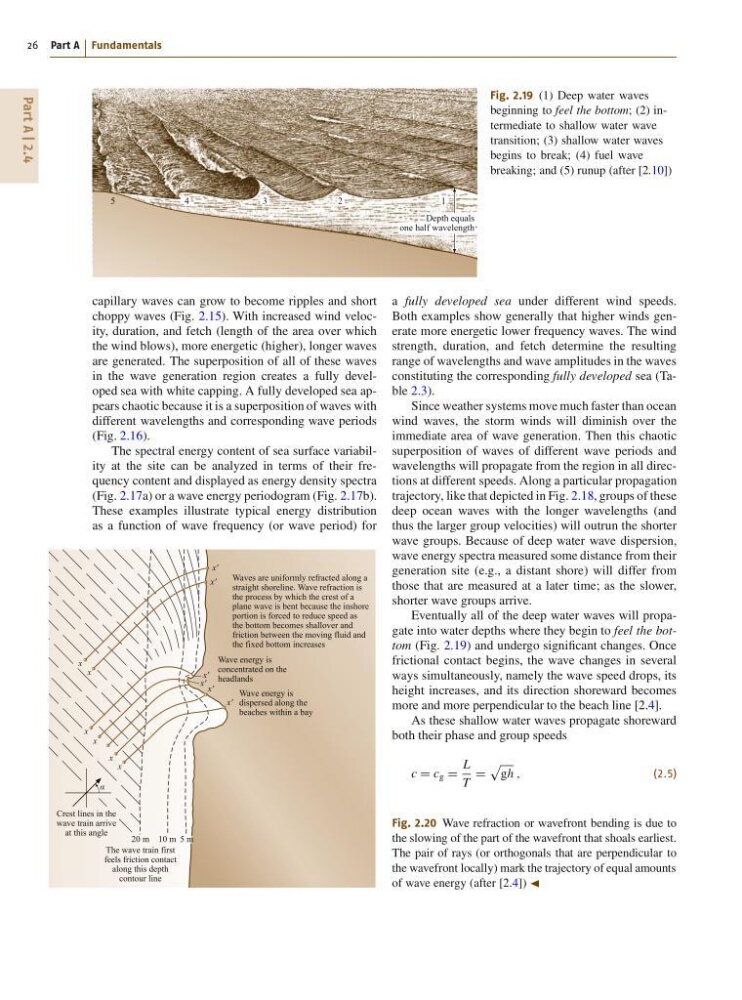
Fig. 2.19 (1) Deep water waves
beginning to feel the bottom; (2) intermediate to shallow water wave
transition; (3) shallow water waves
begins to break; (4) fuel wave
breaking; and (5) runup (after [2.10])
capillary waves can grow to become ripples and short
choppy waves (Fig. 2.15). With increased wind velocity, duration, and fetch (length of the area over which
the wind blows), more energetic (higher), longer waves
are generated. The superposition of all of these waves
in the wave generation region creates a fully developed sea with white capping. A fully developed sea appears chaotic because it is a superposition of waves with
different wavelengths and corresponding wave periods
(Fig. 2.16).
The spectral energy content of sea surface variability at the site can be analyzed in terms of their frequency content and displayed as energy density spectra
(Fig. 2.17a) or a wave energy periodogram (Fig. 2.17b).
These examples illustrate typical energy distribution
as a function of wave frequency (or wave period) for
Crest lines in the
wave train arrive
at this angle
The wave train first
feels friction contact
along this depth
contour line
5 m
10 m
20 m
α
x
x
x
x
x
x
x'
x'
x'
x'
x'
x'
Waves are uniformly refracted along a
straight shoreline. Wave refraction is
the process by which the crest of a
plane wave is bent because the inshore
portion is forced to reduce speed as
the bottom becomes shallover and
friction between the moving fluid and
the fixed bottom increases
Wave energy is
concentrated on the
headlands
Wave energy is
dispersed along the
beaches within a bay
a fully developed sea under different wind speeds.
Both examples show generally that higher winds generate more energetic lower frequency waves. The wind
strength, duration, and fetch determine the resulting
range of wavelengths and wave amplitudes in the waves
constituting the corresponding fully developed sea (Table 2.3).
Since weather systems move much faster than ocean
wind waves, the storm winds will diminish over the
immediate area of wave generation. Then this chaotic
superposition of waves of different wave periods and
wavelengths will propagate from the region in all directions at different speeds. Along a particular propagation
trajectory, like that depicted in Fig. 2.18, groups of these
deep ocean waves with the longer wavelengths (and
thus the larger group velocities) will outrun the shorter
wave groups. Because of deep water wave dispersion,
wave energy spectra measured some distance from their
generation site (e.g., a distant shore) will differ from
those that are measured at a later time; as the slower,
shorter wave groups arrive.
Eventually all of the deep water waves will propagate into water depths where they begin to feel the bottom (Fig. 2.19) and undergo significant changes. Once
frictional contact begins, the wave changes in several
ways simultaneously, namely the wave speed drops, its
height increases, and its direction shoreward becomes
more and more perpendicular to the beach line [2.4].
As these shallow water waves propagate shoreward
both their phase and group speeds
c D c g D
L
T
D
p
gh ;
(2.5)
Fig. 2.20 Wave refraction or wavefront bending is due to
the slowing of the part of the wavefront that shoals earliest.
The pair of rays (or orthogonals that are perpendicular to
the wavefront locally) mark the trajectory of equal amounts
of wave energy (after [2.4]) J
26 Part A Fundamentals
Depth equals
one half wavelength
2
3
4
5
1
Fig. 2.19 (1) Deep water waves
beginning to feel the bottom; (2) intermediate to shallow water wave
transition; (3) shallow water waves
begins to break; (4) fuel wave
breaking; and (5) runup (after [2.10])
capillary waves can grow to become ripples and short
choppy waves (Fig. 2.15). With increased wind velocity, duration, and fetch (length of the area over which
the wind blows), more energetic (higher), longer waves
are generated. The superposition of all of these waves
in the wave generation region creates a fully developed sea with white capping. A fully developed sea appears chaotic because it is a superposition of waves with
different wavelengths and corresponding wave periods
(Fig. 2.16).
The spectral energy content of sea surface variability at the site can be analyzed in terms of their frequency content and displayed as energy density spectra
(Fig. 2.17a) or a wave energy periodogram (Fig. 2.17b).
These examples illustrate typical energy distribution
as a function of wave frequency (or wave period) for
Crest lines in the
wave train arrive
at this angle
The wave train first
feels friction contact
along this depth
contour line
5 m
10 m
20 m
α
x
x
x
x
x
x
x'
x'
x'
x'
x'
x'
Waves are uniformly refracted along a
straight shoreline. Wave refraction is
the process by which the crest of a
plane wave is bent because the inshore
portion is forced to reduce speed as
the bottom becomes shallover and
friction between the moving fluid and
the fixed bottom increases
Wave energy is
concentrated on the
headlands
Wave energy is
dispersed along the
beaches within a bay
a fully developed sea under different wind speeds.
Both examples show generally that higher winds generate more energetic lower frequency waves. The wind
strength, duration, and fetch determine the resulting
range of wavelengths and wave amplitudes in the waves
constituting the corresponding fully developed sea (Table 2.3).
Since weather systems move much faster than ocean
wind waves, the storm winds will diminish over the
immediate area of wave generation. Then this chaotic
superposition of waves of different wave periods and
wavelengths will propagate from the region in all directions at different speeds. Along a particular propagation
trajectory, like that depicted in Fig. 2.18, groups of these
deep ocean waves with the longer wavelengths (and
thus the larger group velocities) will outrun the shorter
wave groups. Because of deep water wave dispersion,
wave energy spectra measured some distance from their
generation site (e.g., a distant shore) will differ from
those that are measured at a later time; as the slower,
shorter wave groups arrive.
Eventually all of the deep water waves will propagate into water depths where they begin to feel the bottom (Fig. 2.19) and undergo significant changes. Once
frictional contact begins, the wave changes in several
ways simultaneously, namely the wave speed drops, its
height increases, and its direction shoreward becomes
more and more perpendicular to the beach line [2.4].
As these shallow water waves propagate shoreward
both their phase and group speeds
c D c g D
L
T
D
p
gh ;
(2.5)
Fig. 2.20 Wave refraction or wavefront bending is due to
the slowing of the part of the wavefront that shoals earliest.
The pair of rays (or orthogonals that are perpendicular to
the wavefront locally) mark the trajectory of equal amounts
of wave energy (after [2.4]) J