

Elements of Physical Oceanography 2.4 Surface Gravity Waves 25
Part A | 2.4
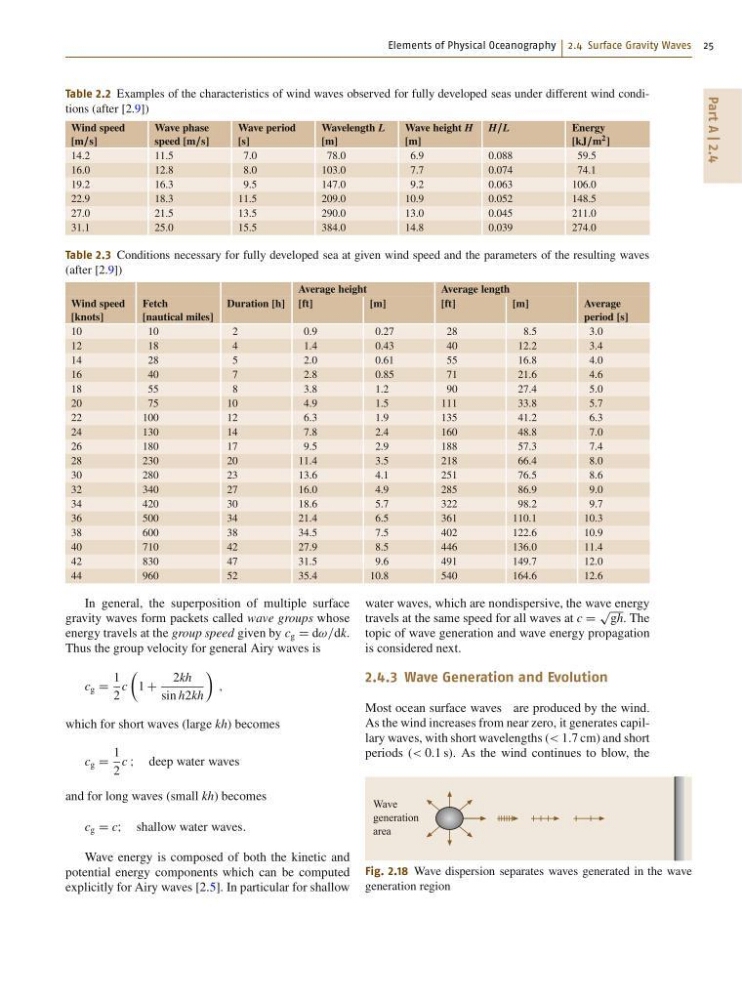
Table 2.2 Examples of the characteristics of wind waves observed for fully developed seas under different wind conditions (after [2.9])
Wind speed
[m=s]
Wave phase
speed [m=s]
Wave period
[s]
Wavelength L
[m]
Wave height H
[m]
H=L
Energy
[kJ=m 2 ]
14.2
11.5
7.0
78.0
6.9
0.088
59.5
16.0
12.8
8.0
103.0
7.7
0.074
74.1
19.2
16.3
9.5
147.0
9.2
0.063
106.0
22.9
18.3
11.5
209.0
10.9
0.052
148.5
27.0
21.5
13.5
290.0
13.0
0.045
211.0
31.1
25.0
15.5
384.0
14.8
0.039
274.0
Table 2.3 Conditions necessary for fully developed sea at given wind speed and the parameters of the resulting waves
(after [2.9])
Average height
Average length
Wind speed
[knots]
Fetch
[nautical miles]
Duration [h] [ft]
[m]
[ft]
[m]
Average
period [s]
10
10
2
0.9
0.27
28
8.5
3.0
12
18
4
1.4
0.43
40
12.2
3.4
14
28
5
2.0
0.61
55
16.8
4.0
16
40
7
2.8
0.85
71
21.6
4.6
18
55
8
3.8
1.2
90
27.4
5.0
20
75
10
4.9
1.5
111
33.8
5.7
22
100
12
6.3
1.9
135
41.2
6.3
24
130
14
7.8
2.4
160
48.8
7.0
26
180
17
9.5
2.9
188
57.3
7.4
28
230
20
11.4
3.5
218
66.4
8.0
30
280
23
13.6
4.1
251
76.5
8.6
32
340
27
16.0
4.9
285
86.9
9.0
34
420
30
18.6
5.7
322
98.2
9.7
36
500
34
21.4
6.5
361
110.1
10.3
38
600
38
34.5
7.5
402
122.6
10.9
40
710
42
27.9
8.5
446
136.0
11.4
42
830
47
31.5
9.6
491
149.7
12.0
44
960
52
35.4
10.8
540
164.6
12.6
In general, the superposition of multiple surface
gravity waves form packets called wave groups whose
energy travels at the group speed given by c g D d!=dk.
Thus the group velocity for general Airy waves is
c g D
1
2
c
Â
1 C
2kh
sin h2kh
Ã
;
which for short waves (large kh) becomes
c g D
1
2
c I deep water waves
and for long waves (small kh) becomes
c g D cI shallow water waves:
Wave energy is composed of both the kinetic and
potential energy components which can be computed
explicitly for Airy waves [2.5]. In particular for shallow
water waves, which are nondispersive, the wave energy
travels at the same speed for all waves at c D
p
gh. The
topic of wave generation and wave energy propagation
is considered next.
2.4.3 Wave Generation and Evolution
Most ocean surface waves are produced by the wind.
As the wind increases from near zero, it generates capillary waves, with short wavelengths (< 1:7 cm) and short
periods (< 0:1 s). As the wind continues to blow, the
Wave
generation
area
Fig. 2.18 Wave dispersion separates waves generated in the wave
generation region
Part A | 2.4
Table 2.2 Examples of the characteristics of wind waves observed for fully developed seas under different wind conditions (after [2.9])
Wind speed
[m=s]
Wave phase
speed [m=s]
Wave period
[s]
Wavelength L
[m]
Wave height H
[m]
H=L
Energy
[kJ=m 2 ]
14.2
11.5
7.0
78.0
6.9
0.088
59.5
16.0
12.8
8.0
103.0
7.7
0.074
74.1
19.2
16.3
9.5
147.0
9.2
0.063
106.0
22.9
18.3
11.5
209.0
10.9
0.052
148.5
27.0
21.5
13.5
290.0
13.0
0.045
211.0
31.1
25.0
15.5
384.0
14.8
0.039
274.0
Table 2.3 Conditions necessary for fully developed sea at given wind speed and the parameters of the resulting waves
(after [2.9])
Average height
Average length
Wind speed
[knots]
Fetch
[nautical miles]
Duration [h] [ft]
[m]
[ft]
[m]
Average
period [s]
10
10
2
0.9
0.27
28
8.5
3.0
12
18
4
1.4
0.43
40
12.2
3.4
14
28
5
2.0
0.61
55
16.8
4.0
16
40
7
2.8
0.85
71
21.6
4.6
18
55
8
3.8
1.2
90
27.4
5.0
20
75
10
4.9
1.5
111
33.8
5.7
22
100
12
6.3
1.9
135
41.2
6.3
24
130
14
7.8
2.4
160
48.8
7.0
26
180
17
9.5
2.9
188
57.3
7.4
28
230
20
11.4
3.5
218
66.4
8.0
30
280
23
13.6
4.1
251
76.5
8.6
32
340
27
16.0
4.9
285
86.9
9.0
34
420
30
18.6
5.7
322
98.2
9.7
36
500
34
21.4
6.5
361
110.1
10.3
38
600
38
34.5
7.5
402
122.6
10.9
40
710
42
27.9
8.5
446
136.0
11.4
42
830
47
31.5
9.6
491
149.7
12.0
44
960
52
35.4
10.8
540
164.6
12.6
In general, the superposition of multiple surface
gravity waves form packets called wave groups whose
energy travels at the group speed given by c g D d!=dk.
Thus the group velocity for general Airy waves is
c g D
1
2
c
Â
1 C
2kh
sin h2kh
Ã
;
which for short waves (large kh) becomes
c g D
1
2
c I deep water waves
and for long waves (small kh) becomes
c g D cI shallow water waves:
Wave energy is composed of both the kinetic and
potential energy components which can be computed
explicitly for Airy waves [2.5]. In particular for shallow
water waves, which are nondispersive, the wave energy
travels at the same speed for all waves at c D
p
gh. The
topic of wave generation and wave energy propagation
is considered next.
2.4.3 Wave Generation and Evolution
Most ocean surface waves are produced by the wind.
As the wind increases from near zero, it generates capillary waves, with short wavelengths (< 1:7 cm) and short
periods (< 0:1 s). As the wind continues to blow, the
Wave
generation
area
Fig. 2.18 Wave dispersion separates waves generated in the wave
generation region