

Part A | 2.4
24 Part A Fundamentals
Fetch
Dispersion
Seas
Wind
Ocean swell
Map
view
Wave
profile
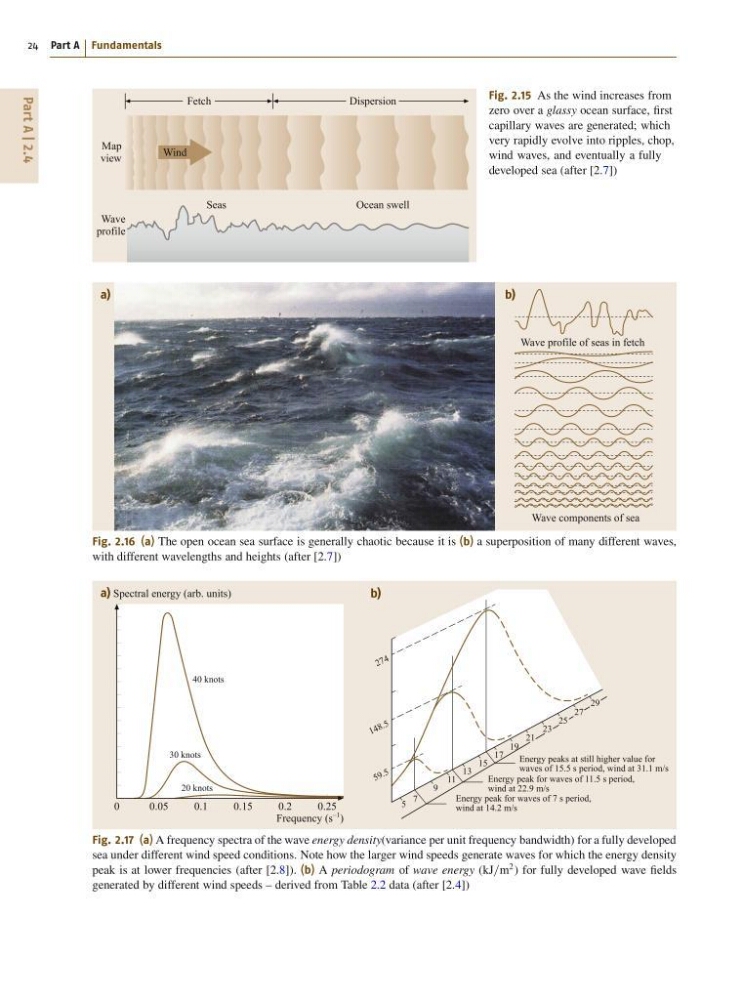
Fig. 2.15 As the wind increases from
zero over a glassy ocean surface, first
capillary waves are generated; which
very rapidly evolve into ripples, chop,
wind waves, and eventually a fully
developed sea (after [2.7])
Wave profile of seas in fetch
Wave components of sea
a)
b)
Fig. 2.16 (a) The open ocean sea surface is generally chaotic because it is (b) a superposition of many different waves,
with different wavelengths and heights (after [2.7])
0
0.05
0.1
0.15
Energy peaks at still higher value for
waves of 15.5 s period, wind at 31.1 m/s
Energy peak for waves of 7 s period,
wind at 14.2 m/s
7
5
9
11
13
15
17
19
21
23
25
27
29
Energy peak for waves of 11.5 s period,
wind at 22.9 m/s
0.2
0.25
a) Spectral energy (arb. units)
b)
Frequency (s
–1 )
2 7 4
1 4 8 .5
5 9 .5
40 knots
30 knots
20 knots
Fig. 2.17 (a) A frequency spectra of the wave energy density(variance per unit frequency bandwidth) for a fully developed
sea under different wind speed conditions. Note how the larger wind speeds generate waves for which the energy density
peak is at lower frequencies (after [2.8]). (b) A periodogram of wave energy (kJ=m
2 ) for fully developed wave fields
generated by different wind speeds – derived from Table 2.2 data (after [2.4])
24 Part A Fundamentals
Fetch
Dispersion
Seas
Wind
Ocean swell
Map
view
Wave
profile
Fig. 2.15 As the wind increases from
zero over a glassy ocean surface, first
capillary waves are generated; which
very rapidly evolve into ripples, chop,
wind waves, and eventually a fully
developed sea (after [2.7])
Wave profile of seas in fetch
Wave components of sea
a)
b)
Fig. 2.16 (a) The open ocean sea surface is generally chaotic because it is (b) a superposition of many different waves,
with different wavelengths and heights (after [2.7])
0
0.05
0.1
0.15
Energy peaks at still higher value for
waves of 15.5 s period, wind at 31.1 m/s
Energy peak for waves of 7 s period,
wind at 14.2 m/s
7
5
9
11
13
15
17
19
21
23
25
27
29
Energy peak for waves of 11.5 s period,
wind at 22.9 m/s
0.2
0.25
a) Spectral energy (arb. units)
b)
Frequency (s
–1 )
2 7 4
1 4 8 .5
5 9 .5
40 knots
30 knots
20 knots
Fig. 2.17 (a) A frequency spectra of the wave energy density(variance per unit frequency bandwidth) for a fully developed
sea under different wind speed conditions. Note how the larger wind speeds generate waves for which the energy density
peak is at lower frequencies (after [2.8]). (b) A periodogram of wave energy (kJ=m
2 ) for fully developed wave fields
generated by different wind speeds – derived from Table 2.2 data (after [2.4])