

Physical Characteristics of Coastal Hazards 25.4 Nomenclature 561
Part C | 25.4
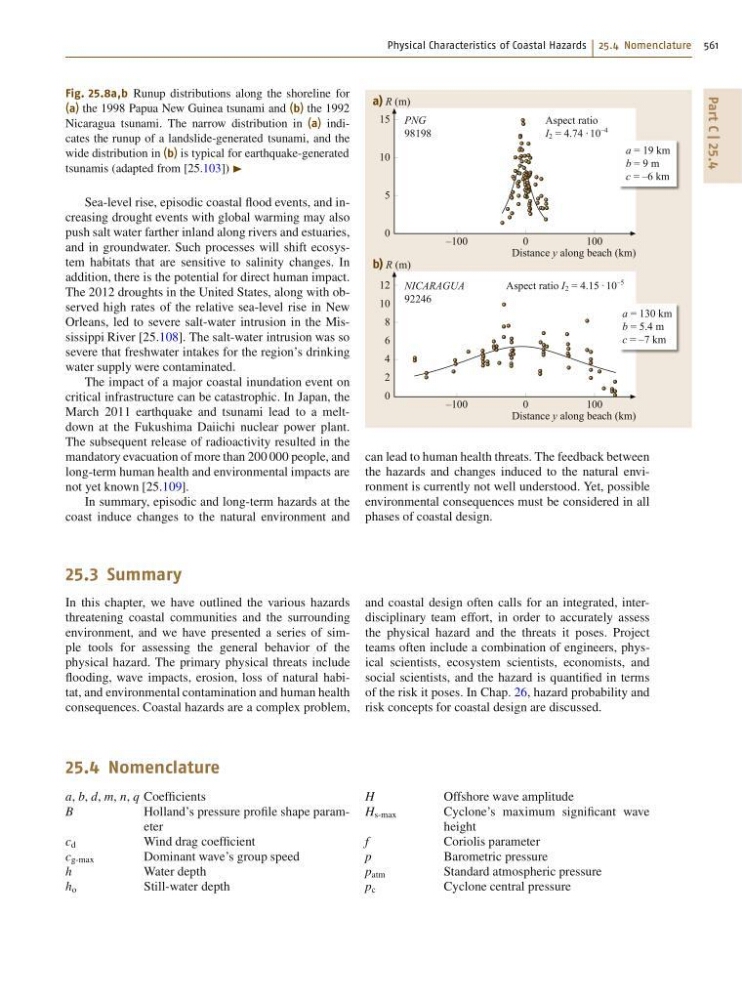
Fig. 25.8a,b Runup distributions along the shoreline for
(a) the 1998 Papua New Guinea tsunami and (b) the 1992
Nicaragua tsunami. The narrow distribution in (a) indicates the runup of a landslide-generated tsunami, and the
wide distribution in (b) is typical for earthquake-generated
tsunamis (adapted from [25.103]) I
Sea-level rise, episodic coastal flood events, and increasing drought events with global warming may also
push salt water farther inland along rivers and estuaries,
and in groundwater. Such processes will shift ecosystem habitats that are sensitive to salinity changes. In
addition, there is the potential for direct human impact.
The 2012 droughts in the United States, along with observed high rates of the relative sea-level rise in New
Orleans, led to severe salt-water intrusion in the Mississippi River [25.108]. The salt-water intrusion was so
severe that freshwater intakes for the region’s drinking
water supply were contaminated.
The impact of a major coastal inundation event on
critical infrastructure can be catastrophic. In Japan, the
March 2011 earthquake and tsunami lead to a meltdown at the Fukushima Daiichi nuclear power plant.
The subsequent release of radioactivity resulted in the
mandatory evacuation of more than 200 000 people, and
long-term human health and environmental impacts are
not yet known [25.109].
In summary, episodic and long-term hazards at the
coast induce changes to the natural environment and
–100
0
100
a) R (m)
Distance y along beach (km)
15
10
5
0
PNG
98198
Aspect ratio
I 2 = 4.74 · 10
–4
a = 19 km
b = 9 m
c = –6 km
–100
0
100
b) R (m)
Distance y along beach (km)
12
10
8
6
4
2
0
NICARAGUA
92246
Aspect ratio I 2 = 4.15 · 10
–5
a = 130 km
b = 5.4 m
c = –7 km
can lead to human health threats. The feedback between
the hazards and changes induced to the natural environment is currently not well understood. Yet, possible
environmental consequences must be considered in all
phases of coastal design.
25.3 Summary
In this chapter, we have outlined the various hazards
threatening coastal communities and the surrounding
environment, and we have presented a series of simple tools for assessing the general behavior of the
physical hazard. The primary physical threats include
flooding, wave impacts, erosion, loss of natural habitat, and environmental contamination and human health
consequences. Coastal hazards are a complex problem,
and coastal design often calls for an integrated, interdisciplinary team effort, in order to accurately assess
the physical hazard and the threats it poses. Project
teams often include a combination of engineers, physical scientists, ecosystem scientists, economists, and
social scientists, and the hazard is quantified in terms
of the risk it poses. In Chap. 26, hazard probability and
risk concepts for coastal design are discussed.
25.4 Nomenclature
a, b, d, m, n, q Coefficients
B
Holland’s pressure profile shape parameter
c d
Wind drag coefficient
c g-max
Dominant wave’s group speed
h
Water depth
h o
Still-water depth
H
Offshore wave amplitude
H s-max
Cyclone’s maximum significant wave
height
f
Coriolis parameter
p
Barometric pressure
p atm
Standard atmospheric pressure
p c
Cyclone central pressure