

Part C | 25.2
560 Part C Coastal Design
dia, but also in Somalia, Madagascar, and Kenya [25.96,
and references therein].
From a general point of view, there are very few
simple rules that can be applied to quickly estimate
the tsunami runup. The most successful rule is the
Plafker rule of thumb, which states that the runup on
a straight beach does not exceed twice the amount of
slip on the fault. Numerical modeling is able to predict the runup magnitude and distribution during an
event in a forecast framework [25.98] and is benchmarked with survey data in the aftermath of events.
Commonly depth-integrated equations are solved numerically and provide a very flexible computational
framework (Chap. 27). While theoretical analyses are
restricted to the canonical problem for the long-wave
runup, analytical treatment of the shallow-water equations provides not only crucial verification for numerical models, but also general information on the runup
magnitude (R) as a function of the average nearshore
and onshore topographic slope and wave characteristics. The canonical problem of long-wave runup is made
up of constant-depth part and a sloping beach. Originally, solitary waves were employed as wave forcing.
Synolakis [25.99, 100] found the long-sought analytical
solution of the shallow water equations, which resulted
in a runup law as a function of the slope (tan ˇ) and
10
–3
10
–2
10
–1
R/h
3.86 (cot β 0 )
1/2 (H/h)
5/4
10
–1
10
–2
10
–3
0.01
0
–0.01 0
5 0
x
η
η
100
0.01
0
–0.01 0
5 0
x
100
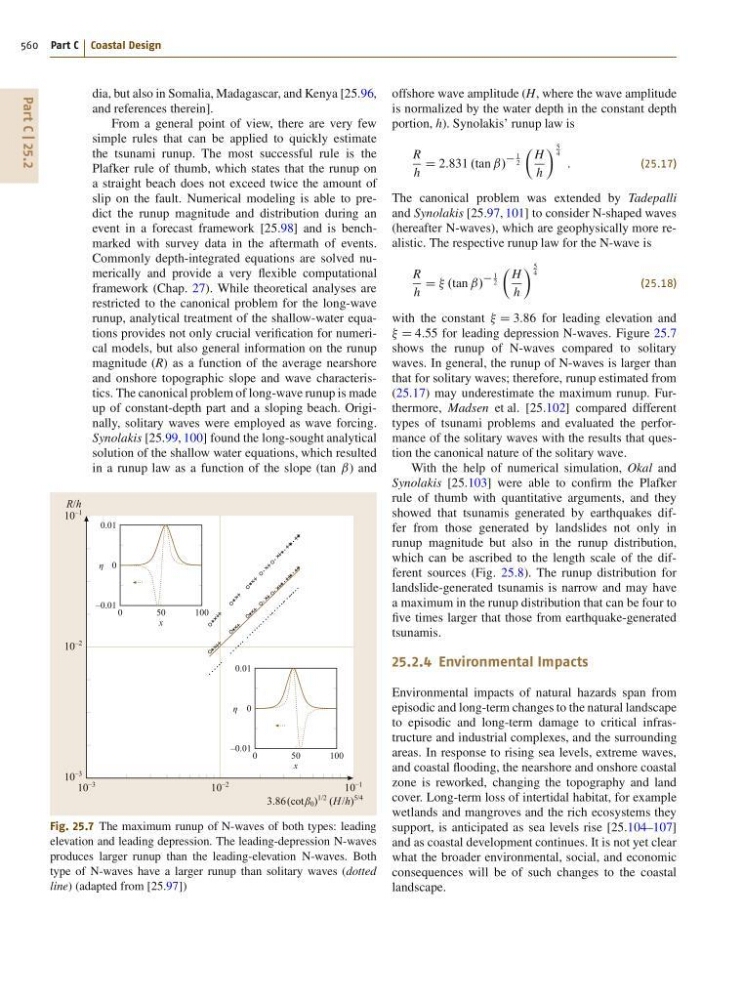
Fig. 25.7 The maximum runup of N-waves of both types: leading
elevation and leading depression. The leading-depression N-waves
produces larger runup than the leading-elevation N-waves. Both
type of N-waves have a larger runup than solitary waves (dotted
line) (adapted from [25.97])
offshore wave amplitude (H, where the wave amplitude
is normalized by the water depth in the constant depth
portion, h). Synolakis’ runup law is
R
h
D 2:831 .tan ˇ/
1
2
Â
H
h
à 5
4 :
(25.17)
The canonical problem was extended by Tadepalli
and Synolakis [25.97, 101] to consider N-shaped waves
(hereafter N-waves), which are geophysically more realistic. The respective runup law for the N-wave is
R
h
D .tan ˇ/
1
2
 H
h
à 5
4
(25.18)
with the constant D 3:86 for leading elevation and
D 4:55 for leading depression N-waves. Figure 25.7
shows the runup of N-waves compared to solitary
waves. In general, the runup of N-waves is larger than
that for solitary waves; therefore, runup estimated from
(25.17) may underestimate the maximum runup. Furthermore, Madsen et al. [25.102] compared different
types of tsunami problems and evaluated the performance of the solitary waves with the results that question the canonical nature of the solitary wave.
With the help of numerical simulation, Okal and
Synolakis [25.103] were able to confirm the Plafker
rule of thumb with quantitative arguments, and they
showed that tsunamis generated by earthquakes differ from those generated by landslides not only in
runup magnitude but also in the runup distribution,
which can be ascribed to the length scale of the different sources (Fig. 25.8). The runup distribution for
landslide-generated tsunamis is narrow and may have
a maximum in the runup distribution that can be four to
five times larger that those from earthquake-generated
tsunamis.
25.2.4 Environmental Impacts
Environmental impacts of natural hazards span from
episodic and long-term changes to the natural landscape
to episodic and long-term damage to critical infrastructure and industrial complexes, and the surrounding
areas. In response to rising sea levels, extreme waves,
and coastal flooding, the nearshore and onshore coastal
zone is reworked, changing the topography and land
cover. Long-term loss of intertidal habitat, for example
wetlands and mangroves and the rich ecosystems they
support, is anticipated as sea levels rise [25.104–107]
and as coastal development continues. It is not yet clear
what the broader environmental, social, and economic
consequences will be of such changes to the coastal
landscape.