

Physical Characteristics of Coastal Hazards 25.1 Types of Coastal Hazards 551
Part C | 25.1
a)
b)
September 9, 2008
September 15, 2008
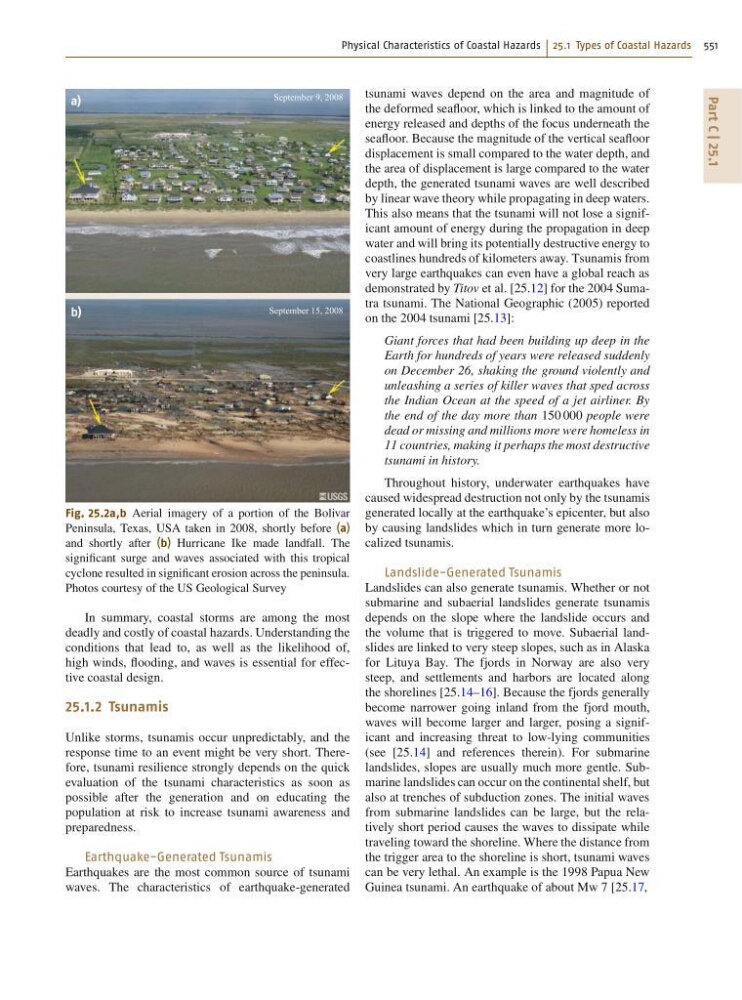
Fig. 25.2a,b Aerial imagery of a portion of the Bolivar
Peninsula, Texas, USA taken in 2008, shortly before (a)
and shortly after (b) Hurricane Ike made landfall. The
significant surge and waves associated with this tropical
cyclone resulted in significant erosion across the peninsula.
Photos courtesy of the US Geological Survey
In summary, coastal storms are among the most
deadly and costly of coastal hazards. Understanding the
conditions that lead to, as well as the likelihood of,
high winds, flooding, and waves is essential for effective coastal design.
25.1.2 Tsunamis
Unlike storms, tsunamis occur unpredictably, and the
response time to an event might be very short. Therefore, tsunami resilience strongly depends on the quick
evaluation of the tsunami characteristics as soon as
possible after the generation and on educating the
population at risk to increase tsunami awareness and
preparedness.
Earthquake-Generated Tsunamis
Earthquakes are the most common source of tsunami
waves. The characteristics of earthquake-generated
tsunami waves depend on the area and magnitude of
the deformed seafloor, which is linked to the amount of
energy released and depths of the focus underneath the
seafloor. Because the magnitude of the vertical seafloor
displacement is small compared to the water depth, and
the area of displacement is large compared to the water
depth, the generated tsunami waves are well described
by linear wave theory while propagating in deep waters.
This also means that the tsunami will not lose a significant amount of energy during the propagation in deep
water and will bring its potentially destructive energy to
coastlines hundreds of kilometers away. Tsunamis from
very large earthquakes can even have a global reach as
demonstrated by Titov et al. [25.12] for the 2004 Sumatra tsunami. The National Geographic (2005) reported
on the 2004 tsunami [25.13]:
Giant forces that had been building up deep in the
Earth for hundreds of years were released suddenly
on December 26, shaking the ground violently and
unleashing a series of killer waves that sped across
the Indian Ocean at the speed of a jet airliner. By
the end of the day more than 150 000 people were
dead or missing and millions more were homeless in
11 countries, making it perhaps the most destructive
tsunami in history.
Throughout history, underwater earthquakes have
caused widespread destruction not only by the tsunamis
generated locally at the earthquake’s epicenter, but also
by causing landslides which in turn generate more localized tsunamis.
Landslide-Generated Tsunamis
Landslides can also generate tsunamis. Whether or not
submarine and subaerial landslides generate tsunamis
depends on the slope where the landslide occurs and
the volume that is triggered to move. Subaerial landslides are linked to very steep slopes, such as in Alaska
for Lituya Bay. The fjords in Norway are also very
steep, and settlements and harbors are located along
the shorelines [25.14–16]. Because the fjords generally
become narrower going inland from the fjord mouth,
waves will become larger and larger, posing a significant and increasing threat to low-lying communities
(see [25.14] and references therein). For submarine
landslides, slopes are usually much more gentle. Submarine landslides can occur on the continental shelf, but
also at trenches of subduction zones. The initial waves
from submarine landslides can be large, but the relatively short period causes the waves to dissipate while
traveling toward the shoreline. Where the distance from
the trigger area to the shoreline is short, tsunami waves
can be very lethal. An example is the 1998 Papua New
Guinea tsunami. An earthquake of about Mw 7 [25.17,