

Part C | 25.1
552 Part C Coastal Design
18] triggered a submarine landslide that then caused the
death of 3000 people along a 30 km stretch of the Papua
New Guinea coast.
The 1958 Lituya Bay, Alaska tsunami, a landslidegenerated tsunami, produced a maximum runup of
about 524 m, and is the largest tsunami runup ever measured. In the case of Lituya Bay, the rockslide started
above the water column, accelerated, and hit the water surface with a velocity of about 110 m s
1 [25.19].
In a scaled model of the Lituya Bay rockslide and
tsunami, Fritz et al. [25.19] demonstrated that Froude
number scaling is applicable for the slide problem. The
Froude number for this problem is defined as the ratio
between the slide velocity at impact and
p
gh, where h
is the average water depth in the vicinity of the impact
location. The Lituya Bay rockslide exhibited a large
Froude number. The impact of the slide body on the
surface generates a cavity whose collapse generates
a wave pulse that reached about 170 m in the experiments in Fritz et al. [25.19] and in simulations by Weiss
et al. [25.20]. For slides featuring a small Froude number, the generated waves are much smaller with wave
amplitudes of the order of the slide thickness.
Submarine slides generate very different waves. The
wave characteristics of the generated tsunamis depend
120°E 140°E 160°E 180° 160°W 140°W 120°W 100°W 80°W 60°W
60°N
40°N
20°N
0°
20°S
40°S
60°N
40°N
20°N
0°
20°S
40°S
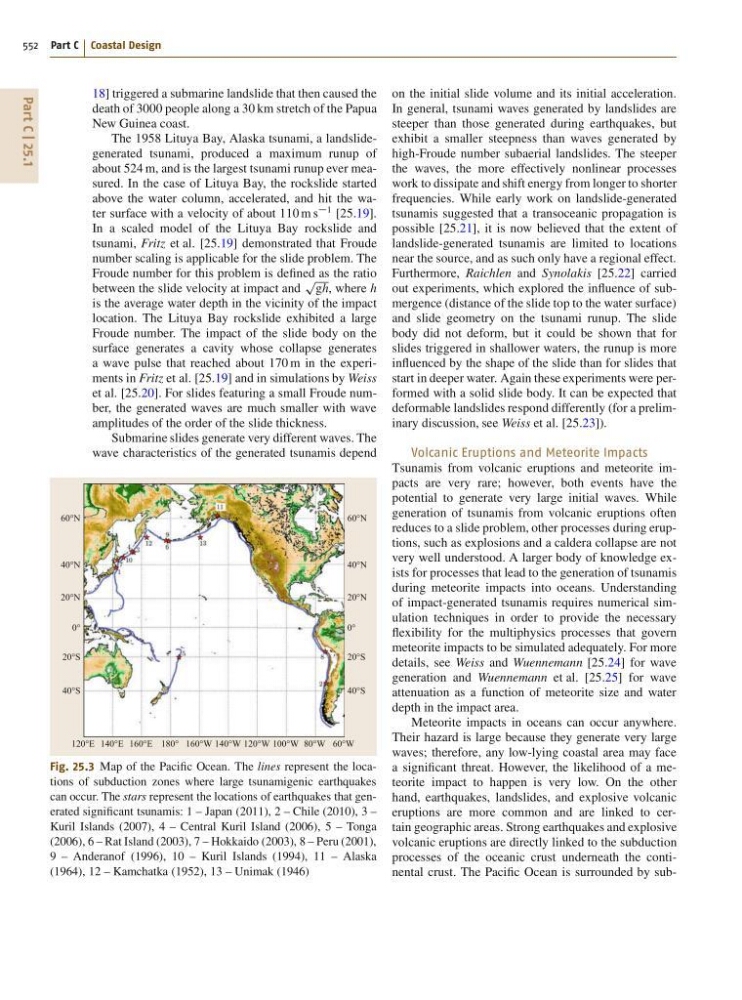
Fig. 25.3 Map of the Pacific Ocean. The lines represent the locations of subduction zones where large tsunamigenic earthquakes
can occur. The stars represent the locations of earthquakes that generated significant tsunamis: 1 – Japan (2011), 2 – Chile (2010), 3 –
Kuril Islands (2007), 4 – Central Kuril Island (2006), 5 – Tonga
(2006), 6 – Rat Island (2003), 7 – Hokkaido (2003), 8 – Peru (2001),
9 – Anderanof (1996), 10 – Kuril Islands (1994), 11 – Alaska
(1964), 12 – Kamchatka (1952), 13 – Unimak (1946)
on the initial slide volume and its initial acceleration.
In general, tsunami waves generated by landslides are
steeper than those generated during earthquakes, but
exhibit a smaller steepness than waves generated by
high-Froude number subaerial landslides. The steeper
the waves, the more effectively nonlinear processes
work to dissipate and shift energy from longer to shorter
frequencies. While early work on landslide-generated
tsunamis suggested that a transoceanic propagation is
possible [25.21], it is now believed that the extent of
landslide-generated tsunamis are limited to locations
near the source, and as such only have a regional effect.
Furthermore, Raichlen and Synolakis [25.22] carried
out experiments, which explored the influence of submergence (distance of the slide top to the water surface)
and slide geometry on the tsunami runup. The slide
body did not deform, but it could be shown that for
slides triggered in shallower waters, the runup is more
influenced by the shape of the slide than for slides that
start in deeper water. Again these experiments were performed with a solid slide body. It can be expected that
deformable landslides respond differently (for a preliminary discussion, see Weiss et al. [25.23]).
Volcanic Eruptions and Meteorite Impacts
Tsunamis from volcanic eruptions and meteorite impacts are very rare; however, both events have the
potential to generate very large initial waves. While
generation of tsunamis from volcanic eruptions often
reduces to a slide problem, other processes during eruptions, such as explosions and a caldera collapse are not
very well understood. A larger body of knowledge exists for processes that lead to the generation of tsunamis
during meteorite impacts into oceans. Understanding
of impact-generated tsunamis requires numerical simulation techniques in order to provide the necessary
flexibility for the multiphysics processes that govern
meteorite impacts to be simulated adequately. For more
details, see Weiss and Wuennemann [25.24] for wave
generation and Wuennemann et al. [25.25] for wave
attenuation as a function of meteorite size and water
depth in the impact area.
Meteorite impacts in oceans can occur anywhere.
Their hazard is large because they generate very large
waves; therefore, any low-lying coastal area may face
a significant threat. However, the likelihood of a meteorite impact to happen is very low. On the other
hand, earthquakes, landslides, and explosive volcanic
eruptions are more common and are linked to certain geographic areas. Strong earthquakes and explosive
volcanic eruptions are directly linked to the subduction
processes of the oceanic crust underneath the continental crust. The Pacific Ocean is surrounded by sub-