

Part C | 25.1
550 Part C Coastal Design
remained on the 9th, and who occupied the houses
may, in many instances, never be known.
The 1900 hurricane, which made landfall in Galveston, TX, USA, remains the most deadly natural disaster on record in the United States. Some of the largest
death tolls associated with tropical cyclones have been
those passing through the Bay of Bengal and impacting India and Bangladesh. The 1970 tropical cyclone,
which made landfall near high tide, generated flood levels in excess of 6 m and claimed as many as a half
million lives along the Bay of Bengal [25.2–4]. This
area was impacted again in 1991, when another tropical cyclone with winds exceeding 130 km=h generated
similar flood elevations, claiming over 100 000 lives
and causing more than 1.5 billion US dollars in damages [25.4].
The United States also has a history of experiencing extensive damages as high winds, flooding, and
large waves impact the coast during tropical cyclones.
Over the last decade, the US has seen some of its
highest storm surges on record as several significant
hurricanes made landfall along the northern Gulf of
Mexico coastline. Hurricane Katrina made landfall near
New Orleans in 2005, generating flood elevations of
more than 8 m along the Louisiana and Mississippi
coasts [25.5], and became the most destructive hurricane in US history. Estimated economic damages from
this event are in excess of 100 billion US Dollars [25.6].
The death toll caused by Hurricane Katrina was just
under 2000, the third most deadly hurricane in US history [25.7]. Just three years later, Hurricane Ike made
landfall in Galveston, TX, USA. While a moderate hurricane wind event, registering as a Category 2 hurricane
at landfall [25.8], this very large storm generated flood
elevations in excess of 4 m along much of the Texas
and Louisiana coasts [25.9]. This storm became the
second most costly storm in US history, with damages estimated to be around 30 billion US Dollars.
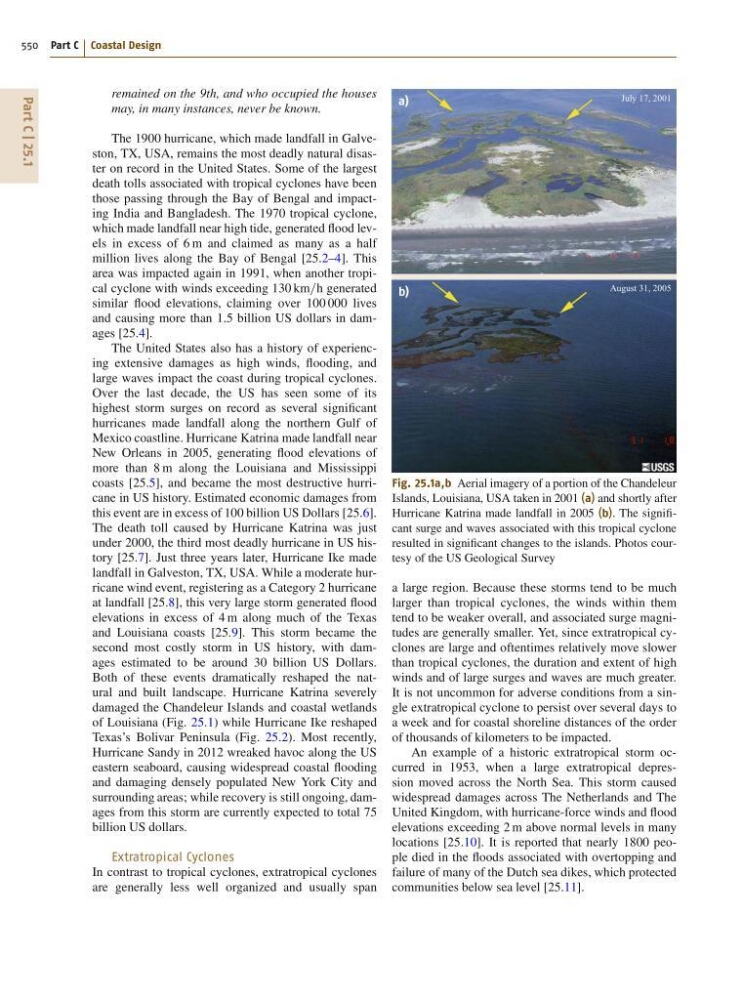
Both of these events dramatically reshaped the natural and built landscape. Hurricane Katrina severely
damaged the Chandeleur Islands and coastal wetlands
of Louisiana (Fig. 25.1) while Hurricane Ike reshaped
Texas’s Bolivar Peninsula (Fig. 25.2). Most recently,
Hurricane Sandy in 2012 wreaked havoc along the US
eastern seaboard, causing widespread coastal flooding
and damaging densely populated New York City and
surrounding areas; while recovery is still ongoing, damages from this storm are currently expected to total 75
billion US dollars.
Extratropical Cyclones
In contrast to tropical cyclones, extratropical cyclones
are generally less well organized and usually span
a)
b)
July 17, 2001
August 31, 2005
Fig. 25.1a,b Aerial imagery of a portion of the Chandeleur
Islands, Louisiana, USA taken in 2001 (a) and shortly after
Hurricane Katrina made landfall in 2005 (b). The significant surge and waves associated with this tropical cyclone
resulted in significant changes to the islands. Photos courtesy of the US Geological Survey
a large region. Because these storms tend to be much
larger than tropical cyclones, the winds within them
tend to be weaker overall, and associated surge magnitudes are generally smaller. Yet, since extratropical cyclones are large and oftentimes relatively move slower
than tropical cyclones, the duration and extent of high
winds and of large surges and waves are much greater.
It is not uncommon for adverse conditions from a single extratropical cyclone to persist over several days to
a week and for coastal shoreline distances of the order
of thousands of kilometers to be impacted.
An example of a historic extratropical storm occurred in 1953, when a large extratropical depression moved across the North Sea. This storm caused
widespread damages across The Netherlands and The
United Kingdom, with hurricane-force winds and flood
elevations exceeding 2 m above normal levels in many
locations [25.10]. It is reported that nearly 1800 people died in the floods associated with overtopping and
failure of many of the Dutch sea dikes, which protected
communities below sea level [25.11].