

Rules of the Road for Unmanned Marine Vehicles 23.3 Proper Behaviors Yield Compliance 521
Part B | 23.3
–50
0
50
100
Vehicle 1
Vehicle 2
Vehicle 1
Vehicle 2
Activation radius
Vehicle 1
start
Vehicle 2
start
a)
b)
0
–50
–100
–50
0
50
100
Activation angle
0
–50
–100
–50
0
50
100
c)
d)
0
–50
–100
–50
0
50
100
Activation angle
0
–50
–100
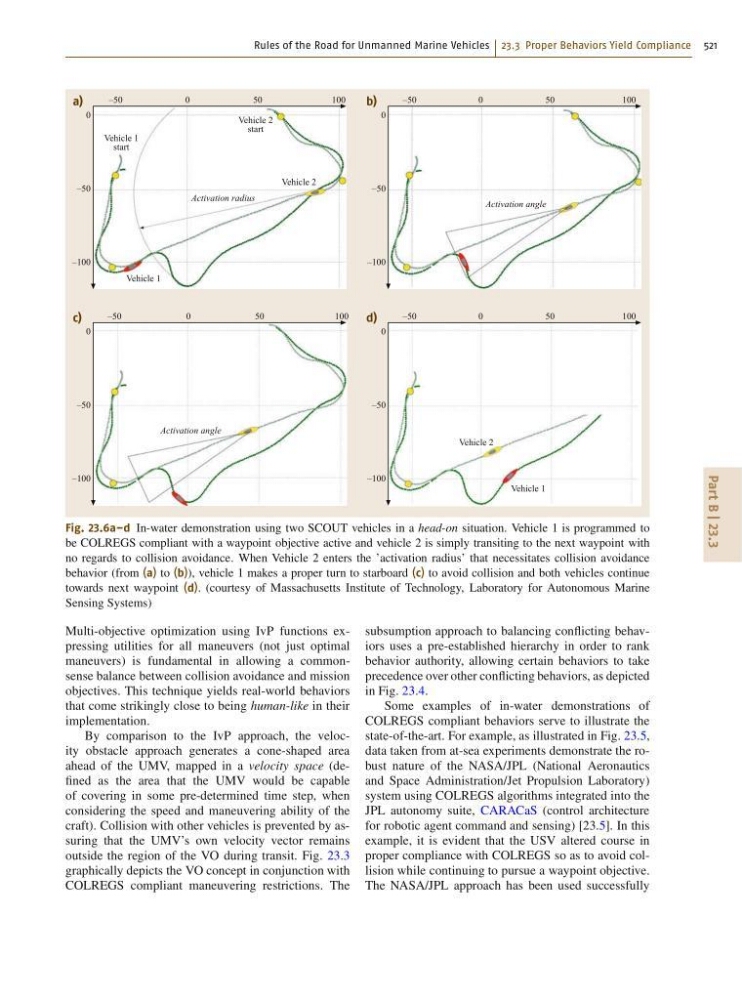
Fig. 23.6a–d In-water demonstration using two SCOUT vehicles in a head-on situation. Vehicle 1 is programmed to
be COLREGS compliant with a waypoint objective active and vehicle 2 is simply transiting to the next waypoint with
no regards to collision avoidance. When Vehicle 2 enters the ’activation radius’ that necessitates collision avoidance
behavior (from (a) to (b)), vehicle 1 makes a proper turn to starboard (c) to avoid collision and both vehicles continue
towards next waypoint (d). (courtesy of Massachusetts Institute of Technology, Laboratory for Autonomous Marine
Sensing Systems)
Multi-objective optimization using IvP functions expressing utilities for all maneuvers (not just optimal
maneuvers) is fundamental in allowing a commonsense balance between collision avoidance and mission
objectives. This technique yields real-world behaviors
that come strikingly close to being human-like in their
implementation.
By comparison to the IvP approach, the velocity obstacle approach generates a cone-shaped area
ahead of the UMV, mapped in a velocity space (defined as the area that the UMV would be capable
of covering in some pre-determined time step, when
considering the speed and maneuvering ability of the
craft). Collision with other vehicles is prevented by assuring that the UMV’s own velocity vector remains
outside the region of the VO during transit. Fig. 23.3
graphically depicts the VO concept in conjunction with
COLREGS compliant maneuvering restrictions. The
subsumption approach to balancing conflicting behaviors uses a pre-established hierarchy in order to rank
behavior authority, allowing certain behaviors to take
precedence over other conflicting behaviors, as depicted
in Fig. 23.4.
Some examples of in-water demonstrations of
COLREGS compliant behaviors serve to illustrate the
state-of-the-art. For example, as illustrated in Fig. 23.5,
data taken from at-sea experiments demonstrate the robust nature of the NASA/JPL (National Aeronautics
and Space Administration/Jet Propulsion Laboratory)
system using COLREGS algorithms integrated into the
JPL autonomy suite, CARACaS (control architecture
for robotic agent command and sensing) [23.5]. In this
example, it is evident that the USV altered course in
proper compliance with COLREGS so as to avoid collision while continuing to pursue a waypoint objective.
The NASA/JPL approach has been used successfully
Part B | 23.3
–50
0
50
100
Vehicle 1
Vehicle 2
Vehicle 1
Vehicle 2
Activation radius
Vehicle 1
start
Vehicle 2
start
a)
b)
0
–50
–100
–50
0
50
100
Activation angle
0
–50
–100
–50
0
50
100
c)
d)
0
–50
–100
–50
0
50
100
Activation angle
0
–50
–100
Fig. 23.6a–d In-water demonstration using two SCOUT vehicles in a head-on situation. Vehicle 1 is programmed to
be COLREGS compliant with a waypoint objective active and vehicle 2 is simply transiting to the next waypoint with
no regards to collision avoidance. When Vehicle 2 enters the ’activation radius’ that necessitates collision avoidance
behavior (from (a) to (b)), vehicle 1 makes a proper turn to starboard (c) to avoid collision and both vehicles continue
towards next waypoint (d). (courtesy of Massachusetts Institute of Technology, Laboratory for Autonomous Marine
Sensing Systems)
Multi-objective optimization using IvP functions expressing utilities for all maneuvers (not just optimal
maneuvers) is fundamental in allowing a commonsense balance between collision avoidance and mission
objectives. This technique yields real-world behaviors
that come strikingly close to being human-like in their
implementation.
By comparison to the IvP approach, the velocity obstacle approach generates a cone-shaped area
ahead of the UMV, mapped in a velocity space (defined as the area that the UMV would be capable
of covering in some pre-determined time step, when
considering the speed and maneuvering ability of the
craft). Collision with other vehicles is prevented by assuring that the UMV’s own velocity vector remains
outside the region of the VO during transit. Fig. 23.3
graphically depicts the VO concept in conjunction with
COLREGS compliant maneuvering restrictions. The
subsumption approach to balancing conflicting behaviors uses a pre-established hierarchy in order to rank
behavior authority, allowing certain behaviors to take
precedence over other conflicting behaviors, as depicted
in Fig. 23.4.
Some examples of in-water demonstrations of
COLREGS compliant behaviors serve to illustrate the
state-of-the-art. For example, as illustrated in Fig. 23.5,
data taken from at-sea experiments demonstrate the robust nature of the NASA/JPL (National Aeronautics
and Space Administration/Jet Propulsion Laboratory)
system using COLREGS algorithms integrated into the
JPL autonomy suite, CARACaS (control architecture
for robotic agent command and sensing) [23.5]. In this
example, it is evident that the USV altered course in
proper compliance with COLREGS so as to avoid collision while continuing to pursue a waypoint objective.
The NASA/JPL approach has been used successfully