

Part B | 22.3
508 Part B Autonomous Ocean Vehicles, Subsystems and Control
portant features of the scenario. We further assume that
the cellular automaton modeling the target consists of
a small number of mental states (reckless, offensive,
defensive, cautious, conservative) (Fig. 22.6) that influence how the actual path planning of the target is
executed. We postulate that each action possible in
a mental state leads to independence from the surveillance team in the near future. Changing the mental state
is only possible for the target when:
The target certainly knows that it is undetected on
some time scale.
The target has reached a point to hide, for example,
within known clutter fields in the environment.
The target has reached a safe point far enough away
to be not affected by the surveillance team.
The target has reached a point in which there are
still many mental states (and therefore actions)
available to be finally successful and the surveillance team is still acting randomly and independently of the target actions.
We explicitly model clutter that can be from
databases or from an in-situ clutter analysis. Clutter
plays a major role in the LFCTT game, influencing the
measurements of the surveillance team and influencing
the target movements. We assume that classification is
best when three sources converge on one target. This
is analogous to the saccades, movements of (human)
eyes in surveillance mode, where the two eyes coordinate their focal point quickly within the scene
To simplify the calculations, we model sensor
performance crudely, taking only grid cells into acDefensive
Conservative
Offensive
Reckless
Cautious
Fig. 22.6 An example for the decision-making process,
modeled as a celluar automaton (CA), inside the target
(dot) on which clutter point (black rectangles) to reach
next. It is deciding depending on its mental state on how
the path for the near future actions is calculated. Since clutter points are genarally a place to hide, in the example of
Fig. 22.6 we depict a one-to-one mapping of mental state
(reckless, offensive conservative, defensive, cautions) and
actual path. The reality in LFCTT is much more stochastic in the sense that uncertainty about positions, resolutions
and performance of tracking processes by the surveillance
team have to be taken into account. But these effects are
understood in the sense that they can be adequately modeled to extend this simplified CA model
count that are under best surveillance conditions. This
approach is similar to the winner-takes-all (WTA)
methodology in artificial neural networks. We call these
grid cells the WTAs of the surveillance team.
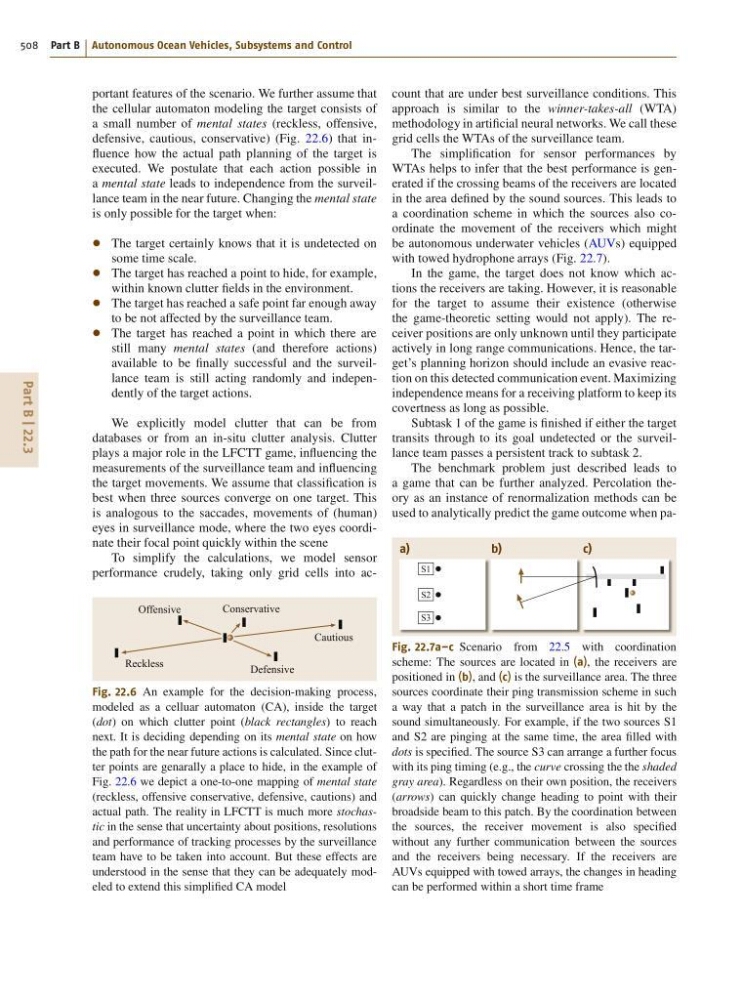
The simplification for sensor performances by
WTAs helps to infer that the best performance is generated if the crossing beams of the receivers are located
in the area defined by the sound sources. This leads to
a coordination scheme in which the sources also coordinate the movement of the receivers which might
be autonomous underwater vehicles (AUVs) equipped
with towed hydrophone arrays (Fig. 22.7).
In the game, the target does not know which actions the receivers are taking. However, it is reasonable
for the target to assume their existence (otherwise
the game-theoretic setting would not apply). The receiver positions are only unknown until they participate
actively in long range communications. Hence, the target’s planning horizon should include an evasive reaction on this detected communication event. Maximizing
independence means for a receiving platform to keep its
covertness as long as possible.
Subtask 1 of the game is finished if either the target
transits through to its goal undetected or the surveillance team passes a persistent track to subtask 2.
The benchmark problem just described leads to
a game that can be further analyzed. Percolation theory as an instance of renormalization methods can be
used to analytically predict the game outcome when paa)
b)
S1
S2
S3
c)
Fig. 22.7a–c Scenario from 22.5 with coordination
scheme: The sources are located in (a), the receivers are
positioned in (b), and (c) is the surveillance area. The three
sources coordinate their ping transmission scheme in such
a way that a patch in the surveillance area is hit by the
sound simultaneously. For example, if the two sources S1
and S2 are pinging at the same time, the area filled with
dots is specified. The source S3 can arrange a further focus
with its ping timing (e.g., the curve crossing the the shaded
gray area). Regardless on their own position, the receivers
(arrows) can quickly change heading to point with their
broadside beam to this patch. By the coordination between
the sources, the receiver movement is also specified
without any further communication between the sources
and the receivers being necessary. If the receivers are
AUVs equipped with towed arrays, the changes in heading
can be performed within a short time frame
508 Part B Autonomous Ocean Vehicles, Subsystems and Control
portant features of the scenario. We further assume that
the cellular automaton modeling the target consists of
a small number of mental states (reckless, offensive,
defensive, cautious, conservative) (Fig. 22.6) that influence how the actual path planning of the target is
executed. We postulate that each action possible in
a mental state leads to independence from the surveillance team in the near future. Changing the mental state
is only possible for the target when:
The target certainly knows that it is undetected on
some time scale.
The target has reached a point to hide, for example,
within known clutter fields in the environment.
The target has reached a safe point far enough away
to be not affected by the surveillance team.
The target has reached a point in which there are
still many mental states (and therefore actions)
available to be finally successful and the surveillance team is still acting randomly and independently of the target actions.
We explicitly model clutter that can be from
databases or from an in-situ clutter analysis. Clutter
plays a major role in the LFCTT game, influencing the
measurements of the surveillance team and influencing
the target movements. We assume that classification is
best when three sources converge on one target. This
is analogous to the saccades, movements of (human)
eyes in surveillance mode, where the two eyes coordinate their focal point quickly within the scene
To simplify the calculations, we model sensor
performance crudely, taking only grid cells into acDefensive
Conservative
Offensive
Reckless
Cautious
Fig. 22.6 An example for the decision-making process,
modeled as a celluar automaton (CA), inside the target
(dot) on which clutter point (black rectangles) to reach
next. It is deciding depending on its mental state on how
the path for the near future actions is calculated. Since clutter points are genarally a place to hide, in the example of
Fig. 22.6 we depict a one-to-one mapping of mental state
(reckless, offensive conservative, defensive, cautions) and
actual path. The reality in LFCTT is much more stochastic in the sense that uncertainty about positions, resolutions
and performance of tracking processes by the surveillance
team have to be taken into account. But these effects are
understood in the sense that they can be adequately modeled to extend this simplified CA model
count that are under best surveillance conditions. This
approach is similar to the winner-takes-all (WTA)
methodology in artificial neural networks. We call these
grid cells the WTAs of the surveillance team.
The simplification for sensor performances by
WTAs helps to infer that the best performance is generated if the crossing beams of the receivers are located
in the area defined by the sound sources. This leads to
a coordination scheme in which the sources also coordinate the movement of the receivers which might
be autonomous underwater vehicles (AUVs) equipped
with towed hydrophone arrays (Fig. 22.7).
In the game, the target does not know which actions the receivers are taking. However, it is reasonable
for the target to assume their existence (otherwise
the game-theoretic setting would not apply). The receiver positions are only unknown until they participate
actively in long range communications. Hence, the target’s planning horizon should include an evasive reaction on this detected communication event. Maximizing
independence means for a receiving platform to keep its
covertness as long as possible.
Subtask 1 of the game is finished if either the target
transits through to its goal undetected or the surveillance team passes a persistent track to subtask 2.
The benchmark problem just described leads to
a game that can be further analyzed. Percolation theory as an instance of renormalization methods can be
used to analytically predict the game outcome when paa)
b)
S1
S2
S3
c)
Fig. 22.7a–c Scenario from 22.5 with coordination
scheme: The sources are located in (a), the receivers are
positioned in (b), and (c) is the surveillance area. The three
sources coordinate their ping transmission scheme in such
a way that a patch in the surveillance area is hit by the
sound simultaneously. For example, if the two sources S1
and S2 are pinging at the same time, the area filled with
dots is specified. The source S3 can arrange a further focus
with its ping timing (e.g., the curve crossing the the shaded
gray area). Regardless on their own position, the receivers
(arrows) can quickly change heading to point with their
broadside beam to this patch. By the coordination between
the sources, the receiver movement is also specified
without any further communication between the sources
and the receivers being necessary. If the receivers are
AUVs equipped with towed arrays, the changes in heading
can be performed within a short time frame