

Cooperative Vehicle Target Tracking 22.3 Multistatic Sonar 507
Part B | 22.3
sible [22.62–65]. The multistatic approach has also
been demonstrated in other domains [22.66, 67], and
multirobot patrolling has been applied to other areas,
like harbor patrolling [22.68].
Experimental experience provides a valuable estimation of costs to the elements of the ontology. Efficient cost accounting will be needed later (Sect. 22.5)
when in the trading methodology the ontology design
must be changed.
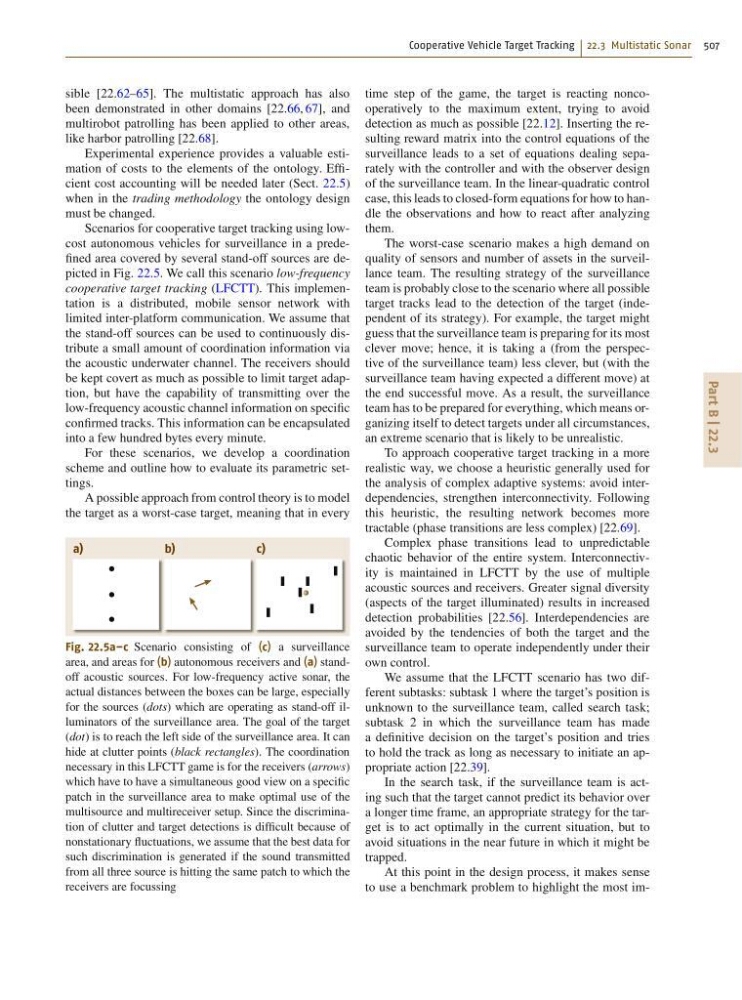
Scenarios for cooperative target tracking using lowcost autonomous vehicles for surveillance in a predefined area covered by several stand-off sources are depicted in Fig. 22.5. We call this scenario low-frequency
cooperative target tracking (LFCTT). This implementation is a distributed, mobile sensor network with
limited inter-platform communication. We assume that
the stand-off sources can be used to continuously distribute a small amount of coordination information via
the acoustic underwater channel. The receivers should
be kept covert as much as possible to limit target adaption, but have the capability of transmitting over the
low-frequency acoustic channel information on specific
confirmed tracks. This information can be encapsulated
into a few hundred bytes every minute.
For these scenarios, we develop a coordination
scheme and outline how to evaluate its parametric settings.
A possible approach from control theory is to model
the target as a worst-case target, meaning that in every
a)
b)
c)
Fig. 22.5a–c Scenario consisting of (c) a surveillance
area, and areas for (b) autonomous receivers and (a) standoff acoustic sources. For low-frequency active sonar, the
actual distances between the boxes can be large, especially
for the sources (dots) which are operating as stand-off illuminators of the surveillance area. The goal of the target
(dot) is to reach the left side of the surveillance area. It can
hide at clutter points (black rectangles). The coordination
necessary in this LFCTT game is for the receivers (arrows)
which have to have a simultaneous good view on a specific
patch in the surveillance area to make optimal use of the
multisource and multireceiver setup. Since the discrimination of clutter and target detections is difficult because of
nonstationary fluctuations, we assume that the best data for
such discrimination is generated if the sound transmitted
from all three source is hitting the same patch to which the
receivers are focussing
time step of the game, the target is reacting noncooperatively to the maximum extent, trying to avoid
detection as much as possible [22.12]. Inserting the resulting reward matrix into the control equations of the
surveillance leads to a set of equations dealing separately with the controller and with the observer design
of the surveillance team. In the linear-quadratic control
case, this leads to closed-form equations for how to handle the observations and how to react after analyzing
them.
The worst-case scenario makes a high demand on
quality of sensors and number of assets in the surveillance team. The resulting strategy of the surveillance
team is probably close to the scenario where all possible
target tracks lead to the detection of the target (independent of its strategy). For example, the target might
guess that the surveillance team is preparing for its most
clever move; hence, it is taking a (from the perspective of the surveillance team) less clever, but (with the
surveillance team having expected a different move) at
the end successful move. As a result, the surveillance
team has to be prepared for everything, which means organizing itself to detect targets under all circumstances,
an extreme scenario that is likely to be unrealistic.
To approach cooperative target tracking in a more
realistic way, we choose a heuristic generally used for
the analysis of complex adaptive systems: avoid interdependencies, strengthen interconnectivity. Following
this heuristic, the resulting network becomes more
tractable (phase transitions are less complex) [22.69].
Complex phase transitions lead to unpredictable
chaotic behavior of the entire system. Interconnectivity is maintained in LFCTT by the use of multiple
acoustic sources and receivers. Greater signal diversity
(aspects of the target illuminated) results in increased
detection probabilities [22.56]. Interdependencies are
avoided by the tendencies of both the target and the
surveillance team to operate independently under their
own control.
We assume that the LFCTT scenario has two different subtasks: subtask 1 where the target’s position is
unknown to the surveillance team, called search task;
subtask 2 in which the surveillance team has made
a definitive decision on the target’s position and tries
to hold the track as long as necessary to initiate an appropriate action [22.39].
In the search task, if the surveillance team is acting such that the target cannot predict its behavior over
a longer time frame, an appropriate strategy for the target is to act optimally in the current situation, but to
avoid situations in the near future in which it might be
trapped.
At this point in the design process, it makes sense
to use a benchmark problem to highlight the most im-
Part B | 22.3
sible [22.62–65]. The multistatic approach has also
been demonstrated in other domains [22.66, 67], and
multirobot patrolling has been applied to other areas,
like harbor patrolling [22.68].
Experimental experience provides a valuable estimation of costs to the elements of the ontology. Efficient cost accounting will be needed later (Sect. 22.5)
when in the trading methodology the ontology design
must be changed.
Scenarios for cooperative target tracking using lowcost autonomous vehicles for surveillance in a predefined area covered by several stand-off sources are depicted in Fig. 22.5. We call this scenario low-frequency
cooperative target tracking (LFCTT). This implementation is a distributed, mobile sensor network with
limited inter-platform communication. We assume that
the stand-off sources can be used to continuously distribute a small amount of coordination information via
the acoustic underwater channel. The receivers should
be kept covert as much as possible to limit target adaption, but have the capability of transmitting over the
low-frequency acoustic channel information on specific
confirmed tracks. This information can be encapsulated
into a few hundred bytes every minute.
For these scenarios, we develop a coordination
scheme and outline how to evaluate its parametric settings.
A possible approach from control theory is to model
the target as a worst-case target, meaning that in every
a)
b)
c)
Fig. 22.5a–c Scenario consisting of (c) a surveillance
area, and areas for (b) autonomous receivers and (a) standoff acoustic sources. For low-frequency active sonar, the
actual distances between the boxes can be large, especially
for the sources (dots) which are operating as stand-off illuminators of the surveillance area. The goal of the target
(dot) is to reach the left side of the surveillance area. It can
hide at clutter points (black rectangles). The coordination
necessary in this LFCTT game is for the receivers (arrows)
which have to have a simultaneous good view on a specific
patch in the surveillance area to make optimal use of the
multisource and multireceiver setup. Since the discrimination of clutter and target detections is difficult because of
nonstationary fluctuations, we assume that the best data for
such discrimination is generated if the sound transmitted
from all three source is hitting the same patch to which the
receivers are focussing
time step of the game, the target is reacting noncooperatively to the maximum extent, trying to avoid
detection as much as possible [22.12]. Inserting the resulting reward matrix into the control equations of the
surveillance leads to a set of equations dealing separately with the controller and with the observer design
of the surveillance team. In the linear-quadratic control
case, this leads to closed-form equations for how to handle the observations and how to react after analyzing
them.
The worst-case scenario makes a high demand on
quality of sensors and number of assets in the surveillance team. The resulting strategy of the surveillance
team is probably close to the scenario where all possible
target tracks lead to the detection of the target (independent of its strategy). For example, the target might
guess that the surveillance team is preparing for its most
clever move; hence, it is taking a (from the perspective of the surveillance team) less clever, but (with the
surveillance team having expected a different move) at
the end successful move. As a result, the surveillance
team has to be prepared for everything, which means organizing itself to detect targets under all circumstances,
an extreme scenario that is likely to be unrealistic.
To approach cooperative target tracking in a more
realistic way, we choose a heuristic generally used for
the analysis of complex adaptive systems: avoid interdependencies, strengthen interconnectivity. Following
this heuristic, the resulting network becomes more
tractable (phase transitions are less complex) [22.69].
Complex phase transitions lead to unpredictable
chaotic behavior of the entire system. Interconnectivity is maintained in LFCTT by the use of multiple
acoustic sources and receivers. Greater signal diversity
(aspects of the target illuminated) results in increased
detection probabilities [22.56]. Interdependencies are
avoided by the tendencies of both the target and the
surveillance team to operate independently under their
own control.
We assume that the LFCTT scenario has two different subtasks: subtask 1 where the target’s position is
unknown to the surveillance team, called search task;
subtask 2 in which the surveillance team has made
a definitive decision on the target’s position and tries
to hold the track as long as necessary to initiate an appropriate action [22.39].
In the search task, if the surveillance team is acting such that the target cannot predict its behavior over
a longer time frame, an appropriate strategy for the target is to act optimally in the current situation, but to
avoid situations in the near future in which it might be
trapped.
At this point in the design process, it makes sense
to use a benchmark problem to highlight the most im-