

Cooperative Vehicle Target Tracking 22.3 Multistatic Sonar 509
Part B | 22.3
b) Cumulative probability of detection
a)
Target velocity
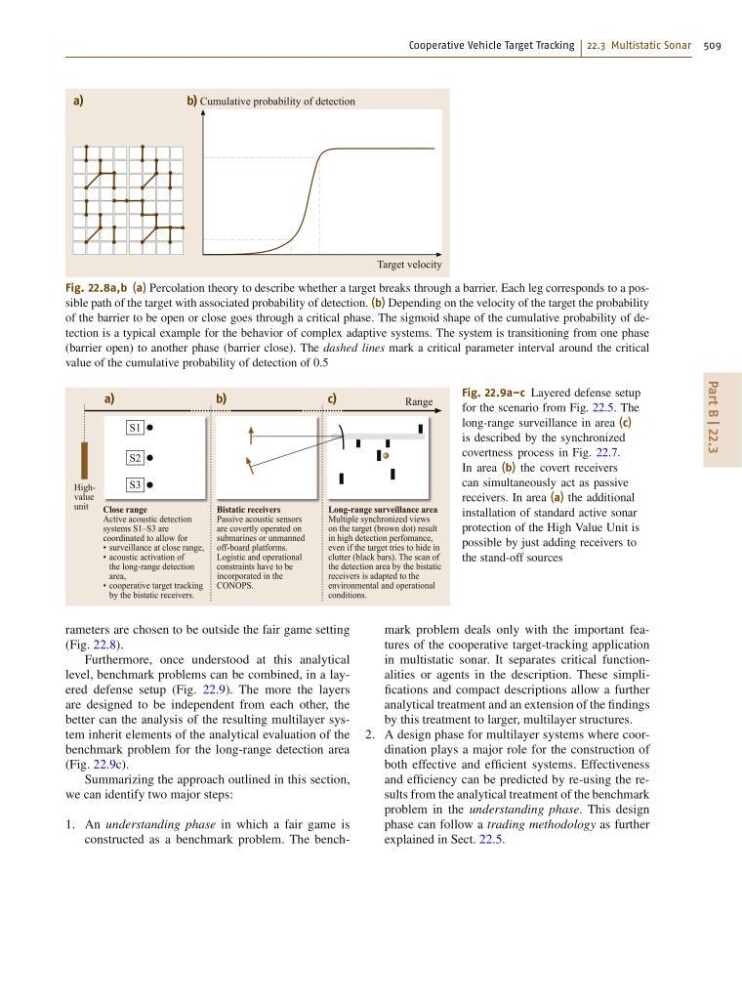
Fig. 22.8a,b (a) Percolation theory to describe whether a target breaks through a barrier. Each leg corresponds to a possible path of the target with associated probability of detection. (b) Depending on the velocity of the target the probability
of the barrier to be open or close goes through a critical phase. The sigmoid shape of the cumulative probability of detection is a typical example for the behavior of complex adaptive systems. The system is transitioning from one phase
(barrier open) to another phase (barrier close). The dashed lines mark a critical parameter interval around the critical
value of the cumulative probability of detection of 0.5
a)
b)
S1
Highvalue
unit
Range
Close range
Active acoustic detection
systems S1–S3 are
coordinated to allow for
• surveillance at close range,
• acoustic activation of
the long-range detection
area,
• cooperative target tracking
by the bistatic receivers.
Bistatic receivers
Passive acoustic sensors
are covertly operated on
submarines or unmanned
off-board platforms.
Logistic and operational
constraints have to be
incorporated in the
CONOPS.
Long-range surveillance area
Multiple synchronized views
on the target (brown dot) result
in high detection perfomance,
even if the target tries to hide in
clutter (black bars). The scan of
the detection area by the bistatic
receivers is adapted to the
environmental and operational
conditions.
S2
S3
c)
Fig. 22.9a–c Layered defense setup
for the scenario from Fig. 22.5. The
long-range surveillance in area (c)
is described by the synchronized
covertness process in Fig. 22.7.
In area (b) the covert receivers
can simultaneously act as passive
receivers. In area (a) the additional
installation of standard active sonar
protection of the High Value Unit is
possible by just adding receivers to
the stand-off sources
rameters are chosen to be outside the fair game setting
(Fig. 22.8).
Furthermore, once understood at this analytical
level, benchmark problems can be combined, in a layered defense setup (Fig. 22.9). The more the layers
are designed to be independent from each other, the
better can the analysis of the resulting multilayer system inherit elements of the analytical evaluation of the
benchmark problem for the long-range detection area
(Fig. 22.9c).
Summarizing the approach outlined in this section,
we can identify two major steps:
1. An understanding phase in which a fair game is
constructed as a benchmark problem. The benchmark problem deals only with the important features of the cooperative target-tracking application
in multistatic sonar. It separates critical functionalities or agents in the description. These simplifications and compact descriptions allow a further
analytical treatment and an extension of the findings
by this treatment to larger, multilayer structures.
2. A design phase for multilayer systems where coordination plays a major role for the construction of
both effective and efficient systems. Effectiveness
and efficiency can be predicted by re-using the results from the analytical treatment of the benchmark
problem in the understanding phase. This design
phase can follow a trading methodology as further
explained in Sect. 22.5.
Part B | 22.3
b) Cumulative probability of detection
a)
Target velocity
Fig. 22.8a,b (a) Percolation theory to describe whether a target breaks through a barrier. Each leg corresponds to a possible path of the target with associated probability of detection. (b) Depending on the velocity of the target the probability
of the barrier to be open or close goes through a critical phase. The sigmoid shape of the cumulative probability of detection is a typical example for the behavior of complex adaptive systems. The system is transitioning from one phase
(barrier open) to another phase (barrier close). The dashed lines mark a critical parameter interval around the critical
value of the cumulative probability of detection of 0.5
a)
b)
S1
Highvalue
unit
Range
Close range
Active acoustic detection
systems S1–S3 are
coordinated to allow for
• surveillance at close range,
• acoustic activation of
the long-range detection
area,
• cooperative target tracking
by the bistatic receivers.
Bistatic receivers
Passive acoustic sensors
are covertly operated on
submarines or unmanned
off-board platforms.
Logistic and operational
constraints have to be
incorporated in the
CONOPS.
Long-range surveillance area
Multiple synchronized views
on the target (brown dot) result
in high detection perfomance,
even if the target tries to hide in
clutter (black bars). The scan of
the detection area by the bistatic
receivers is adapted to the
environmental and operational
conditions.
S2
S3
c)
Fig. 22.9a–c Layered defense setup
for the scenario from Fig. 22.5. The
long-range surveillance in area (c)
is described by the synchronized
covertness process in Fig. 22.7.
In area (b) the covert receivers
can simultaneously act as passive
receivers. In area (a) the additional
installation of standard active sonar
protection of the High Value Unit is
possible by just adding receivers to
the stand-off sources
rameters are chosen to be outside the fair game setting
(Fig. 22.8).
Furthermore, once understood at this analytical
level, benchmark problems can be combined, in a layered defense setup (Fig. 22.9). The more the layers
are designed to be independent from each other, the
better can the analysis of the resulting multilayer system inherit elements of the analytical evaluation of the
benchmark problem for the long-range detection area
(Fig. 22.9c).
Summarizing the approach outlined in this section,
we can identify two major steps:
1. An understanding phase in which a fair game is
constructed as a benchmark problem. The benchmark problem deals only with the important features of the cooperative target-tracking application
in multistatic sonar. It separates critical functionalities or agents in the description. These simplifications and compact descriptions allow a further
analytical treatment and an extension of the findings
by this treatment to larger, multilayer structures.
2. A design phase for multilayer systems where coordination plays a major role for the construction of
both effective and efficient systems. Effectiveness
and efficiency can be predicted by re-using the results from the analytical treatment of the benchmark
problem in the understanding phase. This design
phase can follow a trading methodology as further
explained in Sect. 22.5.