

Science of Autonomy for Swarms of Ocean Vehicles 21.3 Conclusions and Outlook 495
Part B | 21
5
1 0
1 5
2 0
2 5
U variance, Time = 28.9
Variance
V variance, Time = 28.9
y
20 30
10
40 50
x
60 70 80 90
a)
b)
30
25
20
15
10
5
4
3
2
1
10
1
10
0
10
–1
10
–2
10
–3
10
–4
10
–5
10
–6
×10
–3
y
20 30
10
40 50
x
0
Time (s)
Var (y
i )
60 70 80 90 100
25
20
15
10
5
10
8
6
4
2
×10
–3
Time = 006, assimilation cycle = 3, predicted solution
y (m)
2
1
3
0
4
5
x (m)
6
7
8
9
1 0
c)
3
2
1
0
Time = 006, assimilation cycle = 3, true solution
y (m)
2
1
3
0
4
5
x (m)
6
7
8
9
1 0
3
2
1
0
Time = 28.3, assimilation cycle = 1, predicted solution
y (m)
2
1
3
0
4
5
x (m)
6
7
8
9
1 0
d)
3
2
1
0
Time = 28.3, assimilation cycle = 1, true solution
y (m)
2
1
3
0
4
5
x (m)
6
7
8
9
1 0
3
2
1
0
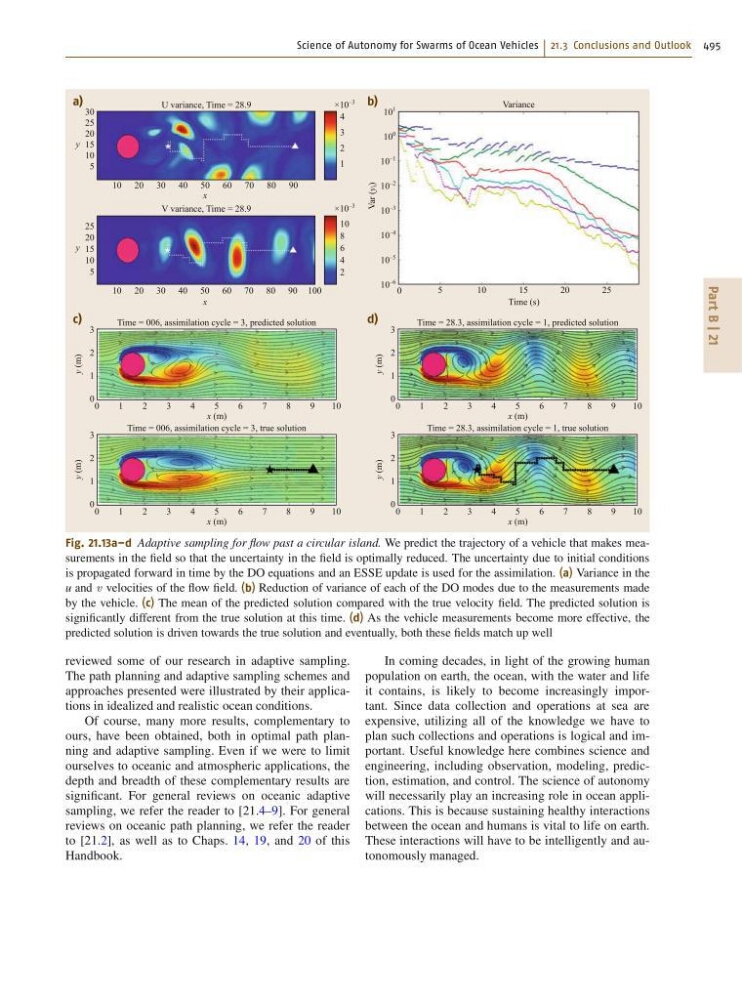
Fig. 21.13a–d Adaptive sampling for flow past a circular island. We predict the trajectory of a vehicle that makes measurements in the field so that the uncertainty in the field is optimally reduced. The uncertainty due to initial conditions
is propagated forward in time by the DO equations and an ESSE update is used for the assimilation. (a) Variance in the
u and v velocities of the flow field. (b) Reduction of variance of each of the DO modes due to the measurements made
by the vehicle. (c) The mean of the predicted solution compared with the true velocity field. The predicted solution is
significantly different from the true solution at this time. (d) As the vehicle measurements become more effective, the
predicted solution is driven towards the true solution and eventually, both these fields match up well
reviewed some of our research in adaptive sampling.
The path planning and adaptive sampling schemes and
approaches presented were illustrated by their applications in idealized and realistic ocean conditions.
Of course, many more results, complementary to
ours, have been obtained, both in optimal path planning and adaptive sampling. Even if we were to limit
ourselves to oceanic and atmospheric applications, the
depth and breadth of these complementary results are
significant. For general reviews on oceanic adaptive
sampling, we refer the reader to [21.4–9]. For general
reviews on oceanic path planning, we refer the reader
to [21.2], as well as to Chaps. 14, 19, and 20 of this
Handbook.
In coming decades, in light of the growing human
population on earth, the ocean, with the water and life
it contains, is likely to become increasingly important. Since data collection and operations at sea are
expensive, utilizing all of the knowledge we have to
plan such collections and operations is logical and important. Useful knowledge here combines science and
engineering, including observation, modeling, prediction, estimation, and control. The science of autonomy
will necessarily play an increasing role in ocean applications. This is because sustaining healthy interactions
between the ocean and humans is vital to life on earth.
These interactions will have to be intelligently and autonomously managed.
Part B | 21
5
1 0
1 5
2 0
2 5
U variance, Time = 28.9
Variance
V variance, Time = 28.9
y
20 30
10
40 50
x
60 70 80 90
a)
b)
30
25
20
15
10
5
4
3
2
1
10
1
10
0
10
–1
10
–2
10
–3
10
–4
10
–5
10
–6
×10
–3
y
20 30
10
40 50
x
0
Time (s)
Var (y
i )
60 70 80 90 100
25
20
15
10
5
10
8
6
4
2
×10
–3
Time = 006, assimilation cycle = 3, predicted solution
y (m)
2
1
3
0
4
5
x (m)
6
7
8
9
1 0
c)
3
2
1
0
Time = 006, assimilation cycle = 3, true solution
y (m)
2
1
3
0
4
5
x (m)
6
7
8
9
1 0
3
2
1
0
Time = 28.3, assimilation cycle = 1, predicted solution
y (m)
2
1
3
0
4
5
x (m)
6
7
8
9
1 0
d)
3
2
1
0
Time = 28.3, assimilation cycle = 1, true solution
y (m)
2
1
3
0
4
5
x (m)
6
7
8
9
1 0
3
2
1
0
Fig. 21.13a–d Adaptive sampling for flow past a circular island. We predict the trajectory of a vehicle that makes measurements in the field so that the uncertainty in the field is optimally reduced. The uncertainty due to initial conditions
is propagated forward in time by the DO equations and an ESSE update is used for the assimilation. (a) Variance in the
u and v velocities of the flow field. (b) Reduction of variance of each of the DO modes due to the measurements made
by the vehicle. (c) The mean of the predicted solution compared with the true velocity field. The predicted solution is
significantly different from the true solution at this time. (d) As the vehicle measurements become more effective, the
predicted solution is driven towards the true solution and eventually, both these fields match up well
reviewed some of our research in adaptive sampling.
The path planning and adaptive sampling schemes and
approaches presented were illustrated by their applications in idealized and realistic ocean conditions.
Of course, many more results, complementary to
ours, have been obtained, both in optimal path planning and adaptive sampling. Even if we were to limit
ourselves to oceanic and atmospheric applications, the
depth and breadth of these complementary results are
significant. For general reviews on oceanic adaptive
sampling, we refer the reader to [21.4–9]. For general
reviews on oceanic path planning, we refer the reader
to [21.2], as well as to Chaps. 14, 19, and 20 of this
Handbook.
In coming decades, in light of the growing human
population on earth, the ocean, with the water and life
it contains, is likely to become increasingly important. Since data collection and operations at sea are
expensive, utilizing all of the knowledge we have to
plan such collections and operations is logical and important. Useful knowledge here combines science and
engineering, including observation, modeling, prediction, estimation, and control. The science of autonomy
will necessarily play an increasing role in ocean applications. This is because sustaining healthy interactions
between the ocean and humans is vital to life on earth.
These interactions will have to be intelligently and autonomously managed.