

Elements of Physical Oceanography 2.4 Surface Gravity Waves 21
Part A | 2.4
To start, we define the characteristics (with units indicated in [: : :]) of the monochromatic sine wave shown
in Fig. 2.8:
Elevation: Á.x; t/ is the instantaneous vertical departure of the sea level from the undisturbed sea
level.
Wave height: H is the distance between the wave
crest and trough. ŒH D .unit length/
1
Wave amplitude: a D 1=2H
Wavelength: L is the distance between points of
equal phase. ŒL D length
Wave number: k D 2=L is the number of times
a wave can fit on the circumference of circle with
a dimensionless radius D 1. Œk D .length/
1
Wave period: T is the time between points of equal
phase. ŒT D unit time.
Wave frequency: f D 1=T is the number of complete
cycles per unit time. Œf D cycles=time
Angular frequency: ! D 2=T D 2f is the number of times a wave of period T can fit on the
circumference of a circle with a dimensionless radius D 1. Œ! D .time/
1
Wave phase speed: c Á L=T or c Á !=k is the speed
of a particular point on the waveform (or phase).
Œc D length=time
The mathematical description of our monochromatic right-traveling waveform is
Á.x; t/ D a cos
 2x
L
2t
T
Ã
or
D a cos.kx !t/ :
(2.1)
Equation (2.1) can also be written in terms of phase
speed as Á.x; t/ D a cosŒk.x ct/. The dynamical relation between wave period T and wavelength L can be
defined by the solution to the two-dimensional (2-D)
Airy wave model of a right-traveling wave at the surface of an ocean (mean depth z D 0) with a flat bottom
at a depth of z D h.
The solution to the approximate linearized Airy
wave equations of motion and boundary conditions for
small amplitude (a=L 1) waves [2.5] yields the dispersion relation
!
2
D gk tanh.kh/ ;
(2.2)
which describes the relation between wave frequency
and wave number, and the dynamical variables of pressure p, and the x- and upward (Cz)-directed velocity
components u and w , respectively:
u D a!
cosh k.z C h/
sinh.kh/
cos.kx !t/ ;
(2.3a)
w D a!
sinh k.z C h/
sinh.kh/
sin.kx !t/ ;
(2.3b)
p D Dgz C ga
cosh k.z C h/
cosh kh
cos.kw !t/ :
(2.3c)
The dispersion relation given above can be rewritten
as
c
2
D
L
2
T 2 D
!
2
k 2 D
g
k
tanh.kh/ ;
which shows that, in general, Airy waves have phase
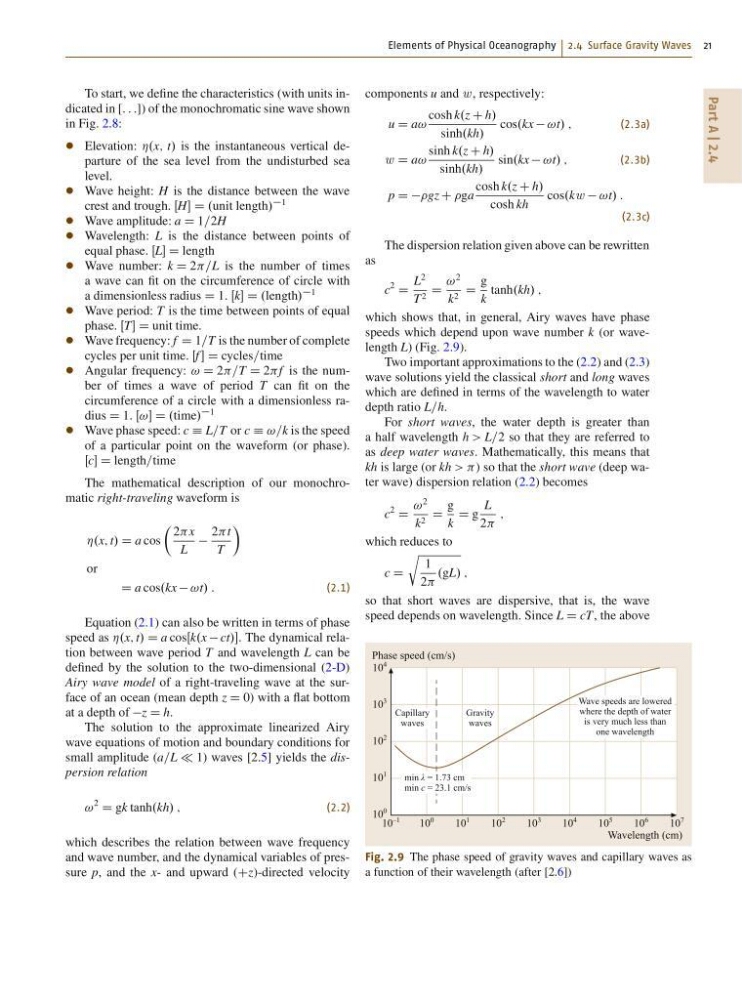
speeds which depend upon wave number k (or wavelength L) (Fig. 2.9).
Two important approximations to the (2.2) and (2.3)
wave solutions yield the classical short and long waves
which are defined in terms of the wavelength to water
depth ratio L=h.
For short waves, the water depth is greater than
a half wavelength h > L=2 so that they are referred to
as deep water waves. Mathematically, this means that
kh is large (or kh > >) so that the short wave (deep water wave) dispersion relation (2.2) becomes
c
2
D
!
2
k 2 D
g
k
D g
L
2
;
which reduces to
c D
r
1
2
.gL/ ;
so that short waves are dispersive, that is, the wave
speed depends on wavelength. Since L D cT, the above
10
–1
10
0
10
1
10
2
10
3
10
4
10
5
10
6
10
7
Wave speeds are lowered
where the depth of water
is very much less than
one wavelength
Gravity
waves
min λ = 1.73 cm
min c = 23.1 cm/s
Capillary
waves
Phase speed (cm/s)
Wavelength (cm)
10
4
10
3
10
2
10
1
10
0
Fig. 2.9 The phase speed of gravity waves and capillary waves as
a function of their wavelength (after [2.6])
Part A | 2.4
To start, we define the characteristics (with units indicated in [: : :]) of the monochromatic sine wave shown
in Fig. 2.8:
Elevation: Á.x; t/ is the instantaneous vertical departure of the sea level from the undisturbed sea
level.
Wave height: H is the distance between the wave
crest and trough. ŒH D .unit length/
1
Wave amplitude: a D 1=2H
Wavelength: L is the distance between points of
equal phase. ŒL D length
Wave number: k D 2=L is the number of times
a wave can fit on the circumference of circle with
a dimensionless radius D 1. Œk D .length/
1
Wave period: T is the time between points of equal
phase. ŒT D unit time.
Wave frequency: f D 1=T is the number of complete
cycles per unit time. Œf D cycles=time
Angular frequency: ! D 2=T D 2f is the number of times a wave of period T can fit on the
circumference of a circle with a dimensionless radius D 1. Œ! D .time/
1
Wave phase speed: c Á L=T or c Á !=k is the speed
of a particular point on the waveform (or phase).
Œc D length=time
The mathematical description of our monochromatic right-traveling waveform is
Á.x; t/ D a cos
 2x
L
2t
T
Ã
or
D a cos.kx !t/ :
(2.1)
Equation (2.1) can also be written in terms of phase
speed as Á.x; t/ D a cosŒk.x ct/. The dynamical relation between wave period T and wavelength L can be
defined by the solution to the two-dimensional (2-D)
Airy wave model of a right-traveling wave at the surface of an ocean (mean depth z D 0) with a flat bottom
at a depth of z D h.
The solution to the approximate linearized Airy
wave equations of motion and boundary conditions for
small amplitude (a=L 1) waves [2.5] yields the dispersion relation
!
2
D gk tanh.kh/ ;
(2.2)
which describes the relation between wave frequency
and wave number, and the dynamical variables of pressure p, and the x- and upward (Cz)-directed velocity
components u and w , respectively:
u D a!
cosh k.z C h/
sinh.kh/
cos.kx !t/ ;
(2.3a)
w D a!
sinh k.z C h/
sinh.kh/
sin.kx !t/ ;
(2.3b)
p D Dgz C ga
cosh k.z C h/
cosh kh
cos.kw !t/ :
(2.3c)
The dispersion relation given above can be rewritten
as
c
2
D
L
2
T 2 D
!
2
k 2 D
g
k
tanh.kh/ ;
which shows that, in general, Airy waves have phase
speeds which depend upon wave number k (or wavelength L) (Fig. 2.9).
Two important approximations to the (2.2) and (2.3)
wave solutions yield the classical short and long waves
which are defined in terms of the wavelength to water
depth ratio L=h.
For short waves, the water depth is greater than
a half wavelength h > L=2 so that they are referred to
as deep water waves. Mathematically, this means that
kh is large (or kh > >) so that the short wave (deep water wave) dispersion relation (2.2) becomes
c
2
D
!
2
k 2 D
g
k
D g
L
2
;
which reduces to
c D
r
1
2
.gL/ ;
so that short waves are dispersive, that is, the wave
speed depends on wavelength. Since L D cT, the above
10
–1
10
0
10
1
10
2
10
3
10
4
10
5
10
6
10
7
Wave speeds are lowered
where the depth of water
is very much less than
one wavelength
Gravity
waves
min λ = 1.73 cm
min c = 23.1 cm/s
Capillary
waves
Phase speed (cm/s)
Wavelength (cm)
10
4
10
3
10
2
10
1
10
0
Fig. 2.9 The phase speed of gravity waves and capillary waves as
a function of their wavelength (after [2.6])