

Part A | 2.4
20 Part A Fundamentals
4–11 years/cycle EL NINO
1 years/cycle
Seasonal changes
in sea level
Wavelike motion caused by passage
of storms and weather fronts
15 days/cycle
The FORTNIGHT tide cycle
24.8 h/cycle
G e n e r a t e d
b y e a r t h q u a k e s
T h e tu r n in g e f f e c t o f th e e a r th 's r o ta ti o n b e g in s to
in f lu e n c e w a v e b e h a v io r
F o r c e d b y w i n d s
F o r c e d b y w i n d s
R e s t o r e d
b y s u r f a c e
t e n s i o n
R e s t o r e d b y f o r c e o f g r a v i t y
G e n e r a t e d b y t i d e s
R e s t o r e d b y f o r c e o f g r a v i t y
The once daily, diurnal TIDE
12.4 h/cycle
The twice daily, semidiurnal TIDE
Very short wind waves: about 1 second/cycle and 30 cm crest to crest
1–10 h/cycle
STORM SURGES
0.1–1 h/cycle
TSUNAMIS
500 s/cycle
Internal waves, vertical oscillations along water layers
30 s/cycle
5 s/cycle
0.1 s/cycle
Surface wind waves, from sea to swell
Capillary waves, the shortest waves of all on fluid oceans
1–7 days/cycle
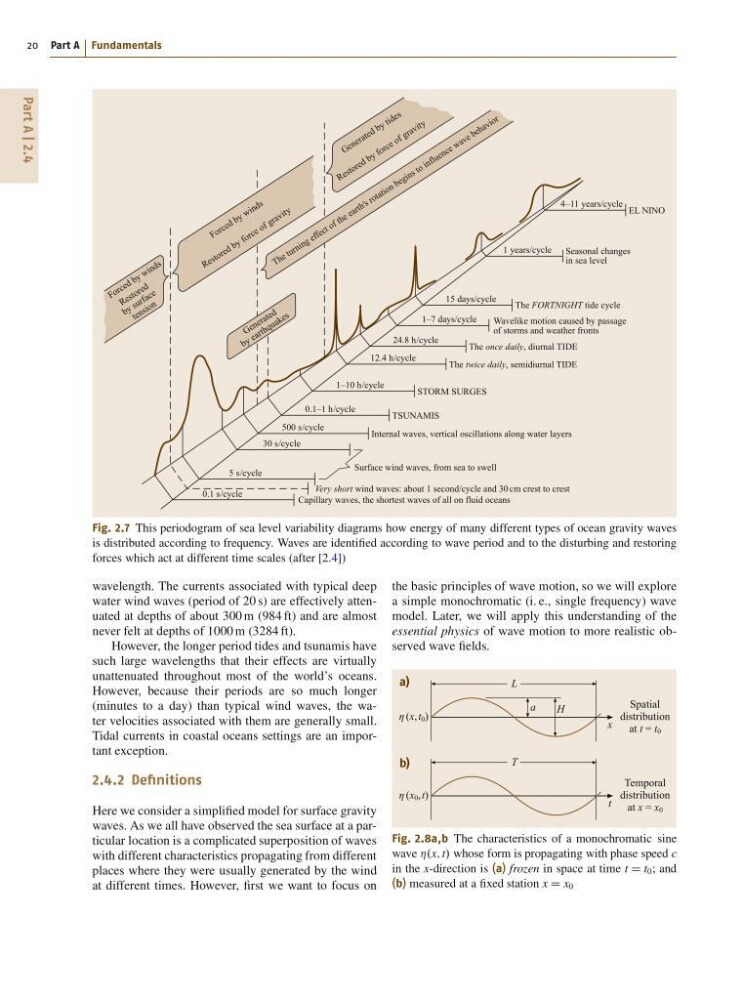
Fig. 2.7 This periodogram of sea level variability diagrams how energy of many different types of ocean gravity waves
is distributed according to frequency. Waves are identified according to wave period and to the disturbing and restoring
forces which act at different time scales (after [2.4])
wavelength. The currents associated with typical deep
water wind waves (period of 20 s) are effectively attenuated at depths of about 300 m (984 ft) and are almost
never felt at depths of 1000 m (3284 ft).
However, the longer period tides and tsunamis have
such large wavelengths that their effects are virtually
unattenuated throughout most of the world’s oceans.
However, because their periods are so much longer
(minutes to a day) than typical wind waves, the water velocities associated with them are generally small.
Tidal currents in coastal oceans settings are an important exception.
2.4.2 Definitions
Here we consider a simplified model for surface gravity
waves. As we all have observed the sea surface at a particular location is a complicated superposition of waves
with different characteristics propagating from different
places where they were usually generated by the wind
at different times. However, first we want to focus on
the basic principles of wave motion, so we will explore
a simple monochromatic (i. e., single frequency) wave
model. Later, we will apply this understanding of the
essential physics of wave motion to more realistic observed wave fields.
a)
η (x,t 0 )
L
Spatial
distribution
at t = t 0
a
x
H
b)
η (x 0 , t)
T
Temporal
distribution
at x = x 0
t
Fig. 2.8a,b The characteristics of a monochromatic sine
wave Á.x; t/ whose form is propagating with phase speed c
in the x-direction is (a) frozen in space at time t D t 0 ; and
(b) measured at a fixed station x D x 0
20 Part A Fundamentals
4–11 years/cycle EL NINO
1 years/cycle
Seasonal changes
in sea level
Wavelike motion caused by passage
of storms and weather fronts
15 days/cycle
The FORTNIGHT tide cycle
24.8 h/cycle
G e n e r a t e d
b y e a r t h q u a k e s
T h e tu r n in g e f f e c t o f th e e a r th 's r o ta ti o n b e g in s to
in f lu e n c e w a v e b e h a v io r
F o r c e d b y w i n d s
F o r c e d b y w i n d s
R e s t o r e d
b y s u r f a c e
t e n s i o n
R e s t o r e d b y f o r c e o f g r a v i t y
G e n e r a t e d b y t i d e s
R e s t o r e d b y f o r c e o f g r a v i t y
The once daily, diurnal TIDE
12.4 h/cycle
The twice daily, semidiurnal TIDE
Very short wind waves: about 1 second/cycle and 30 cm crest to crest
1–10 h/cycle
STORM SURGES
0.1–1 h/cycle
TSUNAMIS
500 s/cycle
Internal waves, vertical oscillations along water layers
30 s/cycle
5 s/cycle
0.1 s/cycle
Surface wind waves, from sea to swell
Capillary waves, the shortest waves of all on fluid oceans
1–7 days/cycle
Fig. 2.7 This periodogram of sea level variability diagrams how energy of many different types of ocean gravity waves
is distributed according to frequency. Waves are identified according to wave period and to the disturbing and restoring
forces which act at different time scales (after [2.4])
wavelength. The currents associated with typical deep
water wind waves (period of 20 s) are effectively attenuated at depths of about 300 m (984 ft) and are almost
never felt at depths of 1000 m (3284 ft).
However, the longer period tides and tsunamis have
such large wavelengths that their effects are virtually
unattenuated throughout most of the world’s oceans.
However, because their periods are so much longer
(minutes to a day) than typical wind waves, the water velocities associated with them are generally small.
Tidal currents in coastal oceans settings are an important exception.
2.4.2 Definitions
Here we consider a simplified model for surface gravity
waves. As we all have observed the sea surface at a particular location is a complicated superposition of waves
with different characteristics propagating from different
places where they were usually generated by the wind
at different times. However, first we want to focus on
the basic principles of wave motion, so we will explore
a simple monochromatic (i. e., single frequency) wave
model. Later, we will apply this understanding of the
essential physics of wave motion to more realistic observed wave fields.
a)
η (x,t 0 )
L
Spatial
distribution
at t = t 0
a
x
H
b)
η (x 0 , t)
T
Temporal
distribution
at x = x 0
t
Fig. 2.8a,b The characteristics of a monochromatic sine
wave Á.x; t/ whose form is propagating with phase speed c
in the x-direction is (a) frozen in space at time t D t 0 ; and
(b) measured at a fixed station x D x 0