

Part A | 2.4
22 Part A Fundamentals
a)
L
H
Water depth ≥ wavelength
Direction of wave motion
1
2
Water depth ≥ wavelength
Sea bottom
1
20
b)
Direction of wave motion
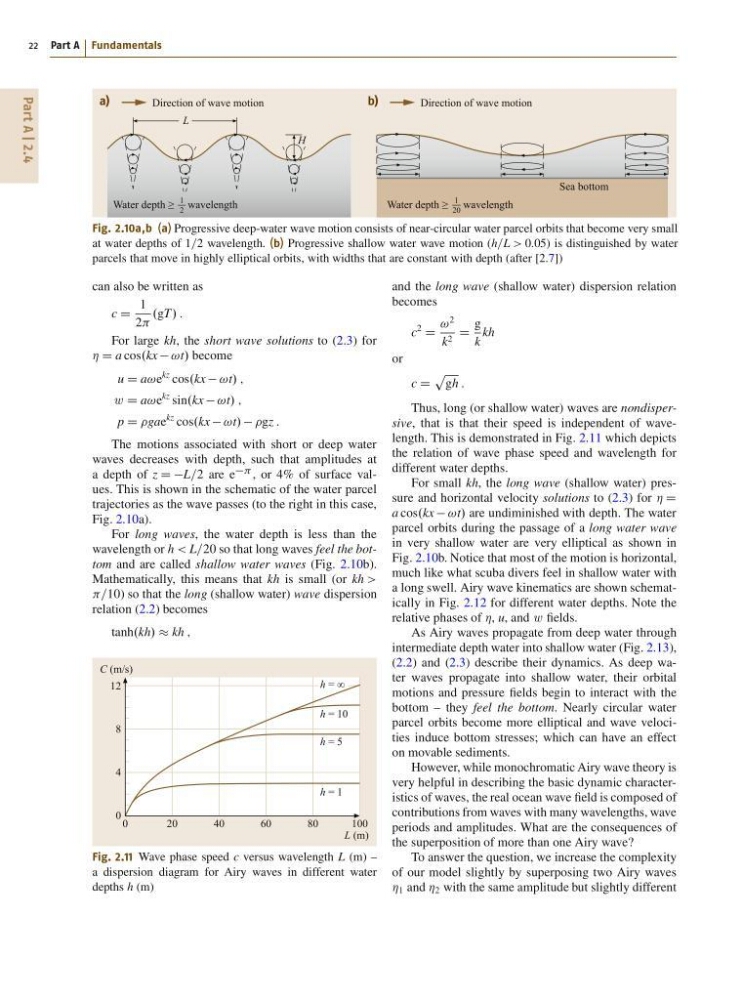
Fig. 2.10a,b (a) Progressive deep-water wave motion consists of near-circular water parcel orbits that become very small
at water depths of 1=2 wavelength. (b) Progressive shallow water wave motion (h=L > 0:05) is distinguished by water
parcels that move in highly elliptical orbits, with widths that are constant with depth (after [2.7])
can also be written as
c D
1
2
.gT/ :
For large kh, the short wave solutions to (2.3) for
Á D a cos.kx !t/ become
u D a!e
kz cos.kx !t/ ;
w D a!e
kz sin.kx !t/ ;
p D gae
kz cos.kx !t/ gz :
The motions associated with short or deep water
waves decreases with depth, such that amplitudes at
a depth of z D DL=2 are e
, or 4% of surface values. This is shown in the schematic of the water parcel
trajectories as the wave passes (to the right in this case,
Fig. 2.10a).
For long waves, the water depth is less than the
wavelength or h < L=20 so that long waves feel the bottom and are called shallow water waves (Fig. 2.10b).
Mathematically, this means that kh is small (or kh >
=10) so that the long (shallow water) wave dispersion
relation (2.2) becomes
tanh.kh/ kh ;
0
2 0
4 0
6 0
8 0
h = ∞
h = 10
h = 5
h = 1
100
C (m/s)
L (m)
12
8
4
0
Fig. 2.11 Wave phase speed c versus wavelength L (m) –
a dispersion diagram for Airy waves in different water
depths h (m)
and the long wave (shallow water) dispersion relation
becomes
c
2
D
!
2
k 2 D
g
k
kh
or
c D
p
gh :
Thus, long (or shallow water) waves are nondispersive, that is that their speed is independent of wavelength. This is demonstrated in Fig. 2.11 which depicts
the relation of wave phase speed and wavelength for
different water depths.
For small kh, the long wave (shallow water) pressure and horizontal velocity solutions to (2.3) for Á D
a cos.kx !t/ are undiminished with depth. The water
parcel orbits during the passage of a long water wave
in very shallow water are very elliptical as shown in
Fig. 2.10b. Notice that most of the motion is horizontal,
much like what scuba divers feel in shallow water with
a long swell. Airy wave kinematics are shown schematically in Fig. 2.12 for different water depths. Note the
relative phases of Á, u, and w fields.
As Airy waves propagate from deep water through
intermediate depth water into shallow water (Fig. 2.13),
(2.2) and (2.3) describe their dynamics. As deep water waves propagate into shallow water, their orbital
motions and pressure fields begin to interact with the
bottom – they feel the bottom. Nearly circular water
parcel orbits become more elliptical and wave velocities induce bottom stresses; which can have an effect
on movable sediments.
However, while monochromatic Airy wave theory is
very helpful in describing the basic dynamic characteristics of waves, the real ocean wave field is composed of
contributions from waves with many wavelengths, wave
periods and amplitudes. What are the consequences of
the superposition of more than one Airy wave?
To answer the question, we increase the complexity
of our model slightly by superposing two Airy waves
Á 1 and Á 2 with the same amplitude but slightly different
22 Part A Fundamentals
a)
L
H
Water depth ≥ wavelength
Direction of wave motion
1
2
Water depth ≥ wavelength
Sea bottom
1
20
b)
Direction of wave motion
Fig. 2.10a,b (a) Progressive deep-water wave motion consists of near-circular water parcel orbits that become very small
at water depths of 1=2 wavelength. (b) Progressive shallow water wave motion (h=L > 0:05) is distinguished by water
parcels that move in highly elliptical orbits, with widths that are constant with depth (after [2.7])
can also be written as
c D
1
2
.gT/ :
For large kh, the short wave solutions to (2.3) for
Á D a cos.kx !t/ become
u D a!e
kz cos.kx !t/ ;
w D a!e
kz sin.kx !t/ ;
p D gae
kz cos.kx !t/ gz :
The motions associated with short or deep water
waves decreases with depth, such that amplitudes at
a depth of z D DL=2 are e
, or 4% of surface values. This is shown in the schematic of the water parcel
trajectories as the wave passes (to the right in this case,
Fig. 2.10a).
For long waves, the water depth is less than the
wavelength or h < L=20 so that long waves feel the bottom and are called shallow water waves (Fig. 2.10b).
Mathematically, this means that kh is small (or kh >
=10) so that the long (shallow water) wave dispersion
relation (2.2) becomes
tanh.kh/ kh ;
0
2 0
4 0
6 0
8 0
h = ∞
h = 10
h = 5
h = 1
100
C (m/s)
L (m)
12
8
4
0
Fig. 2.11 Wave phase speed c versus wavelength L (m) –
a dispersion diagram for Airy waves in different water
depths h (m)
and the long wave (shallow water) dispersion relation
becomes
c
2
D
!
2
k 2 D
g
k
kh
or
c D
p
gh :
Thus, long (or shallow water) waves are nondispersive, that is that their speed is independent of wavelength. This is demonstrated in Fig. 2.11 which depicts
the relation of wave phase speed and wavelength for
different water depths.
For small kh, the long wave (shallow water) pressure and horizontal velocity solutions to (2.3) for Á D
a cos.kx !t/ are undiminished with depth. The water
parcel orbits during the passage of a long water wave
in very shallow water are very elliptical as shown in
Fig. 2.10b. Notice that most of the motion is horizontal,
much like what scuba divers feel in shallow water with
a long swell. Airy wave kinematics are shown schematically in Fig. 2.12 for different water depths. Note the
relative phases of Á, u, and w fields.
As Airy waves propagate from deep water through
intermediate depth water into shallow water (Fig. 2.13),
(2.2) and (2.3) describe their dynamics. As deep water waves propagate into shallow water, their orbital
motions and pressure fields begin to interact with the
bottom – they feel the bottom. Nearly circular water
parcel orbits become more elliptical and wave velocities induce bottom stresses; which can have an effect
on movable sediments.
However, while monochromatic Airy wave theory is
very helpful in describing the basic dynamic characteristics of waves, the real ocean wave field is composed of
contributions from waves with many wavelengths, wave
periods and amplitudes. What are the consequences of
the superposition of more than one Airy wave?
To answer the question, we increase the complexity
of our model slightly by superposing two Airy waves
Á 1 and Á 2 with the same amplitude but slightly different