

Part B | 21.2
490 Part B Autonomous Ocean Vehicles, Subsystems and Control
ocean situations, as well as the results of these schemes
(Sect. 21.2.1). The constraints of the realistic ocean
forecasts and the computational capabilities of the last
decade led to a range of approximations necessary to issue optimal sampling paths forecasts in real time. After
these results, we have started new theoretical research
towards schemes and methods that are both rigorous
and applicable to real ocean systems. This progress is
summarized in Sect. 21.2.2.
21.2.1 Early Results: Approximate Schemes
for Realistic Applications
During the last decade, we have developed and applied a range of adaptive sampling and onboard routing
schemes for optimal sensing in varied regions of the
world’s oceans. They include:
Adaptive sampling via error subspace statistical estimation (ESSE) with nonlinear predictions of error
reductions [21.5, 23]
Mixed integer linear programming (MILP) for
optimal-sampling path planning [21.24]
Nonlinear optimal-sampling path planning using
genetic algorithms [21.25]
Dynamic programming and onboard routing for
optimal-sampling path planning [21.26]
Command and control of surface kayaks over the
Web, directly read from model instructions [21.27].
These schemes and results are outlined next.
Real-Time Adaptive Sampling via ESSE
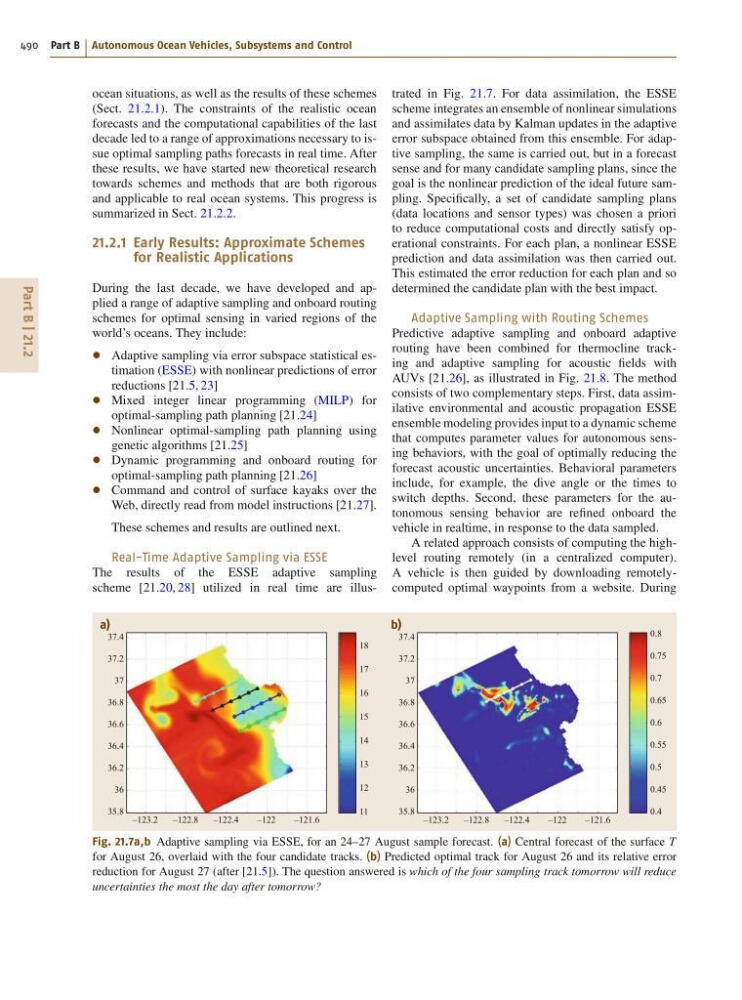
The results of the ESSE adaptive sampling
scheme [21.20, 28] utilized in real time are illus–123.2
–122.8
–122.4
–122
–121.6
a)
37.4
37.2
37
36.8
36.6
36.4
36.2
36
35.8
18
17
16
15
14
13
12
11
–123.2
–122.8
–122.4
–122
–121.6
b)
37.4
37.2
37
36.8
36.6
36.4
36.2
36
35.8
0.8
0.75
0.7
0.65
0.6
0.55
0.5
0.45
0.4
Fig. 21.7a,b Adaptive sampling via ESSE, for an 24–27 August sample forecast. (a) Central forecast of the surface T
for August 26, overlaid with the four candidate tracks. (b) Predicted optimal track for August 26 and its relative error
reduction for August 27 (after [21.5]). The question answered is which of the four sampling track tomorrow will reduce
uncertainties the most the day after tomorrow?
trated in Fig. 21.7. For data assimilation, the ESSE
scheme integrates an ensemble of nonlinear simulations
and assimilates data by Kalman updates in the adaptive
error subspace obtained from this ensemble. For adaptive sampling, the same is carried out, but in a forecast
sense and for many candidate sampling plans, since the
goal is the nonlinear prediction of the ideal future sampling. Specifically, a set of candidate sampling plans
(data locations and sensor types) was chosen a priori
to reduce computational costs and directly satisfy operational constraints. For each plan, a nonlinear ESSE
prediction and data assimilation was then carried out.
This estimated the error reduction for each plan and so
determined the candidate plan with the best impact.
Adaptive Sampling with Routing Schemes
Predictive adaptive sampling and onboard adaptive
routing have been combined for thermocline tracking and adaptive sampling for acoustic fields with
AUVs [21.26], as illustrated in Fig. 21.8. The method
consists of two complementary steps. First, data assimilative environmental and acoustic propagation ESSE
ensemble modeling provides input to a dynamic scheme
that computes parameter values for autonomous sensing behaviors, with the goal of optimally reducing the
forecast acoustic uncertainties. Behavioral parameters
include, for example, the dive angle or the times to
switch depths. Second, these parameters for the autonomous sensing behavior are refined onboard the
vehicle in realtime, in response to the data sampled.
A related approach consists of computing the highlevel routing remotely (in a centralized computer).
A vehicle is then guided by downloading remotelycomputed optimal waypoints from a website. During
490 Part B Autonomous Ocean Vehicles, Subsystems and Control
ocean situations, as well as the results of these schemes
(Sect. 21.2.1). The constraints of the realistic ocean
forecasts and the computational capabilities of the last
decade led to a range of approximations necessary to issue optimal sampling paths forecasts in real time. After
these results, we have started new theoretical research
towards schemes and methods that are both rigorous
and applicable to real ocean systems. This progress is
summarized in Sect. 21.2.2.
21.2.1 Early Results: Approximate Schemes
for Realistic Applications
During the last decade, we have developed and applied a range of adaptive sampling and onboard routing
schemes for optimal sensing in varied regions of the
world’s oceans. They include:
Adaptive sampling via error subspace statistical estimation (ESSE) with nonlinear predictions of error
reductions [21.5, 23]
Mixed integer linear programming (MILP) for
optimal-sampling path planning [21.24]
Nonlinear optimal-sampling path planning using
genetic algorithms [21.25]
Dynamic programming and onboard routing for
optimal-sampling path planning [21.26]
Command and control of surface kayaks over the
Web, directly read from model instructions [21.27].
These schemes and results are outlined next.
Real-Time Adaptive Sampling via ESSE
The results of the ESSE adaptive sampling
scheme [21.20, 28] utilized in real time are illus–123.2
–122.8
–122.4
–122
–121.6
a)
37.4
37.2
37
36.8
36.6
36.4
36.2
36
35.8
18
17
16
15
14
13
12
11
–123.2
–122.8
–122.4
–122
–121.6
b)
37.4
37.2
37
36.8
36.6
36.4
36.2
36
35.8
0.8
0.75
0.7
0.65
0.6
0.55
0.5
0.45
0.4
Fig. 21.7a,b Adaptive sampling via ESSE, for an 24–27 August sample forecast. (a) Central forecast of the surface T
for August 26, overlaid with the four candidate tracks. (b) Predicted optimal track for August 26 and its relative error
reduction for August 27 (after [21.5]). The question answered is which of the four sampling track tomorrow will reduce
uncertainties the most the day after tomorrow?
trated in Fig. 21.7. For data assimilation, the ESSE
scheme integrates an ensemble of nonlinear simulations
and assimilates data by Kalman updates in the adaptive
error subspace obtained from this ensemble. For adaptive sampling, the same is carried out, but in a forecast
sense and for many candidate sampling plans, since the
goal is the nonlinear prediction of the ideal future sampling. Specifically, a set of candidate sampling plans
(data locations and sensor types) was chosen a priori
to reduce computational costs and directly satisfy operational constraints. For each plan, a nonlinear ESSE
prediction and data assimilation was then carried out.
This estimated the error reduction for each plan and so
determined the candidate plan with the best impact.
Adaptive Sampling with Routing Schemes
Predictive adaptive sampling and onboard adaptive
routing have been combined for thermocline tracking and adaptive sampling for acoustic fields with
AUVs [21.26], as illustrated in Fig. 21.8. The method
consists of two complementary steps. First, data assimilative environmental and acoustic propagation ESSE
ensemble modeling provides input to a dynamic scheme
that computes parameter values for autonomous sensing behaviors, with the goal of optimally reducing the
forecast acoustic uncertainties. Behavioral parameters
include, for example, the dive angle or the times to
switch depths. Second, these parameters for the autonomous sensing behavior are refined onboard the
vehicle in realtime, in response to the data sampled.
A related approach consists of computing the highlevel routing remotely (in a centralized computer).
A vehicle is then guided by downloading remotelycomputed optimal waypoints from a website. During