

Part B | 20.6
476 Part B Autonomous Ocean Vehicles, Subsystems and Control
t413:k=33/rank=4
t70:k=176/rank=2
t122:k=153/rank=3
t368:k=55
t12:k=80
t97:k=17
t288:k=9
t304:k=81
t26:k=97
t197:k=5
t134:k=4
t123:k=95
t199:k=33
t31:k=61
t289:k=32
t7:k=4
t128:k=31
demus
har/bens
t52:k=46
t344:k=49
t307:k=14
t258:k=20
t292:k=38
t320:k=28
t349:k=30
t288:k=5
t284:k=8
t58:k=86
t25:k=76
t205:k=14
t11:k=231/rank=1
leo/er
t196:k=5
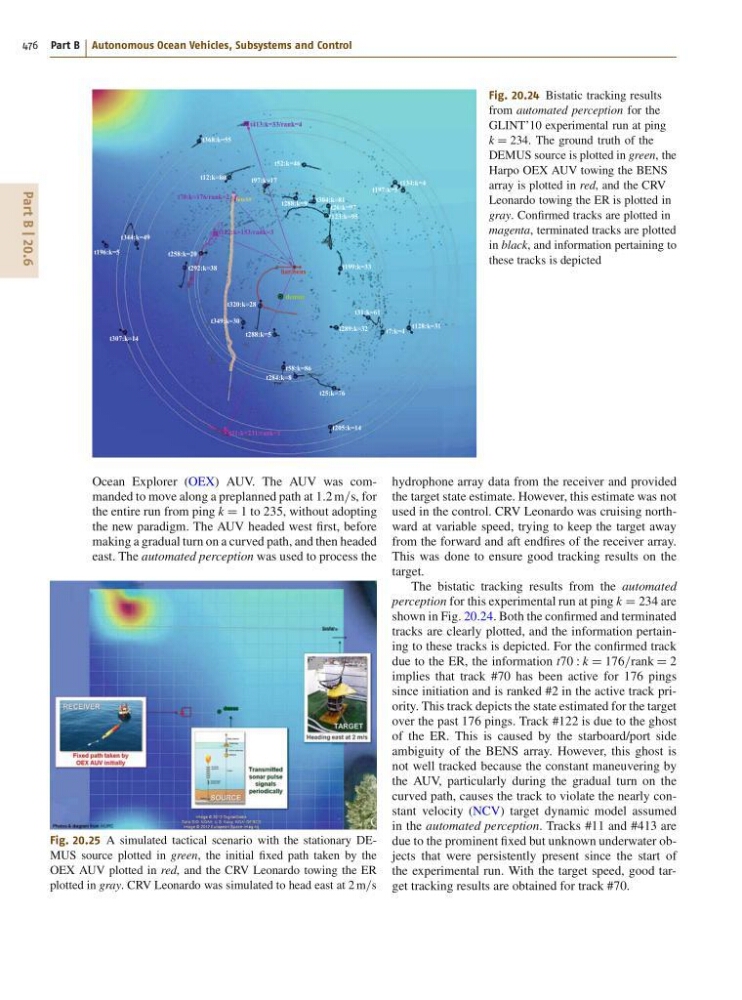
Fig. 20.24 Bistatic tracking results
from automated perception for the
GLINT’10 experimental run at ping
k D 234. The ground truth of the
DEMUS source is plotted in green, the
Harpo OEX AUV towing the BENS
array is plotted in red, and the CRV
Leonardo towing the ER is plotted in
gray. Confirmed tracks are plotted in
magenta, terminated tracks are plotted
in black, and information pertaining to
these tracks is depicted
Ocean Explorer (OEX) AUV. The AUV was commanded to move along a preplanned path at 1:2 m=s, for
the entire run from ping k D 1 to 235, without adopting
the new paradigm. The AUV headed west first, before
making a gradual turn on a curved path, and then headed
east. The automated perception was used to process the
Fig. 20.25 A simulated tactical scenario with the stationary DEMUS source plotted in green, the initial fixed path taken by the
OEX AUV plotted in red, and the CRV Leonardo towing the ER
plotted in gray. CRV Leonardo was simulated to head east at 2 m=s
hydrophone array data from the receiver and provided
the target state estimate. However, this estimate was not
used in the control. CRV Leonardo was cruising northward at variable speed, trying to keep the target away
from the forward and aft endfires of the receiver array.
This was done to ensure good tracking results on the
target.
The bistatic tracking results from the automated
perception for this experimental run at ping k D 234 are
shown in Fig. 20.24. Both the confirmed and terminated
tracks are clearly plotted, and the information pertaining to these tracks is depicted. For the confirmed track
due to the ER, the information t70 W k D 176=rank D 2
implies that track #70 has been active for 176 pings
since initiation and is ranked #2 in the active track priority. This track depicts the state estimated for the target
over the past 176 pings. Track #122 is due to the ghost
of the ER. This is caused by the starboard/port side
ambiguity of the BENS array. However, this ghost is
not well tracked because the constant maneuvering by
the AUV, particularly during the gradual turn on the
curved path, causes the track to violate the nearly constant velocity (NCV) target dynamic model assumed
in the automated perception. Tracks #11 and #413 are
due to the prominent fixed but unknown underwater objects that were persistently present since the start of
the experimental run. With the target speed, good target tracking results are obtained for track #70.
476 Part B Autonomous Ocean Vehicles, Subsystems and Control
t413:k=33/rank=4
t70:k=176/rank=2
t122:k=153/rank=3
t368:k=55
t12:k=80
t97:k=17
t288:k=9
t304:k=81
t26:k=97
t197:k=5
t134:k=4
t123:k=95
t199:k=33
t31:k=61
t289:k=32
t7:k=4
t128:k=31
demus
har/bens
t52:k=46
t344:k=49
t307:k=14
t258:k=20
t292:k=38
t320:k=28
t349:k=30
t288:k=5
t284:k=8
t58:k=86
t25:k=76
t205:k=14
t11:k=231/rank=1
leo/er
t196:k=5
Fig. 20.24 Bistatic tracking results
from automated perception for the
GLINT’10 experimental run at ping
k D 234. The ground truth of the
DEMUS source is plotted in green, the
Harpo OEX AUV towing the BENS
array is plotted in red, and the CRV
Leonardo towing the ER is plotted in
gray. Confirmed tracks are plotted in
magenta, terminated tracks are plotted
in black, and information pertaining to
these tracks is depicted
Ocean Explorer (OEX) AUV. The AUV was commanded to move along a preplanned path at 1:2 m=s, for
the entire run from ping k D 1 to 235, without adopting
the new paradigm. The AUV headed west first, before
making a gradual turn on a curved path, and then headed
east. The automated perception was used to process the
Fig. 20.25 A simulated tactical scenario with the stationary DEMUS source plotted in green, the initial fixed path taken by the
OEX AUV plotted in red, and the CRV Leonardo towing the ER
plotted in gray. CRV Leonardo was simulated to head east at 2 m=s
hydrophone array data from the receiver and provided
the target state estimate. However, this estimate was not
used in the control. CRV Leonardo was cruising northward at variable speed, trying to keep the target away
from the forward and aft endfires of the receiver array.
This was done to ensure good tracking results on the
target.
The bistatic tracking results from the automated
perception for this experimental run at ping k D 234 are
shown in Fig. 20.24. Both the confirmed and terminated
tracks are clearly plotted, and the information pertaining to these tracks is depicted. For the confirmed track
due to the ER, the information t70 W k D 176=rank D 2
implies that track #70 has been active for 176 pings
since initiation and is ranked #2 in the active track priority. This track depicts the state estimated for the target
over the past 176 pings. Track #122 is due to the ghost
of the ER. This is caused by the starboard/port side
ambiguity of the BENS array. However, this ghost is
not well tracked because the constant maneuvering by
the AUV, particularly during the gradual turn on the
curved path, causes the track to violate the nearly constant velocity (NCV) target dynamic model assumed
in the automated perception. Tracks #11 and #413 are
due to the prominent fixed but unknown underwater objects that were persistently present since the start of
the experimental run. With the target speed, good target tracking results are obtained for track #70.