

Nested Autonomy for Distributed Ocean Sensing 20.6 Application Examples 477
Part B | 20.6
a) k = 75
b) k = 275
c) k = 385
d) k = 475
e) k = 575
t251:k=5/rank=3
t611:k=8/rank=7
t599:k=11/rank=5
t591:k=12/rank=3
t27:k=173/rank=1
t130:k=141/rank=2
t612:k=8/rank=8
t1701:k=8/rank=5
t27:k=473/rank=1
t1506:k=51/rank=2
t600:k=11/rank=6
t252:k=5/rank=4
t27:k=73/rank=1
demus
demus
oex/bens
oex/bens
demus
oex/bens
t1029:k=9/rank=3
t1130:k=241/rank=2
t27:k=273/rank=1
t1030:k=9/rank=4
demus
oex/bens
t27:k=573/rank=1
t1988:k=6/rank=3
t1506:k=151/rank=2
demus
oex/bens
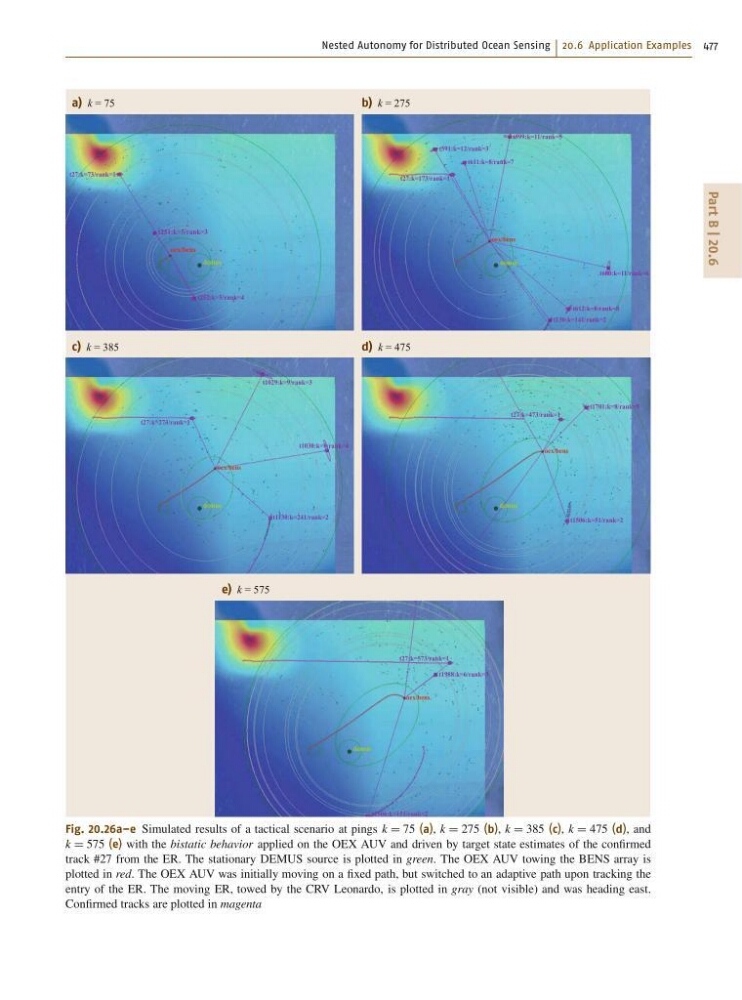
Fig. 20.26a–e Simulated results of a tactical scenario at pings k D 75 (a), k D 275 (b), k D 385 (c), k D 475 (d), and
k D 575 (e) with the bistatic behavior applied on the OEX AUV and driven by target state estimates of the confirmed
track #27 from the ER. The stationary DEMUS source is plotted in green. The OEX AUV towing the BENS array is
plotted in red. The OEX AUV was initially moving on a fixed path, but switched to an adaptive path upon tracking the
entry of the ER. The moving ER, towed by the CRV Leonardo, is plotted in gray (not visible) and was heading east.
Confirmed tracks are plotted in magenta
Part B | 20.6
a) k = 75
b) k = 275
c) k = 385
d) k = 475
e) k = 575
t251:k=5/rank=3
t611:k=8/rank=7
t599:k=11/rank=5
t591:k=12/rank=3
t27:k=173/rank=1
t130:k=141/rank=2
t612:k=8/rank=8
t1701:k=8/rank=5
t27:k=473/rank=1
t1506:k=51/rank=2
t600:k=11/rank=6
t252:k=5/rank=4
t27:k=73/rank=1
demus
demus
oex/bens
oex/bens
demus
oex/bens
t1029:k=9/rank=3
t1130:k=241/rank=2
t27:k=273/rank=1
t1030:k=9/rank=4
demus
oex/bens
t27:k=573/rank=1
t1988:k=6/rank=3
t1506:k=151/rank=2
demus
oex/bens
Fig. 20.26a–e Simulated results of a tactical scenario at pings k D 75 (a), k D 275 (b), k D 385 (c), k D 475 (d), and
k D 575 (e) with the bistatic behavior applied on the OEX AUV and driven by target state estimates of the confirmed
track #27 from the ER. The stationary DEMUS source is plotted in green. The OEX AUV towing the BENS array is
plotted in red. The OEX AUV was initially moving on a fixed path, but switched to an adaptive path upon tracking the
entry of the ER. The moving ER, towed by the CRV Leonardo, is plotted in gray (not visible) and was heading east.
Confirmed tracks are plotted in magenta