

Part B | 20.6
474 Part B Autonomous Ocean Vehicles, Subsystems and Control
chain was also deployed for the duration of the experiment.
In examining the resulting AUV and thermistor
data sets from this experiment, there is strong evidence of internal wave propagation along the thermocline near the buoyancy frequency of the thermocline
interface (N max D 0:05747 rad=s). Internal waves with
nearly identical and lower frequencies were seen in
the Unicorn, Harpo, and thermistor data collected near
the thermocline depth. The 12 m depth AUV and
11 m depth thermistor results suggest the presence of
buoyancy-supported internal waves along the thermocline (about 11 m depth) in the AUV operation region
throughout the day on August 13, 2010. This conclusion
may also be extrapolated to say that internal waves are
likely detectable along the thermocline throughout the
rest of the Tuscan Archipelago basin during the summer, when the thermocline is fairly well defined. Given
the lack of previous literature regarding internal waves
in the Tuscan Archipelago basin, this finding is rather
significant to the scientific groups that conduct acoustic (and other) experiments in this region. See [20.9]
for more detailed results and analysis from the internal
wave detection experiment.
Overall, this experiment was novel in its use of multiple AUVs collaborating autonomously with each other
and autonomously collecting environmentally adaptive
data sets for more synoptic spatiotemporal data coverage. Not only does this increase the efficiency of data
collection (environmentally-adaptive autonomy behaviors allow us to collect the exact data set we need
without a human in the loop), but it also gives us the
ability to collect the specific data set a scientist is interested in by using AUVs running autonomy. The use of
intelligent acoustic communication networking also allows the AUV operators and scientists to monitor (from
the topside on a ship or shore) the data collected in
near real time. These abilities are invaluable when ship
time for data collection is so expensive, and we hope
that such improvements in AUV autonomy, adaptive
environmental sampling techniques, and acoustic communications will allow us to further reduce necessary
ship time for scientists and engineers to collect the specific data sets they need in the future.
20.6.3 Bistatic Target Tracking (GLINT’10)
As part of the GLINT experiment program and associated research, the nested autonomy paradigm was
extended to the bistatic tracking of underwater targets.
The concept of this application can be illustrated by the
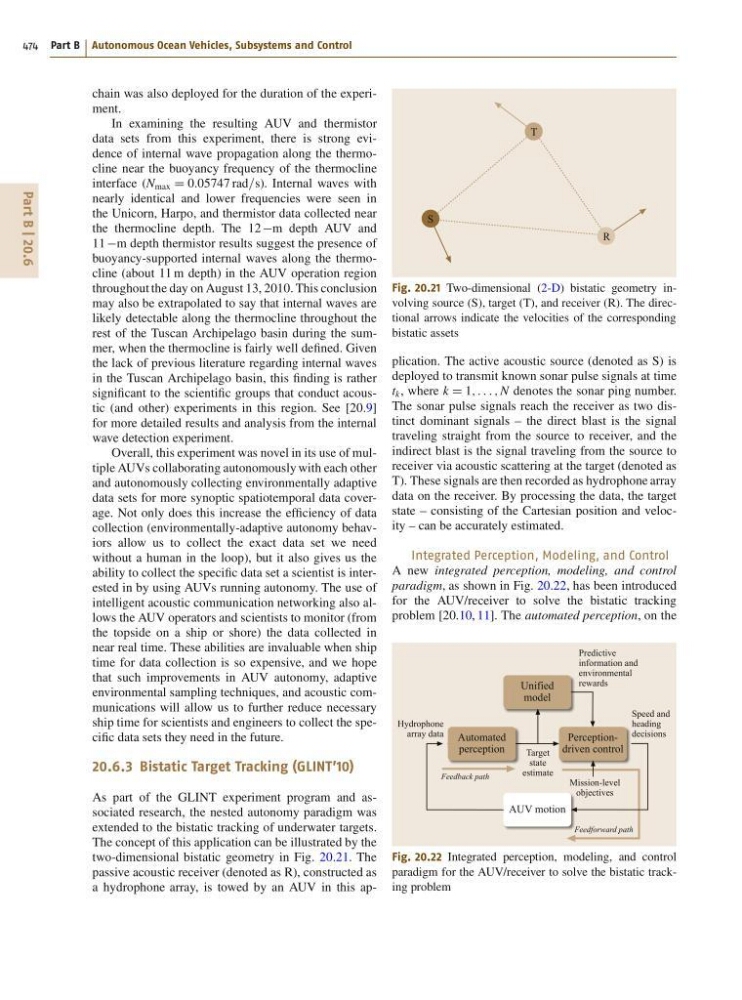
two-dimensional bistatic geometry in Fig. 20.21. The
passive acoustic receiver (denoted as R), constructed as
a hydrophone array, is towed by an AUV in this apT
S
R
Fig. 20.21 Two-dimensional (2-D) bistatic geometry involving source (S), target (T), and receiver (R). The directional arrows indicate the velocities of the corresponding
bistatic assets
plication. The active acoustic source (denoted as S) is
deployed to transmit known sonar pulse signals at time
t k , where k D 1; : : : ; N denotes the sonar ping number.
The sonar pulse signals reach the receiver as two distinct dominant signals – the direct blast is the signal
traveling straight from the source to receiver, and the
indirect blast is the signal traveling from the source to
receiver via acoustic scattering at the target (denoted as
T). These signals are then recorded as hydrophone array
data on the receiver. By processing the data, the target
state – consisting of the Cartesian position and velocity – can be accurately estimated.
Integrated Perception, Modeling, and Control
A new integrated perception, modeling, and control
paradigm, as shown in Fig. 20.22, has been introduced
for the AUV/receiver to solve the bistatic tracking
problem [20.10, 11]. The automated perception, on the
AUV motion
Unified
model
Automated
perception
Perceptiondriven control
Predictive
information and
environmental
rewards
Target
state
estimate
Feedback path
Feedforward path
Mission-level
objectives
Speed and
heading
decisions
Hydrophone
array data
Fig. 20.22 Integrated perception, modeling, and control
paradigm for the AUV/receiver to solve the bistatic tracking problem
474 Part B Autonomous Ocean Vehicles, Subsystems and Control
chain was also deployed for the duration of the experiment.
In examining the resulting AUV and thermistor
data sets from this experiment, there is strong evidence of internal wave propagation along the thermocline near the buoyancy frequency of the thermocline
interface (N max D 0:05747 rad=s). Internal waves with
nearly identical and lower frequencies were seen in
the Unicorn, Harpo, and thermistor data collected near
the thermocline depth. The 12 m depth AUV and
11 m depth thermistor results suggest the presence of
buoyancy-supported internal waves along the thermocline (about 11 m depth) in the AUV operation region
throughout the day on August 13, 2010. This conclusion
may also be extrapolated to say that internal waves are
likely detectable along the thermocline throughout the
rest of the Tuscan Archipelago basin during the summer, when the thermocline is fairly well defined. Given
the lack of previous literature regarding internal waves
in the Tuscan Archipelago basin, this finding is rather
significant to the scientific groups that conduct acoustic (and other) experiments in this region. See [20.9]
for more detailed results and analysis from the internal
wave detection experiment.
Overall, this experiment was novel in its use of multiple AUVs collaborating autonomously with each other
and autonomously collecting environmentally adaptive
data sets for more synoptic spatiotemporal data coverage. Not only does this increase the efficiency of data
collection (environmentally-adaptive autonomy behaviors allow us to collect the exact data set we need
without a human in the loop), but it also gives us the
ability to collect the specific data set a scientist is interested in by using AUVs running autonomy. The use of
intelligent acoustic communication networking also allows the AUV operators and scientists to monitor (from
the topside on a ship or shore) the data collected in
near real time. These abilities are invaluable when ship
time for data collection is so expensive, and we hope
that such improvements in AUV autonomy, adaptive
environmental sampling techniques, and acoustic communications will allow us to further reduce necessary
ship time for scientists and engineers to collect the specific data sets they need in the future.
20.6.3 Bistatic Target Tracking (GLINT’10)
As part of the GLINT experiment program and associated research, the nested autonomy paradigm was
extended to the bistatic tracking of underwater targets.
The concept of this application can be illustrated by the
two-dimensional bistatic geometry in Fig. 20.21. The
passive acoustic receiver (denoted as R), constructed as
a hydrophone array, is towed by an AUV in this apT
S
R
Fig. 20.21 Two-dimensional (2-D) bistatic geometry involving source (S), target (T), and receiver (R). The directional arrows indicate the velocities of the corresponding
bistatic assets
plication. The active acoustic source (denoted as S) is
deployed to transmit known sonar pulse signals at time
t k , where k D 1; : : : ; N denotes the sonar ping number.
The sonar pulse signals reach the receiver as two distinct dominant signals – the direct blast is the signal
traveling straight from the source to receiver, and the
indirect blast is the signal traveling from the source to
receiver via acoustic scattering at the target (denoted as
T). These signals are then recorded as hydrophone array
data on the receiver. By processing the data, the target
state – consisting of the Cartesian position and velocity – can be accurately estimated.
Integrated Perception, Modeling, and Control
A new integrated perception, modeling, and control
paradigm, as shown in Fig. 20.22, has been introduced
for the AUV/receiver to solve the bistatic tracking
problem [20.10, 11]. The automated perception, on the
AUV motion
Unified
model
Automated
perception
Perceptiondriven control
Predictive
information and
environmental
rewards
Target
state
estimate
Feedback path
Feedforward path
Mission-level
objectives
Speed and
heading
decisions
Hydrophone
array data
Fig. 20.22 Integrated perception, modeling, and control
paradigm for the AUV/receiver to solve the bistatic tracking problem