

Nested Autonomy for Distributed Ocean Sensing 20.6 Application Examples 473
Part B | 20.6
The average thermocline depth range was calculated as
about 1629 m (dashed lines, Fig. 20.18a,b) in postprocessing, with the total average temperature gradient
(T=z/ tot_avg of 0:168
ı C=m set as the threshold value
for bounding the thermocline range (solid vertical line,
Fig. 20.18b). A gradient greater in magnitude than this
average value’s magnitude is determined to be within
the depth range of the thermocline. When comparing the thermocline ranges determined by inspection
of the AUV’s actions in real time versus those calculated in postprocessing (dashed lines, Figs. 20.17a,b
and 20.18a,b, respectively), it is apparent that they
are very similar (within a couple of meters), verifying the effectiveness of the real time calculations and
adaptation.
In this experiment, the muddy lake bottom at an
imprecisely known depth posed a risk to the recovery
of the AUV, thus we could not let it dive deeper than
about 35 m. This directly bounded the range of depths
over which we could collect temperature data, which
affected the threshold value used to bound the thermocline. Thus, it is likely that we did not capture the full
range of the thermocline during the mission. However,
since the thermocline range was determined by pEnvtGrad to extend down to 30 m in the real-time data (for
safety the maximum thermocline depth was bounded at
30 m from the initial yo–yo settings), this demonstrates
the ability of the AUV to detect the majority of the
sampled thermocline range with pEnvtGrad algorithms
even in cases where data are unavailable over part of
water column.
Thermocline Tracking for Internal Wave
Detection (GLINT’10)
On August 13, 2010, MIT and NURC conducted the
internal wave detection experiment (a single-day exFig. 20.19 The region of the Tyrrhenian Sea bounded by
the western coast of Italy and the islands of the Tuscan
Archipelago. The Tuscan Archipelago basin is outlined by
the dashed line. The GLINT’10 AUV operation region is
delineated by the box. The numbering shows the five inlets
of the basin (after [20.9], courtesy of Petillo and Schmidt)
periment in the larger GLINT’10 experiment) in the
northern coastal basin of the Tyrrhenian Sea bordered
by the Tuscan Archipelago and the western coast of
Italy (Fig. 20.19). This experiment aimed to use nested
autonomy and multiple AUVs to detect the presence
of internal waves (or lack thereof) in this region of the
Tyrrhenian Sea.
This experiment took a novel approach to internal
wave detection by tasking two collaborating AUVs to
autonomously adapt their motion in relation to each
other and to their dynamic environment, resulting in
a greater efficiency of sampling given a restrictive mission duration and in collection of fully synoptic data
sets capturing internal waves.
The internal wave detection experiment involved
two AUVs running the MOOS autonomy system guided
by the IvP-Helm. These AUVs used acoustic communication during the experiment to send and receive
real-time data and status updates, which they used
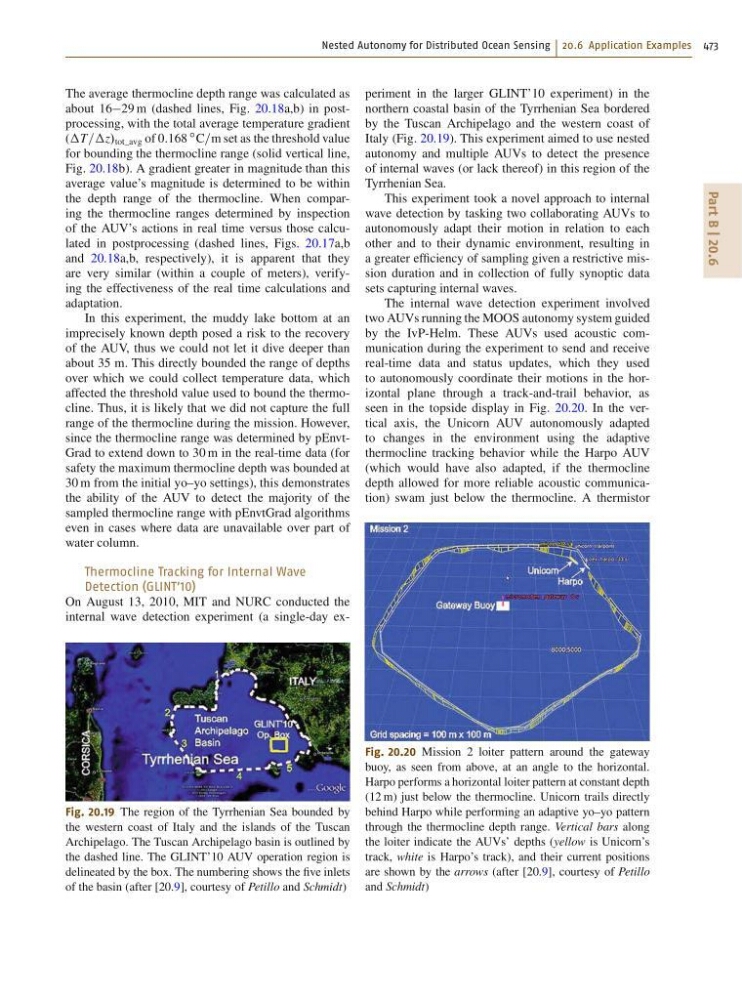
to autonomously coordinate their motions in the horizontal plane through a track-and-trail behavior, as
seen in the topside display in Fig. 20.20. In the vertical axis, the Unicorn AUV autonomously adapted
to changes in the environment using the adaptive
thermocline tracking behavior while the Harpo AUV
(which would have also adapted, if the thermocline
depth allowed for more reliable acoustic communication) swam just below the thermocline. A thermistor
Fig. 20.20 Mission 2 loiter pattern around the gateway
buoy, as seen from above, at an angle to the horizontal.
Harpo performs a horizontal loiter pattern at constant depth
(12 m) just below the thermocline. Unicorn trails directly
behind Harpo while performing an adaptive yo–yo pattern
through the thermocline depth range. Vertical bars along
the loiter indicate the AUVs’ depths (yellow is Unicorn’s
track, white is Harpo’s track), and their current positions
are shown by the arrows (after [20.9], courtesy of Petillo
and Schmidt)
Part B | 20.6
The average thermocline depth range was calculated as
about 1629 m (dashed lines, Fig. 20.18a,b) in postprocessing, with the total average temperature gradient
(T=z/ tot_avg of 0:168
ı C=m set as the threshold value
for bounding the thermocline range (solid vertical line,
Fig. 20.18b). A gradient greater in magnitude than this
average value’s magnitude is determined to be within
the depth range of the thermocline. When comparing the thermocline ranges determined by inspection
of the AUV’s actions in real time versus those calculated in postprocessing (dashed lines, Figs. 20.17a,b
and 20.18a,b, respectively), it is apparent that they
are very similar (within a couple of meters), verifying the effectiveness of the real time calculations and
adaptation.
In this experiment, the muddy lake bottom at an
imprecisely known depth posed a risk to the recovery
of the AUV, thus we could not let it dive deeper than
about 35 m. This directly bounded the range of depths
over which we could collect temperature data, which
affected the threshold value used to bound the thermocline. Thus, it is likely that we did not capture the full
range of the thermocline during the mission. However,
since the thermocline range was determined by pEnvtGrad to extend down to 30 m in the real-time data (for
safety the maximum thermocline depth was bounded at
30 m from the initial yo–yo settings), this demonstrates
the ability of the AUV to detect the majority of the
sampled thermocline range with pEnvtGrad algorithms
even in cases where data are unavailable over part of
water column.
Thermocline Tracking for Internal Wave
Detection (GLINT’10)
On August 13, 2010, MIT and NURC conducted the
internal wave detection experiment (a single-day exFig. 20.19 The region of the Tyrrhenian Sea bounded by
the western coast of Italy and the islands of the Tuscan
Archipelago. The Tuscan Archipelago basin is outlined by
the dashed line. The GLINT’10 AUV operation region is
delineated by the box. The numbering shows the five inlets
of the basin (after [20.9], courtesy of Petillo and Schmidt)
periment in the larger GLINT’10 experiment) in the
northern coastal basin of the Tyrrhenian Sea bordered
by the Tuscan Archipelago and the western coast of
Italy (Fig. 20.19). This experiment aimed to use nested
autonomy and multiple AUVs to detect the presence
of internal waves (or lack thereof) in this region of the
Tyrrhenian Sea.
This experiment took a novel approach to internal
wave detection by tasking two collaborating AUVs to
autonomously adapt their motion in relation to each
other and to their dynamic environment, resulting in
a greater efficiency of sampling given a restrictive mission duration and in collection of fully synoptic data
sets capturing internal waves.
The internal wave detection experiment involved
two AUVs running the MOOS autonomy system guided
by the IvP-Helm. These AUVs used acoustic communication during the experiment to send and receive
real-time data and status updates, which they used
to autonomously coordinate their motions in the horizontal plane through a track-and-trail behavior, as
seen in the topside display in Fig. 20.20. In the vertical axis, the Unicorn AUV autonomously adapted
to changes in the environment using the adaptive
thermocline tracking behavior while the Harpo AUV
(which would have also adapted, if the thermocline
depth allowed for more reliable acoustic communication) swam just below the thermocline. A thermistor
Fig. 20.20 Mission 2 loiter pattern around the gateway
buoy, as seen from above, at an angle to the horizontal.
Harpo performs a horizontal loiter pattern at constant depth
(12 m) just below the thermocline. Unicorn trails directly
behind Harpo while performing an adaptive yo–yo pattern
through the thermocline depth range. Vertical bars along
the loiter indicate the AUVs’ depths (yellow is Unicorn’s
track, white is Harpo’s track), and their current positions
are shown by the arrows (after [20.9], courtesy of Petillo
and Schmidt)