

Nested Autonomy for Distributed Ocean Sensing 20.6 Application Examples 469
Part B | 20.6
MOOS DB
MOOS DB
Alliance μModem
Alliance
topside
Leonardo
topside
Acoustic comms
80–5400 bps @ 25 kHz
Modem on a rope
MOR
Shore lab
topside
RF
50 kbps @ 2.4 GHz
Wireless ethernet (HyperLan)
Gateway
buoy
Kayaks
BF21
OEX
MOR μModem
Leonardo
μModem
IVERs
FOLAGA
REMUS
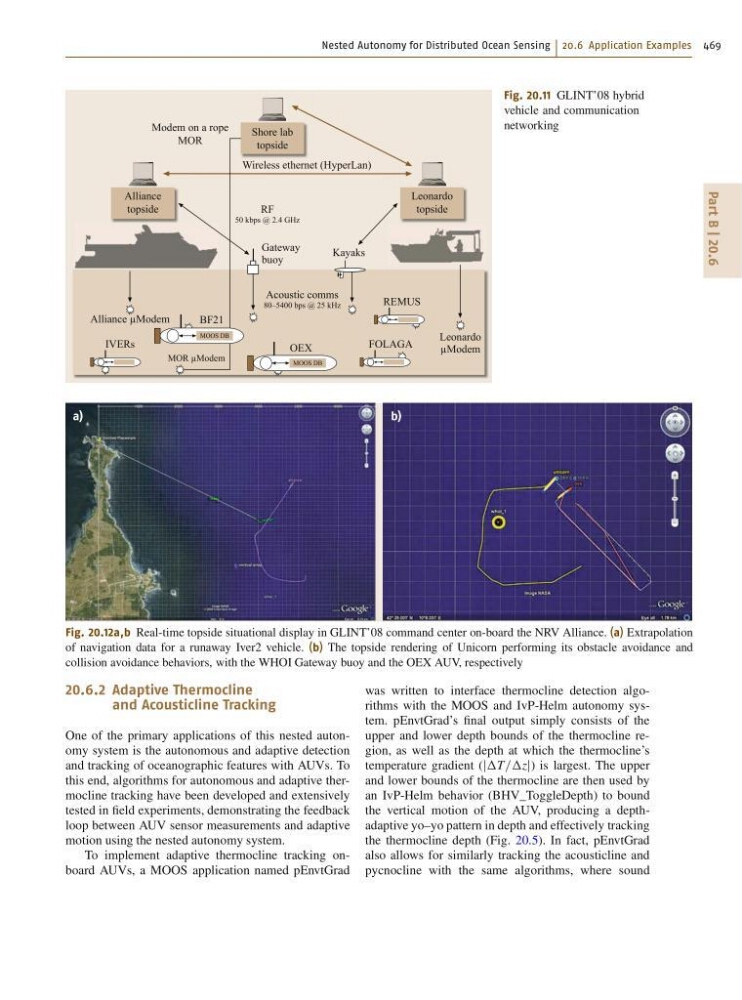
Fig. 20.11 GLINT’08 hybrid
vehicle and communication
networking
a)
b)
Fig. 20.12a,b Real-time topside situational display in GLINT’08 command center on-board the NRV Alliance. (a) Extrapolation
of navigation data for a runaway Iver2 vehicle. (b) The topside rendering of Unicorn performing its obstacle avoidance and
collision avoidance behaviors, with the WHOI Gateway buoy and the OEX AUV, respectively
20.6.2 Adaptive Thermocline
and Acousticline Tracking
One of the primary applications of this nested autonomy system is the autonomous and adaptive detection
and tracking of oceanographic features with AUVs. To
this end, algorithms for autonomous and adaptive thermocline tracking have been developed and extensively
tested in field experiments, demonstrating the feedback
loop between AUV sensor measurements and adaptive
motion using the nested autonomy system.
To implement adaptive thermocline tracking onboard AUVs, a MOOS application named pEnvtGrad
was written to interface thermocline detection algorithms with the MOOS and IvP-Helm autonomy system. pEnvtGrad’s final output simply consists of the
upper and lower depth bounds of the thermocline region, as well as the depth at which the thermocline’s
temperature gradient (jT=zj) is largest. The upper
and lower bounds of the thermocline are then used by
an IvP-Helm behavior (BHV_ToggleDepth) to bound
the vertical motion of the AUV, producing a depthadaptive yo–yo pattern in depth and effectively tracking
the thermocline depth (Fig. 20.5). In fact, pEnvtGrad
also allows for similarly tracking the acousticline and
pycnocline with the same algorithms, where sound
Part B | 20.6
MOOS DB
MOOS DB
Alliance μModem
Alliance
topside
Leonardo
topside
Acoustic comms
80–5400 bps @ 25 kHz
Modem on a rope
MOR
Shore lab
topside
RF
50 kbps @ 2.4 GHz
Wireless ethernet (HyperLan)
Gateway
buoy
Kayaks
BF21
OEX
MOR μModem
Leonardo
μModem
IVERs
FOLAGA
REMUS
Fig. 20.11 GLINT’08 hybrid
vehicle and communication
networking
a)
b)
Fig. 20.12a,b Real-time topside situational display in GLINT’08 command center on-board the NRV Alliance. (a) Extrapolation
of navigation data for a runaway Iver2 vehicle. (b) The topside rendering of Unicorn performing its obstacle avoidance and
collision avoidance behaviors, with the WHOI Gateway buoy and the OEX AUV, respectively
20.6.2 Adaptive Thermocline
and Acousticline Tracking
One of the primary applications of this nested autonomy system is the autonomous and adaptive detection
and tracking of oceanographic features with AUVs. To
this end, algorithms for autonomous and adaptive thermocline tracking have been developed and extensively
tested in field experiments, demonstrating the feedback
loop between AUV sensor measurements and adaptive
motion using the nested autonomy system.
To implement adaptive thermocline tracking onboard AUVs, a MOOS application named pEnvtGrad
was written to interface thermocline detection algorithms with the MOOS and IvP-Helm autonomy system. pEnvtGrad’s final output simply consists of the
upper and lower depth bounds of the thermocline region, as well as the depth at which the thermocline’s
temperature gradient (jT=zj) is largest. The upper
and lower bounds of the thermocline are then used by
an IvP-Helm behavior (BHV_ToggleDepth) to bound
the vertical motion of the AUV, producing a depthadaptive yo–yo pattern in depth and effectively tracking
the thermocline depth (Fig. 20.5). In fact, pEnvtGrad
also allows for similarly tracking the acousticline and
pycnocline with the same algorithms, where sound