

Nested Autonomy for Distributed Ocean Sensing 20.2 Concept of Operations (CONOPS) 461
Part B | 20.2
Field control
modeling
mission control
Operator
Collaboration
Information
Adaptive control
Radio link
10 KBytes (/30 min)
100 MBytes/s
ACOMMS
Ethernet
Sensor
process
Sensor
process
Autonomy
Sensor
process
Environ
sensor
Nav
sensor
Actuation
Artifact
sensor
100 Bytes (/1 min)
Clusters
collaboration
convergence
Hardware
sensors
actuators
Nodes
modeling
sensor processing
navigation
autonomy
actuation/control
Cluster
Cluster
Cluster
Platform
Platform
Platform
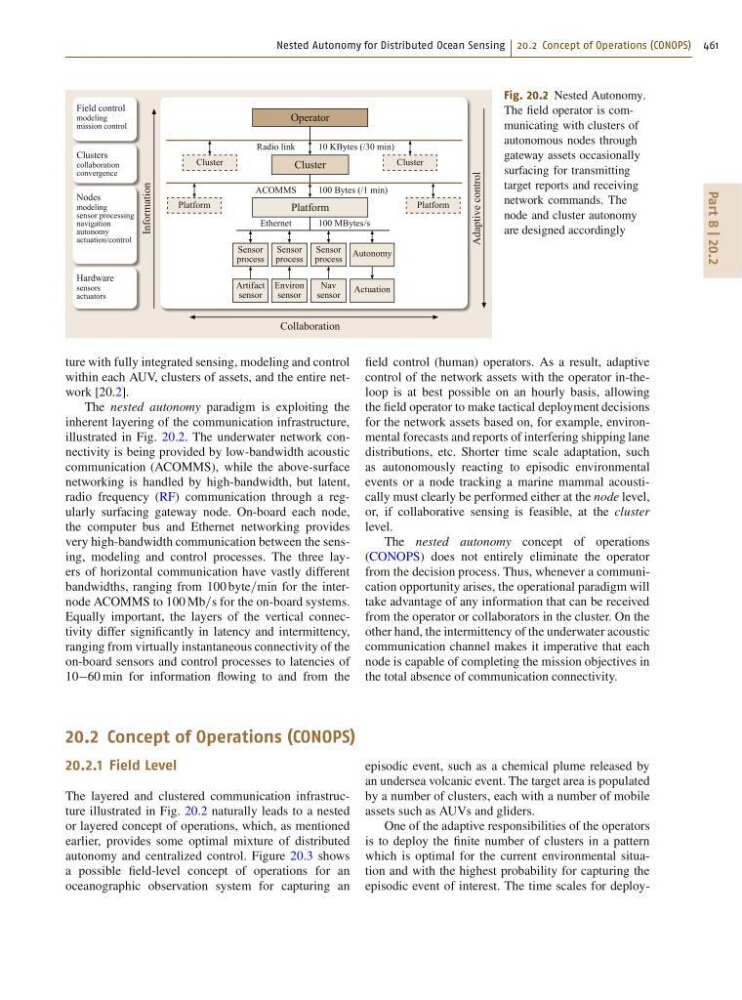
Fig. 20.2 Nested Autonomy.
The field operator is communicating with clusters of
autonomous nodes through
gateway assets occasionally
surfacing for transmitting
target reports and receiving
network commands. The
node and cluster autonomy
are designed accordingly
ture with fully integrated sensing, modeling and control
within each AUV, clusters of assets, and the entire network [20.2].
The nested autonomy paradigm is exploiting the
inherent layering of the communication infrastructure,
illustrated in Fig. 20.2. The underwater network connectivity is being provided by low-bandwidth acoustic
communication (ACOMMS), while the above-surface
networking is handled by high-bandwidth, but latent,
radio frequency (RF) communication through a regularly surfacing gateway node. On-board each node,
the computer bus and Ethernet networking provides
very high-bandwidth communication between the sensing, modeling and control processes. The three layers of horizontal communication have vastly different
bandwidths, ranging from 100 byte=min for the internode ACOMMS to 100 Mb=s for the on-board systems.
Equally important, the layers of the vertical connectivity differ significantly in latency and intermittency,
ranging from virtually instantaneous connectivity of the
on-board sensors and control processes to latencies of
1060 min for information flowing to and from the
field control (human) operators. As a result, adaptive
control of the network assets with the operator in-theloop is at best possible on an hourly basis, allowing
the field operator to make tactical deployment decisions
for the network assets based on, for example, environmental forecasts and reports of interfering shipping lane
distributions, etc. Shorter time scale adaptation, such
as autonomously reacting to episodic environmental
events or a node tracking a marine mammal acoustically must clearly be performed either at the node level,
or, if collaborative sensing is feasible, at the cluster
level.
The nested autonomy concept of operations
(CONOPS) does not entirely eliminate the operator
from the decision process. Thus, whenever a communication opportunity arises, the operational paradigm will
take advantage of any information that can be received
from the operator or collaborators in the cluster. On the
other hand, the intermittency of the underwater acoustic
communication channel makes it imperative that each
node is capable of completing the mission objectives in
the total absence of communication connectivity.
20.2 Concept of Operations (CONOPS)
20.2.1 Field Level
The layered and clustered communication infrastructure illustrated in Fig. 20.2 naturally leads to a nested
or layered concept of operations, which, as mentioned
earlier, provides some optimal mixture of distributed
autonomy and centralized control. Figure 20.3 shows
a possible field-level concept of operations for an
oceanographic observation system for capturing an
episodic event, such as a chemical plume released by
an undersea volcanic event. The target area is populated
by a number of clusters, each with a number of mobile
assets such as AUVs and gliders.
One of the adaptive responsibilities of the operators
is to deploy the finite number of clusters in a pattern
which is optimal for the current environmental situation and with the highest probability for capturing the
episodic event of interest. The time scales for deploy-
Part B | 20.2
Field control
modeling
mission control
Operator
Collaboration
Information
Adaptive control
Radio link
10 KBytes (/30 min)
100 MBytes/s
ACOMMS
Ethernet
Sensor
process
Sensor
process
Autonomy
Sensor
process
Environ
sensor
Nav
sensor
Actuation
Artifact
sensor
100 Bytes (/1 min)
Clusters
collaboration
convergence
Hardware
sensors
actuators
Nodes
modeling
sensor processing
navigation
autonomy
actuation/control
Cluster
Cluster
Cluster
Platform
Platform
Platform
Fig. 20.2 Nested Autonomy.
The field operator is communicating with clusters of
autonomous nodes through
gateway assets occasionally
surfacing for transmitting
target reports and receiving
network commands. The
node and cluster autonomy
are designed accordingly
ture with fully integrated sensing, modeling and control
within each AUV, clusters of assets, and the entire network [20.2].
The nested autonomy paradigm is exploiting the
inherent layering of the communication infrastructure,
illustrated in Fig. 20.2. The underwater network connectivity is being provided by low-bandwidth acoustic
communication (ACOMMS), while the above-surface
networking is handled by high-bandwidth, but latent,
radio frequency (RF) communication through a regularly surfacing gateway node. On-board each node,
the computer bus and Ethernet networking provides
very high-bandwidth communication between the sensing, modeling and control processes. The three layers of horizontal communication have vastly different
bandwidths, ranging from 100 byte=min for the internode ACOMMS to 100 Mb=s for the on-board systems.
Equally important, the layers of the vertical connectivity differ significantly in latency and intermittency,
ranging from virtually instantaneous connectivity of the
on-board sensors and control processes to latencies of
1060 min for information flowing to and from the
field control (human) operators. As a result, adaptive
control of the network assets with the operator in-theloop is at best possible on an hourly basis, allowing
the field operator to make tactical deployment decisions
for the network assets based on, for example, environmental forecasts and reports of interfering shipping lane
distributions, etc. Shorter time scale adaptation, such
as autonomously reacting to episodic environmental
events or a node tracking a marine mammal acoustically must clearly be performed either at the node level,
or, if collaborative sensing is feasible, at the cluster
level.
The nested autonomy concept of operations
(CONOPS) does not entirely eliminate the operator
from the decision process. Thus, whenever a communication opportunity arises, the operational paradigm will
take advantage of any information that can be received
from the operator or collaborators in the cluster. On the
other hand, the intermittency of the underwater acoustic
communication channel makes it imperative that each
node is capable of completing the mission objectives in
the total absence of communication connectivity.
20.2 Concept of Operations (CONOPS)
20.2.1 Field Level
The layered and clustered communication infrastructure illustrated in Fig. 20.2 naturally leads to a nested
or layered concept of operations, which, as mentioned
earlier, provides some optimal mixture of distributed
autonomy and centralized control. Figure 20.3 shows
a possible field-level concept of operations for an
oceanographic observation system for capturing an
episodic event, such as a chemical plume released by
an undersea volcanic event. The target area is populated
by a number of clusters, each with a number of mobile
assets such as AUVs and gliders.
One of the adaptive responsibilities of the operators
is to deploy the finite number of clusters in a pattern
which is optimal for the current environmental situation and with the highest probability for capturing the
episodic event of interest. The time scales for deploy-