

Part B | 17.6
416 Part B Autonomous Ocean Vehicles, Subsystems and Control
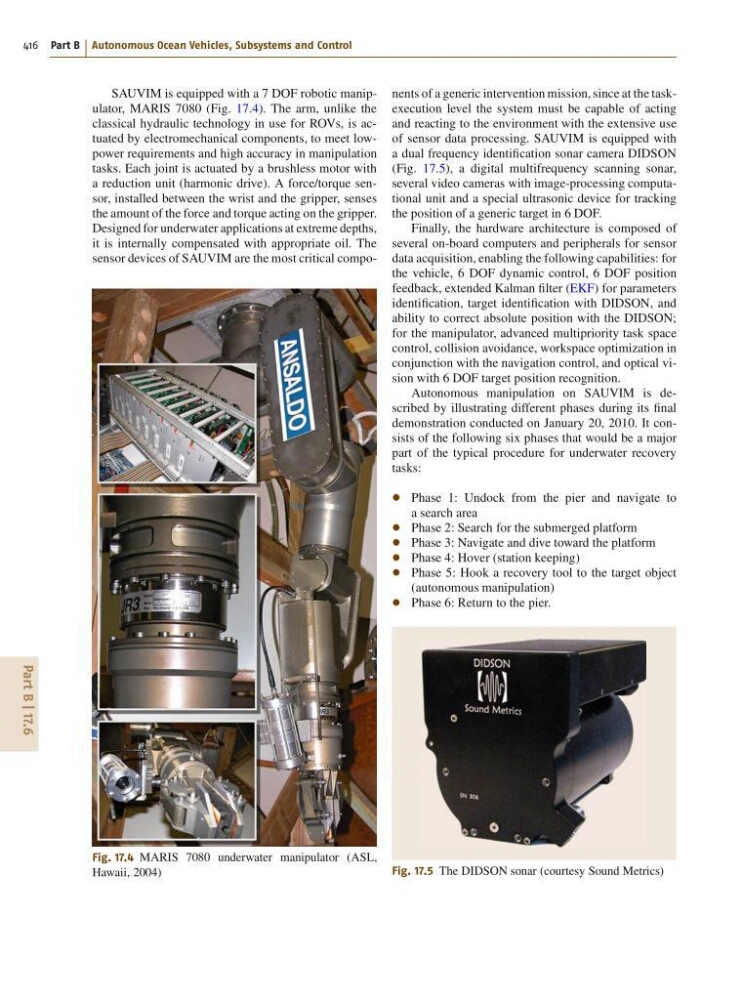
SAUVIM is equipped with a 7 DOF robotic manipulator, MARIS 7080 (Fig. 17.4). The arm, unlike the
classical hydraulic technology in use for ROVs, is actuated by electromechanical components, to meet lowpower requirements and high accuracy in manipulation
tasks. Each joint is actuated by a brushless motor with
a reduction unit (harmonic drive). A force/torque sensor, installed between the wrist and the gripper, senses
the amount of the force and torque acting on the gripper.
Designed for underwater applications at extreme depths,
it is internally compensated with appropriate oil. The
sensor devices of SAUVIM are the most critical compoFig. 17.4 MARIS 7080 underwater manipulator (ASL,
Hawaii, 2004)
nents of a generic intervention mission, since at the taskexecution level the system must be capable of acting
and reacting to the environment with the extensive use
of sensor data processing. SAUVIM is equipped with
a dual frequency identification sonar camera DIDSON
(Fig. 17.5), a digital multifrequency scanning sonar,
several video cameras with image-processing computational unit and a special ultrasonic device for tracking
the position of a generic target in 6 DOF.
Finally, the hardware architecture is composed of
several on-board computers and peripherals for sensor
data acquisition, enabling the following capabilities: for
the vehicle, 6 DOF dynamic control, 6 DOF position
feedback, extended Kalman filter (EKF) for parameters
identification, target identification with DIDSON, and
ability to correct absolute position with the DIDSON;
for the manipulator, advanced multipriority task space
control, collision avoidance, workspace optimization in
conjunction with the navigation control, and optical vision with 6 DOF target position recognition.
Autonomous manipulation on SAUVIM is described by illustrating different phases during its final
demonstration conducted on January 20, 2010. It consists of the following six phases that would be a major
part of the typical procedure for underwater recovery
tasks:
Phase 1: Undock from the pier and navigate to
a search area
Phase 2: Search for the submerged platform
Phase 3: Navigate and dive toward the platform
Phase 4: Hover (station keeping)
Phase 5: Hook a recovery tool to the target object
(autonomous manipulation)
Phase 6: Return to the pier.
Fig. 17.5 The DIDSON sonar (courtesy Sound Metrics)
416 Part B Autonomous Ocean Vehicles, Subsystems and Control
SAUVIM is equipped with a 7 DOF robotic manipulator, MARIS 7080 (Fig. 17.4). The arm, unlike the
classical hydraulic technology in use for ROVs, is actuated by electromechanical components, to meet lowpower requirements and high accuracy in manipulation
tasks. Each joint is actuated by a brushless motor with
a reduction unit (harmonic drive). A force/torque sensor, installed between the wrist and the gripper, senses
the amount of the force and torque acting on the gripper.
Designed for underwater applications at extreme depths,
it is internally compensated with appropriate oil. The
sensor devices of SAUVIM are the most critical compoFig. 17.4 MARIS 7080 underwater manipulator (ASL,
Hawaii, 2004)
nents of a generic intervention mission, since at the taskexecution level the system must be capable of acting
and reacting to the environment with the extensive use
of sensor data processing. SAUVIM is equipped with
a dual frequency identification sonar camera DIDSON
(Fig. 17.5), a digital multifrequency scanning sonar,
several video cameras with image-processing computational unit and a special ultrasonic device for tracking
the position of a generic target in 6 DOF.
Finally, the hardware architecture is composed of
several on-board computers and peripherals for sensor
data acquisition, enabling the following capabilities: for
the vehicle, 6 DOF dynamic control, 6 DOF position
feedback, extended Kalman filter (EKF) for parameters
identification, target identification with DIDSON, and
ability to correct absolute position with the DIDSON;
for the manipulator, advanced multipriority task space
control, collision avoidance, workspace optimization in
conjunction with the navigation control, and optical vision with 6 DOF target position recognition.
Autonomous manipulation on SAUVIM is described by illustrating different phases during its final
demonstration conducted on January 20, 2010. It consists of the following six phases that would be a major
part of the typical procedure for underwater recovery
tasks:
Phase 1: Undock from the pier and navigate to
a search area
Phase 2: Search for the submerged platform
Phase 3: Navigate and dive toward the platform
Phase 4: Hover (station keeping)
Phase 5: Hook a recovery tool to the target object
(autonomous manipulation)
Phase 6: Return to the pier.
Fig. 17.5 The DIDSON sonar (courtesy Sound Metrics)