

Underwater Vehicle Manipulators 17.6 Underwater AutonomousManipulation 415
Part B | 17.6
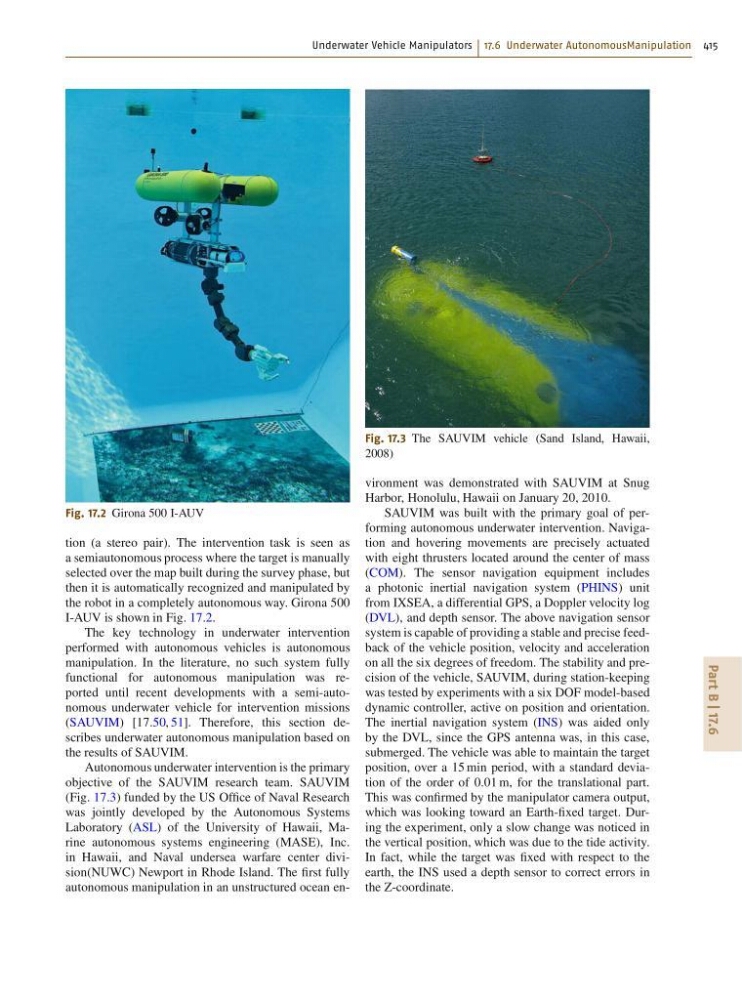
Fig. 17.2 Girona 500 I-AUV
tion (a stereo pair). The intervention task is seen as
a semiautonomous process where the target is manually
selected over the map built during the survey phase, but
then it is automatically recognized and manipulated by
the robot in a completely autonomous way. Girona 500
I-AUV is shown in Fig. 17.2.
The key technology in underwater intervention
performed with autonomous vehicles is autonomous
manipulation. In the literature, no such system fully
functional for autonomous manipulation was reported until recent developments with a semi-autonomous underwater vehicle for intervention missions
(SAUVIM) [17.50, 51]. Therefore, this section describes underwater autonomous manipulation based on
the results of SAUVIM.
Autonomous underwater intervention is the primary
objective of the SAUVIM research team. SAUVIM
(Fig. 17.3) funded by the US Office of Naval Research
was jointly developed by the Autonomous Systems
Laboratory (ASL) of the University of Hawaii, Marine autonomous systems engineering (MASE), Inc.
in Hawaii, and Naval undersea warfare center division(NUWC) Newport in Rhode Island. The first fully
autonomous manipulation in an unstructured ocean enFig. 17.3 The SAUVIM vehicle (Sand Island, Hawaii,
2008)
vironment was demonstrated with SAUVIM at Snug
Harbor, Honolulu, Hawaii on January 20, 2010.
SAUVIM was built with the primary goal of performing autonomous underwater intervention. Navigation and hovering movements are precisely actuated
with eight thrusters located around the center of mass
(COM). The sensor navigation equipment includes
a photonic inertial navigation system (PHINS) unit
from IXSEA, a differential GPS, a Doppler velocity log
(DVL), and depth sensor. The above navigation sensor
system is capable of providing a stable and precise feedback of the vehicle position, velocity and acceleration
on all the six degrees of freedom. The stability and precision of the vehicle, SAUVIM, during station-keeping
was tested by experiments with a six DOF model-based
dynamic controller, active on position and orientation.
The inertial navigation system (INS) was aided only
by the DVL, since the GPS antenna was, in this case,
submerged. The vehicle was able to maintain the target
position, over a 15 min period, with a standard deviation of the order of 0:01 m, for the translational part.
This was confirmed by the manipulator camera output,
which was looking toward an Earth-fixed target. During the experiment, only a slow change was noticed in
the vertical position, which was due to the tide activity.
In fact, while the target was fixed with respect to the
earth, the INS used a depth sensor to correct errors in
the Z-coordinate.
Part B | 17.6
Fig. 17.2 Girona 500 I-AUV
tion (a stereo pair). The intervention task is seen as
a semiautonomous process where the target is manually
selected over the map built during the survey phase, but
then it is automatically recognized and manipulated by
the robot in a completely autonomous way. Girona 500
I-AUV is shown in Fig. 17.2.
The key technology in underwater intervention
performed with autonomous vehicles is autonomous
manipulation. In the literature, no such system fully
functional for autonomous manipulation was reported until recent developments with a semi-autonomous underwater vehicle for intervention missions
(SAUVIM) [17.50, 51]. Therefore, this section describes underwater autonomous manipulation based on
the results of SAUVIM.
Autonomous underwater intervention is the primary
objective of the SAUVIM research team. SAUVIM
(Fig. 17.3) funded by the US Office of Naval Research
was jointly developed by the Autonomous Systems
Laboratory (ASL) of the University of Hawaii, Marine autonomous systems engineering (MASE), Inc.
in Hawaii, and Naval undersea warfare center division(NUWC) Newport in Rhode Island. The first fully
autonomous manipulation in an unstructured ocean enFig. 17.3 The SAUVIM vehicle (Sand Island, Hawaii,
2008)
vironment was demonstrated with SAUVIM at Snug
Harbor, Honolulu, Hawaii on January 20, 2010.
SAUVIM was built with the primary goal of performing autonomous underwater intervention. Navigation and hovering movements are precisely actuated
with eight thrusters located around the center of mass
(COM). The sensor navigation equipment includes
a photonic inertial navigation system (PHINS) unit
from IXSEA, a differential GPS, a Doppler velocity log
(DVL), and depth sensor. The above navigation sensor
system is capable of providing a stable and precise feedback of the vehicle position, velocity and acceleration
on all the six degrees of freedom. The stability and precision of the vehicle, SAUVIM, during station-keeping
was tested by experiments with a six DOF model-based
dynamic controller, active on position and orientation.
The inertial navigation system (INS) was aided only
by the DVL, since the GPS antenna was, in this case,
submerged. The vehicle was able to maintain the target
position, over a 15 min period, with a standard deviation of the order of 0:01 m, for the translational part.
This was confirmed by the manipulator camera output,
which was looking toward an Earth-fixed target. During the experiment, only a slow change was noticed in
the vertical position, which was due to the tide activity.
In fact, while the target was fixed with respect to the
earth, the INS used a depth sensor to correct errors in
the Z-coordinate.