

Part B | 15.4
366 Part B Autonomous Ocean Vehicles, Subsystems and Control
Deep ocean
trenches at 10 km
c
c
Distance
Sea
Land
Surf Shallow Deep
a) Sound speed profile
Ocean cross-section
b) Sound speed profile
Ocean cross-section
t x
t x
r x
r x
Surface layer (mixing):
const. temperature (except under ice)
Continental shelf (~100 m)
Continental slice
Continental rise
Abyssal
plain
Main thermocline:
temperature decreases rapidly
Deep ocean:
constant temperature (4 deg. C)
pressure increases
Sound speed increases with temperature
pressure, salinity
~100 m
~600 m
~3000 m
Depth
Depth
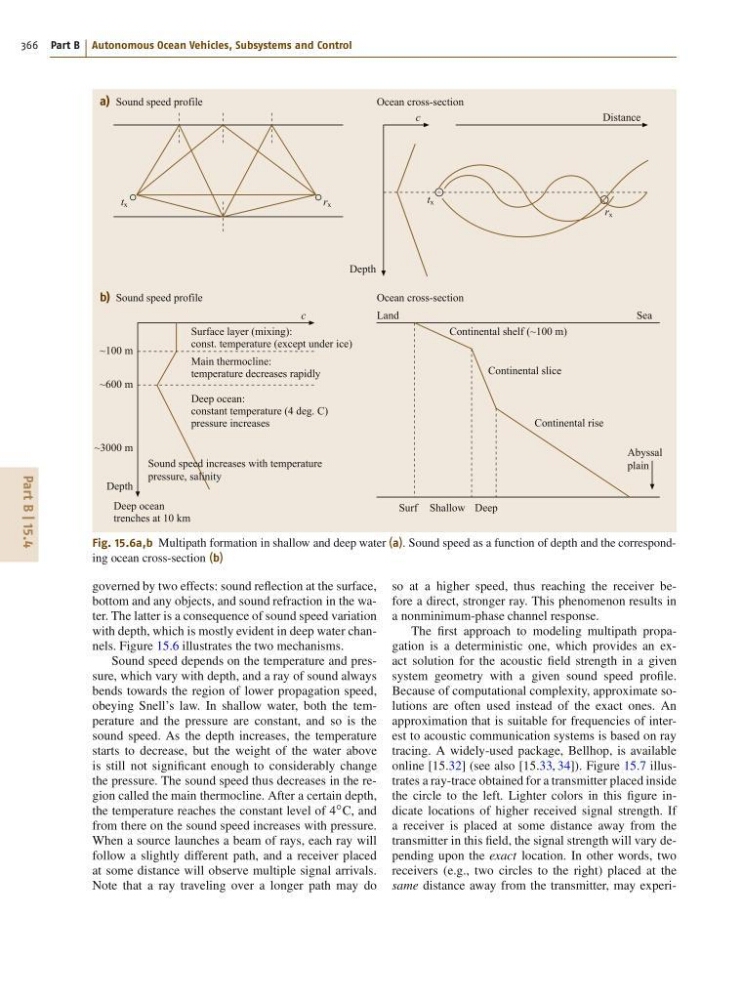
Fig. 15.6a,b Multipath formation in shallow and deep water (a). Sound speed as a function of depth and the corresponding ocean cross-section (b)
governed by two effects: sound reflection at the surface,
bottom and any objects, and sound refraction in the water. The latter is a consequence of sound speed variation
with depth, which is mostly evident in deep water channels. Figure 15.6 illustrates the two mechanisms.
Sound speed depends on the temperature and pressure, which vary with depth, and a ray of sound always
bends towards the region of lower propagation speed,
obeying Snell’s law. In shallow water, both the temperature and the pressure are constant, and so is the
sound speed. As the depth increases, the temperature
starts to decrease, but the weight of the water above
is still not significant enough to considerably change
the pressure. The sound speed thus decreases in the region called the main thermocline. After a certain depth,
the temperature reaches the constant level of 4
ı C, and
from there on the sound speed increases with pressure.
When a source launches a beam of rays, each ray will
follow a slightly different path, and a receiver placed
at some distance will observe multiple signal arrivals.
Note that a ray traveling over a longer path may do
so at a higher speed, thus reaching the receiver before a direct, stronger ray. This phenomenon results in
a nonminimum-phase channel response.
The first approach to modeling multipath propagation is a deterministic one, which provides an exact solution for the acoustic field strength in a given
system geometry with a given sound speed profile.
Because of computational complexity, approximate solutions are often used instead of the exact ones. An
approximation that is suitable for frequencies of interest to acoustic communication systems is based on ray
tracing. A widely-used package, Bellhop, is available
online [15.32] (see also [15.33, 34]). Figure 15.7 illustrates a ray-trace obtained for a transmitter placed inside
the circle to the left. Lighter colors in this figure indicate locations of higher received signal strength. If
a receiver is placed at some distance away from the
transmitter in this field, the signal strength will vary depending upon the exact location. In other words, two
receivers (e.g., two circles to the right) placed at the
same distance away from the transmitter, may experi-
366 Part B Autonomous Ocean Vehicles, Subsystems and Control
Deep ocean
trenches at 10 km
c
c
Distance
Sea
Land
Surf Shallow Deep
a) Sound speed profile
Ocean cross-section
b) Sound speed profile
Ocean cross-section
t x
t x
r x
r x
Surface layer (mixing):
const. temperature (except under ice)
Continental shelf (~100 m)
Continental slice
Continental rise
Abyssal
plain
Main thermocline:
temperature decreases rapidly
Deep ocean:
constant temperature (4 deg. C)
pressure increases
Sound speed increases with temperature
pressure, salinity
~100 m
~600 m
~3000 m
Depth
Depth
Fig. 15.6a,b Multipath formation in shallow and deep water (a). Sound speed as a function of depth and the corresponding ocean cross-section (b)
governed by two effects: sound reflection at the surface,
bottom and any objects, and sound refraction in the water. The latter is a consequence of sound speed variation
with depth, which is mostly evident in deep water channels. Figure 15.6 illustrates the two mechanisms.
Sound speed depends on the temperature and pressure, which vary with depth, and a ray of sound always
bends towards the region of lower propagation speed,
obeying Snell’s law. In shallow water, both the temperature and the pressure are constant, and so is the
sound speed. As the depth increases, the temperature
starts to decrease, but the weight of the water above
is still not significant enough to considerably change
the pressure. The sound speed thus decreases in the region called the main thermocline. After a certain depth,
the temperature reaches the constant level of 4
ı C, and
from there on the sound speed increases with pressure.
When a source launches a beam of rays, each ray will
follow a slightly different path, and a receiver placed
at some distance will observe multiple signal arrivals.
Note that a ray traveling over a longer path may do
so at a higher speed, thus reaching the receiver before a direct, stronger ray. This phenomenon results in
a nonminimum-phase channel response.
The first approach to modeling multipath propagation is a deterministic one, which provides an exact solution for the acoustic field strength in a given
system geometry with a given sound speed profile.
Because of computational complexity, approximate solutions are often used instead of the exact ones. An
approximation that is suitable for frequencies of interest to acoustic communication systems is based on ray
tracing. A widely-used package, Bellhop, is available
online [15.32] (see also [15.33, 34]). Figure 15.7 illustrates a ray-trace obtained for a transmitter placed inside
the circle to the left. Lighter colors in this figure indicate locations of higher received signal strength. If
a receiver is placed at some distance away from the
transmitter in this field, the signal strength will vary depending upon the exact location. In other words, two
receivers (e.g., two circles to the right) placed at the
same distance away from the transmitter, may experi-