

Acoustic Communication 15.4 Propagation Channel 365
Part B | 15.4
Wind at 10 m/s
Wind at 0 m/s
Shipping activity 0, 0.5 and 1
(bottom to top)
10
0
10
2
10
1
10
3
10
4
10
5
10
6
Noise p.s.d. (dB re μ Pa)
Frequency (kHz)
110
100
90
80
70
60
50
40
30
20
10
0
Fig. 15.4 Power spectral density of the ambient noise. The
dash-dotted line shows an approximation 10 log N.f / D
50 dB rePa 8 log.f =1 kHz/
bandwidth. If one defines a narrow band of frequencies
of width f around some frequency f , the SNR in this
band can be expressed as
SNR.l; f / D
S l .f /f
A.l; f /N.f /f
;
(15.4)
where S l .f / is the PSD of the transmitted signal. For any
given distance, the narrowband SNR is thus a function
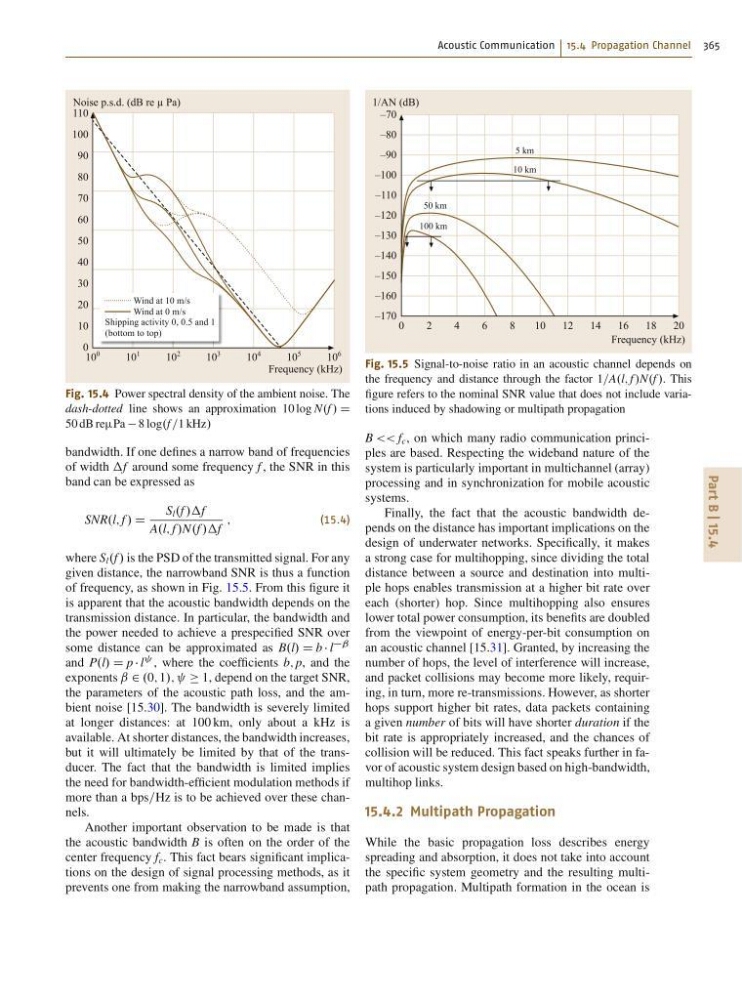
of frequency, as shown in Fig. 15.5. From this figure it
is apparent that the acoustic bandwidth depends on the
transmission distance. In particular, the bandwidth and
the power needed to achieve a prespecified SNR over
some distance can be approximated as B.l/ D b l
ˇ
and P.l/ D p l , where the coefficients b; p, and the
exponents ˇ 2 .0; 1/; 1, depend on the target SNR,
the parameters of the acoustic path loss, and the ambient noise [15.30]. The bandwidth is severely limited
at longer distances: at 100 km, only about a kHz is
available. At shorter distances, the bandwidth increases,
but it will ultimately be limited by that of the transducer. The fact that the bandwidth is limited implies
the need for bandwidth-efficient modulation methods if
more than a bps=Hz is to be achieved over these channels.
Another important observation to be made is that
the acoustic bandwidth B is often on the order of the
center frequency f c . This fact bears significant implications on the design of signal processing methods, as it
prevents one from making the narrowband assumption,
0
2
4
5 km
10 km
50 km
100 km
6
8
10
12
14
18
16
20
1/AN (dB)
Frequency (kHz)
–70
–80
–90
–100
–110
–120
–130
–140
–150
–160
–170
Fig. 15.5 Signal-to-noise ratio in an acoustic channel depends on
the frequency and distance through the factor 1=A.l; f /N.f /. This
figure refers to the nominal SNR value that does not include variations induced by shadowing or multipath propagation
B << f c , on which many radio communication principles are based. Respecting the wideband nature of the
system is particularly important in multichannel (array)
processing and in synchronization for mobile acoustic
systems.
Finally, the fact that the acoustic bandwidth depends on the distance has important implications on the
design of underwater networks. Specifically, it makes
a strong case for multihopping, since dividing the total
distance between a source and destination into multiple hops enables transmission at a higher bit rate over
each (shorter) hop. Since multihopping also ensures
lower total power consumption, its benefits are doubled
from the viewpoint of energy-per-bit consumption on
an acoustic channel [15.31]. Granted, by increasing the
number of hops, the level of interference will increase,
and packet collisions may become more likely, requiring, in turn, more re-transmissions. However, as shorter
hops support higher bit rates, data packets containing
a given number of bits will have shorter duration if the
bit rate is appropriately increased, and the chances of
collision will be reduced. This fact speaks further in favor of acoustic system design based on high-bandwidth,
multihop links.
15.4.2 Multipath Propagation
While the basic propagation loss describes energy
spreading and absorption, it does not take into account
the specific system geometry and the resulting multipath propagation. Multipath formation in the ocean is
Part B | 15.4
Wind at 10 m/s
Wind at 0 m/s
Shipping activity 0, 0.5 and 1
(bottom to top)
10
0
10
2
10
1
10
3
10
4
10
5
10
6
Noise p.s.d. (dB re μ Pa)
Frequency (kHz)
110
100
90
80
70
60
50
40
30
20
10
0
Fig. 15.4 Power spectral density of the ambient noise. The
dash-dotted line shows an approximation 10 log N.f / D
50 dB rePa 8 log.f =1 kHz/
bandwidth. If one defines a narrow band of frequencies
of width f around some frequency f , the SNR in this
band can be expressed as
SNR.l; f / D
S l .f /f
A.l; f /N.f /f
;
(15.4)
where S l .f / is the PSD of the transmitted signal. For any
given distance, the narrowband SNR is thus a function
of frequency, as shown in Fig. 15.5. From this figure it
is apparent that the acoustic bandwidth depends on the
transmission distance. In particular, the bandwidth and
the power needed to achieve a prespecified SNR over
some distance can be approximated as B.l/ D b l
ˇ
and P.l/ D p l , where the coefficients b; p, and the
exponents ˇ 2 .0; 1/; 1, depend on the target SNR,
the parameters of the acoustic path loss, and the ambient noise [15.30]. The bandwidth is severely limited
at longer distances: at 100 km, only about a kHz is
available. At shorter distances, the bandwidth increases,
but it will ultimately be limited by that of the transducer. The fact that the bandwidth is limited implies
the need for bandwidth-efficient modulation methods if
more than a bps=Hz is to be achieved over these channels.
Another important observation to be made is that
the acoustic bandwidth B is often on the order of the
center frequency f c . This fact bears significant implications on the design of signal processing methods, as it
prevents one from making the narrowband assumption,
0
2
4
5 km
10 km
50 km
100 km
6
8
10
12
14
18
16
20
1/AN (dB)
Frequency (kHz)
–70
–80
–90
–100
–110
–120
–130
–140
–150
–160
–170
Fig. 15.5 Signal-to-noise ratio in an acoustic channel depends on
the frequency and distance through the factor 1=A.l; f /N.f /. This
figure refers to the nominal SNR value that does not include variations induced by shadowing or multipath propagation
B << f c , on which many radio communication principles are based. Respecting the wideband nature of the
system is particularly important in multichannel (array)
processing and in synchronization for mobile acoustic
systems.
Finally, the fact that the acoustic bandwidth depends on the distance has important implications on the
design of underwater networks. Specifically, it makes
a strong case for multihopping, since dividing the total
distance between a source and destination into multiple hops enables transmission at a higher bit rate over
each (shorter) hop. Since multihopping also ensures
lower total power consumption, its benefits are doubled
from the viewpoint of energy-per-bit consumption on
an acoustic channel [15.31]. Granted, by increasing the
number of hops, the level of interference will increase,
and packet collisions may become more likely, requiring, in turn, more re-transmissions. However, as shorter
hops support higher bit rates, data packets containing
a given number of bits will have shorter duration if the
bit rate is appropriately increased, and the chances of
collision will be reduced. This fact speaks further in favor of acoustic system design based on high-bandwidth,
multihop links.
15.4.2 Multipath Propagation
While the basic propagation loss describes energy
spreading and absorption, it does not take into account
the specific system geometry and the resulting multipath propagation. Multipath formation in the ocean is