

Autonomous Underwater Vehicle Navigation 14.1 Sensors 345
Part B | 14.1
14.1.8 Acoustic Ranging Methods
The most commonly used way to obtain absolute position information underwater is through the use of
beacons. These beacons are at known locations and
the AUV obtains the range and/or bearing to several
of these and then calculates its position through trilateration or triangulation. Based on the location of the
transceivers, we can identify three different baseline
systems.
Electromagnetic energy cannot propagate appreciable distances in the ocean except at very low frequencies. Acoustic energy, however, propagates well in the
ocean, and hence acoustic transponders can be used as
beacons to guide the motion of an AUV without the
need for resurfacing. Two types of system have been
primarily employed [14.11–13]: LBL and USBL. Both
systems employ external transducers or transducer arrays as aids to navigation.
Standard LBL
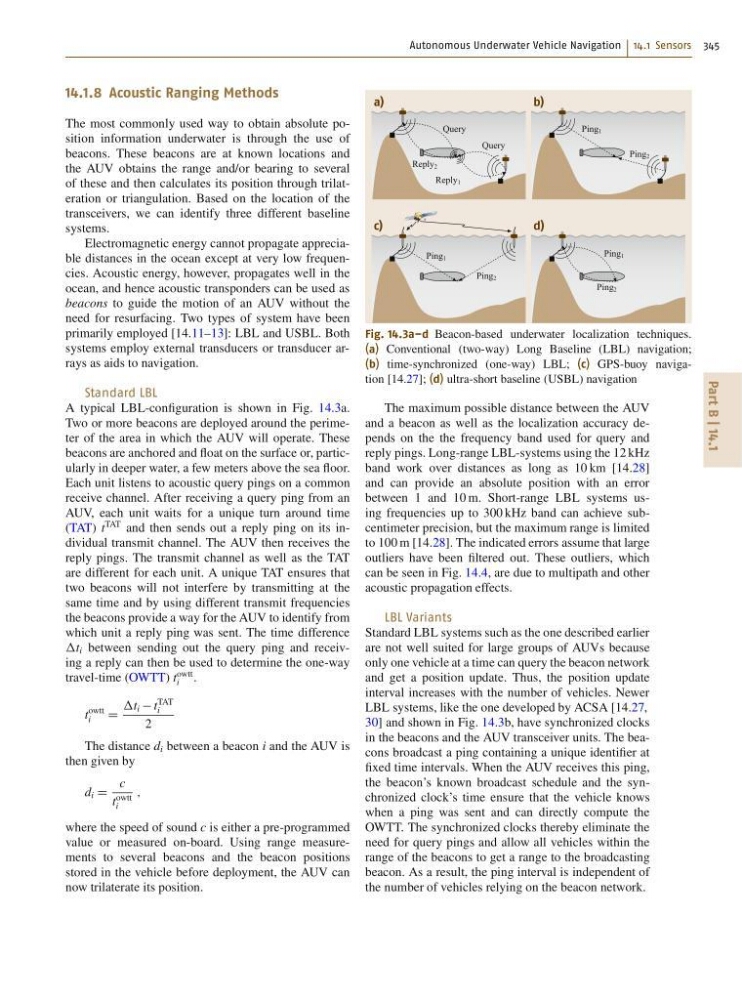
A typical LBL-configuration is shown in Fig. 14.3a.
Two or more beacons are deployed around the perimeter of the area in which the AUV will operate. These
beacons are anchored and float on the surface or, particularly in deeper water, a few meters above the sea floor.
Each unit listens to acoustic query pings on a common
receive channel. After receiving a query ping from an
AUV, each unit waits for a unique turn around time
(TAT) t
TAT and then sends out a reply ping on its individual transmit channel. The AUV then receives the
reply pings. The transmit channel as well as the TAT
are different for each unit. A unique TAT ensures that
two beacons will not interfere by transmitting at the
same time and by using different transmit frequencies
the beacons provide a way for the AUV to identify from
which unit a reply ping was sent. The time difference
t i between sending out the query ping and receiving a reply can then be used to determine the one-way
travel-time (OWTT) t
owtt
i
.
t
owtt
i
D
t i t
TAT
i
2
The distance d i between a beacon i and the AUV is
then given by
d i D
c
t
owtt
i
;
where the speed of sound c is either a pre-programmed
value or measured on-board. Using range measurements to several beacons and the beacon positions
stored in the vehicle before deployment, the AUV can
now trilaterate its position.
Query
Query
Reply 2
Reply 1
Ping 1
Ping 2
a)
b)
Ping 1
Ping 1
Ping 2
Ping 2
c)
d)
Fig. 14.3a–d Beacon-based underwater localization techniques.
(a) Conventional (two-way) Long Baseline (LBL) navigation;
(b) time-synchronized (one-way) LBL; (c) GPS-buoy navigation [14.27]; (d) ultra-short baseline (USBL) navigation
The maximum possible distance between the AUV
and a beacon as well as the localization accuracy depends on the the frequency band used for query and
reply pings. Long-range LBL-systems using the 12 kHz
band work over distances as long as 10 km [14.28]
and can provide an absolute position with an error
between 1 and 10 m. Short-range LBL systems using frequencies up to 300 kHz band can achieve subcentimeter precision, but the maximum range is limited
to 100 m [14.28]. The indicated errors assume that large
outliers have been filtered out. These outliers, which
can be seen in Fig. 14.4, are due to multipath and other
acoustic propagation effects.
LBL Variants
Standard LBL systems such as the one described earlier
are not well suited for large groups of AUVs because
only one vehicle at a time can query the beacon network
and get a position update. Thus, the position update
interval increases with the number of vehicles. Newer
LBL systems, like the one developed by ACSA [14.27,
30] and shown in Fig. 14.3b, have synchronized clocks
in the beacons and the AUV transceiver units. The beacons broadcast a ping containing a unique identifier at
fixed time intervals. When the AUV receives this ping,
the beacon’s known broadcast schedule and the synchronized clock’s time ensure that the vehicle knows
when a ping was sent and can directly compute the
OWTT. The synchronized clocks thereby eliminate the
need for query pings and allow all vehicles within the
range of the beacons to get a range to the broadcasting
beacon. As a result, the ping interval is independent of
the number of vehicles relying on the beacon network.
Part B | 14.1
14.1.8 Acoustic Ranging Methods
The most commonly used way to obtain absolute position information underwater is through the use of
beacons. These beacons are at known locations and
the AUV obtains the range and/or bearing to several
of these and then calculates its position through trilateration or triangulation. Based on the location of the
transceivers, we can identify three different baseline
systems.
Electromagnetic energy cannot propagate appreciable distances in the ocean except at very low frequencies. Acoustic energy, however, propagates well in the
ocean, and hence acoustic transponders can be used as
beacons to guide the motion of an AUV without the
need for resurfacing. Two types of system have been
primarily employed [14.11–13]: LBL and USBL. Both
systems employ external transducers or transducer arrays as aids to navigation.
Standard LBL
A typical LBL-configuration is shown in Fig. 14.3a.
Two or more beacons are deployed around the perimeter of the area in which the AUV will operate. These
beacons are anchored and float on the surface or, particularly in deeper water, a few meters above the sea floor.
Each unit listens to acoustic query pings on a common
receive channel. After receiving a query ping from an
AUV, each unit waits for a unique turn around time
(TAT) t
TAT and then sends out a reply ping on its individual transmit channel. The AUV then receives the
reply pings. The transmit channel as well as the TAT
are different for each unit. A unique TAT ensures that
two beacons will not interfere by transmitting at the
same time and by using different transmit frequencies
the beacons provide a way for the AUV to identify from
which unit a reply ping was sent. The time difference
t i between sending out the query ping and receiving a reply can then be used to determine the one-way
travel-time (OWTT) t
owtt
i
.
t
owtt
i
D
t i t
TAT
i
2
The distance d i between a beacon i and the AUV is
then given by
d i D
c
t
owtt
i
;
where the speed of sound c is either a pre-programmed
value or measured on-board. Using range measurements to several beacons and the beacon positions
stored in the vehicle before deployment, the AUV can
now trilaterate its position.
Query
Query
Reply 2
Reply 1
Ping 1
Ping 2
a)
b)
Ping 1
Ping 1
Ping 2
Ping 2
c)
d)
Fig. 14.3a–d Beacon-based underwater localization techniques.
(a) Conventional (two-way) Long Baseline (LBL) navigation;
(b) time-synchronized (one-way) LBL; (c) GPS-buoy navigation [14.27]; (d) ultra-short baseline (USBL) navigation
The maximum possible distance between the AUV
and a beacon as well as the localization accuracy depends on the the frequency band used for query and
reply pings. Long-range LBL-systems using the 12 kHz
band work over distances as long as 10 km [14.28]
and can provide an absolute position with an error
between 1 and 10 m. Short-range LBL systems using frequencies up to 300 kHz band can achieve subcentimeter precision, but the maximum range is limited
to 100 m [14.28]. The indicated errors assume that large
outliers have been filtered out. These outliers, which
can be seen in Fig. 14.4, are due to multipath and other
acoustic propagation effects.
LBL Variants
Standard LBL systems such as the one described earlier
are not well suited for large groups of AUVs because
only one vehicle at a time can query the beacon network
and get a position update. Thus, the position update
interval increases with the number of vehicles. Newer
LBL systems, like the one developed by ACSA [14.27,
30] and shown in Fig. 14.3b, have synchronized clocks
in the beacons and the AUV transceiver units. The beacons broadcast a ping containing a unique identifier at
fixed time intervals. When the AUV receives this ping,
the beacon’s known broadcast schedule and the synchronized clock’s time ensure that the vehicle knows
when a ping was sent and can directly compute the
OWTT. The synchronized clocks thereby eliminate the
need for query pings and allow all vehicles within the
range of the beacons to get a range to the broadcasting
beacon. As a result, the ping interval is independent of
the number of vehicles relying on the beacon network.