

Autonomous Sea Surface Vehicles 13.5 Conclusions 337
Part B | 13.5
USV-SWATH
Catamaran
0
2
4
6
8
1 0
1 2
1 4
1 6
1 8
2 0
2 2
Pitch amplitude (deg)
Time (s)
6
4
2
0
–2
–4
–6
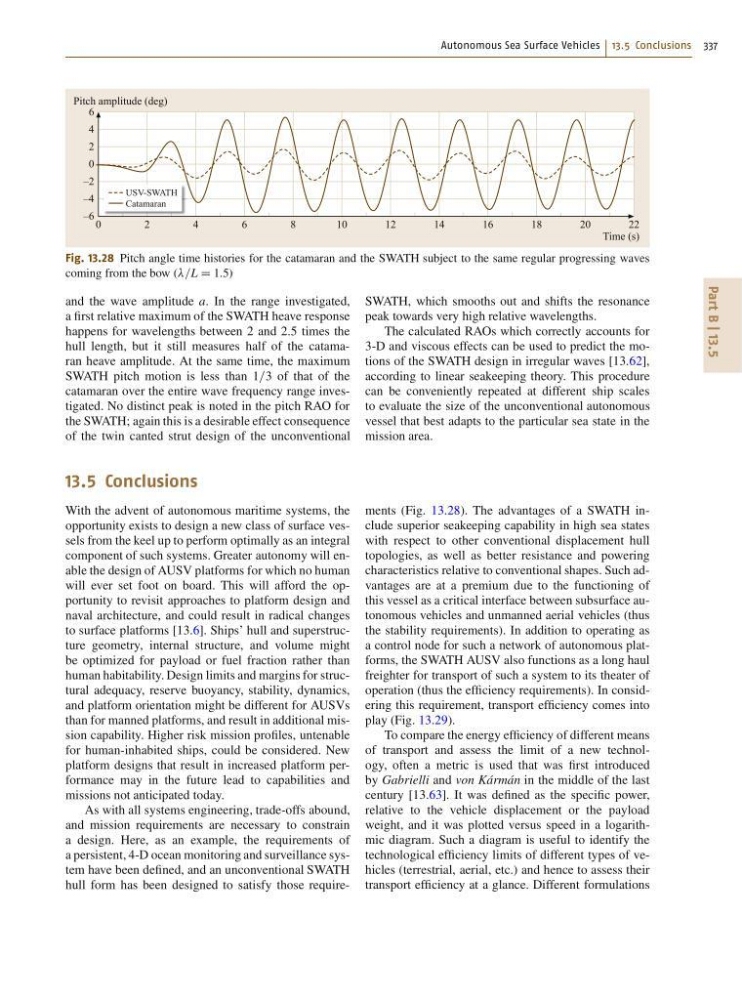
Fig. 13.28 Pitch angle time histories for the catamaran and the SWATH subject to the same regular progressing waves
coming from the bow (=L D 1:5)
and the wave amplitude a. In the range investigated,
a first relative maximum of the SWATH heave response
happens for wavelengths between 2 and 2:5 times the
hull length, but it still measures half of the catamaran heave amplitude. At the same time, the maximum
SWATH pitch motion is less than 1=3 of that of the
catamaran over the entire wave frequency range investigated. No distinct peak is noted in the pitch RAO for
the SWATH; again this is a desirable effect consequence
of the twin canted strut design of the unconventional
SWATH, which smooths out and shifts the resonance
peak towards very high relative wavelengths.
The calculated RAOs which correctly accounts for
3-D and viscous effects can be used to predict the motions of the SWATH design in irregular waves [13.62],
according to linear seakeeping theory. This procedure
can be conveniently repeated at different ship scales
to evaluate the size of the unconventional autonomous
vessel that best adapts to the particular sea state in the
mission area.
13.5 Conclusions
With the advent of autonomous maritime systems, the
opportunity exists to design a new class of surface vessels from the keel up to perform optimally as an integral
component of such systems. Greater autonomy will enable the design of AUSV platforms for which no human
will ever set foot on board. This will afford the opportunity to revisit approaches to platform design and
naval architecture, and could result in radical changes
to surface platforms [13.6]. Ships’ hull and superstructure geometry, internal structure, and volume might
be optimized for payload or fuel fraction rather than
human habitability. Design limits and margins for structural adequacy, reserve buoyancy, stability, dynamics,
and platform orientation might be different for AUSVs
than for manned platforms, and result in additional mission capability. Higher risk mission profiles, untenable
for human-inhabited ships, could be considered. New
platform designs that result in increased platform performance may in the future lead to capabilities and
missions not anticipated today.
As with all systems engineering, trade-offs abound,
and mission requirements are necessary to constrain
a design. Here, as an example, the requirements of
a persistent, 4-D ocean monitoring and surveillance system have been defined, and an unconventional SWATH
hull form has been designed to satisfy those requirements (Fig. 13.28). The advantages of a SWATH include superior seakeeping capability in high sea states
with respect to other conventional displacement hull
topologies, as well as better resistance and powering
characteristics relative to conventional shapes. Such advantages are at a premium due to the functioning of
this vessel as a critical interface between subsurface autonomous vehicles and unmanned aerial vehicles (thus
the stability requirements). In addition to operating as
a control node for such a network of autonomous platforms, the SWATH AUSV also functions as a long haul
freighter for transport of such a system to its theater of
operation (thus the efficiency requirements). In considering this requirement, transport efficiency comes into
play (Fig. 13.29).
To compare the energy efficiency of different means
of transport and assess the limit of a new technology, often a metric is used that was first introduced
by Gabrielli and von Kármán in the middle of the last
century [13.63]. It was defined as the specific power,
relative to the vehicle displacement or the payload
weight, and it was plotted versus speed in a logarithmic diagram. Such a diagram is useful to identify the
technological efficiency limits of different types of vehicles (terrestrial, aerial, etc.) and hence to assess their
transport efficiency at a glance. Different formulations
Part B | 13.5
USV-SWATH
Catamaran
0
2
4
6
8
1 0
1 2
1 4
1 6
1 8
2 0
2 2
Pitch amplitude (deg)
Time (s)
6
4
2
0
–2
–4
–6
Fig. 13.28 Pitch angle time histories for the catamaran and the SWATH subject to the same regular progressing waves
coming from the bow (=L D 1:5)
and the wave amplitude a. In the range investigated,
a first relative maximum of the SWATH heave response
happens for wavelengths between 2 and 2:5 times the
hull length, but it still measures half of the catamaran heave amplitude. At the same time, the maximum
SWATH pitch motion is less than 1=3 of that of the
catamaran over the entire wave frequency range investigated. No distinct peak is noted in the pitch RAO for
the SWATH; again this is a desirable effect consequence
of the twin canted strut design of the unconventional
SWATH, which smooths out and shifts the resonance
peak towards very high relative wavelengths.
The calculated RAOs which correctly accounts for
3-D and viscous effects can be used to predict the motions of the SWATH design in irregular waves [13.62],
according to linear seakeeping theory. This procedure
can be conveniently repeated at different ship scales
to evaluate the size of the unconventional autonomous
vessel that best adapts to the particular sea state in the
mission area.
13.5 Conclusions
With the advent of autonomous maritime systems, the
opportunity exists to design a new class of surface vessels from the keel up to perform optimally as an integral
component of such systems. Greater autonomy will enable the design of AUSV platforms for which no human
will ever set foot on board. This will afford the opportunity to revisit approaches to platform design and
naval architecture, and could result in radical changes
to surface platforms [13.6]. Ships’ hull and superstructure geometry, internal structure, and volume might
be optimized for payload or fuel fraction rather than
human habitability. Design limits and margins for structural adequacy, reserve buoyancy, stability, dynamics,
and platform orientation might be different for AUSVs
than for manned platforms, and result in additional mission capability. Higher risk mission profiles, untenable
for human-inhabited ships, could be considered. New
platform designs that result in increased platform performance may in the future lead to capabilities and
missions not anticipated today.
As with all systems engineering, trade-offs abound,
and mission requirements are necessary to constrain
a design. Here, as an example, the requirements of
a persistent, 4-D ocean monitoring and surveillance system have been defined, and an unconventional SWATH
hull form has been designed to satisfy those requirements (Fig. 13.28). The advantages of a SWATH include superior seakeeping capability in high sea states
with respect to other conventional displacement hull
topologies, as well as better resistance and powering
characteristics relative to conventional shapes. Such advantages are at a premium due to the functioning of
this vessel as a critical interface between subsurface autonomous vehicles and unmanned aerial vehicles (thus
the stability requirements). In addition to operating as
a control node for such a network of autonomous platforms, the SWATH AUSV also functions as a long haul
freighter for transport of such a system to its theater of
operation (thus the efficiency requirements). In considering this requirement, transport efficiency comes into
play (Fig. 13.29).
To compare the energy efficiency of different means
of transport and assess the limit of a new technology, often a metric is used that was first introduced
by Gabrielli and von Kármán in the middle of the last
century [13.63]. It was defined as the specific power,
relative to the vehicle displacement or the payload
weight, and it was plotted versus speed in a logarithmic diagram. Such a diagram is useful to identify the
technological efficiency limits of different types of vehicles (terrestrial, aerial, etc.) and hence to assess their
transport efficiency at a glance. Different formulations