

Part B | 13.4
336 Part B Autonomous Ocean Vehicles, Subsystems and Control
a)
b)
Fig. 13.24a,b Comparison by overlap
of the AUSV-SWATH hull with the
equivalent catamaran considered for
resistance and seakeeping comparative
studies. (a) Perspective view from
bow quartering and (b) from stern
quartering
around the AUSV-SWATH hull (superstructures are not
represented) subject to an incoming wave with a length
() 2.5 times that of the SWATH hull length. Although
the pitch and heave motions of the AUSV-SWATH, as
presented later, are smaller than those of the catamaran,
the radiated and diffracted waves are very well visible
in the picture, consistently with the larger motion damping of the SWATH with respect to the catamaran. This is
the result of the twin canted struts, which have a distinct
capacity of dissipating the kinetic energy of the vessel
moving in waves, by radiated waves and shed vorticity
around the hull.
A hybrid strip theory method, based on twodimensional (2-D) viscous non-linear free surface unsteady RANS calculation of radiated forces, demonstrated that the viscous effects responsible for vortex
shedding are absolutely non-negligible for a correct
prediction of the vertical plane motion of SWATH
hull forms [13.62]. This study also confirmed that the
peaks of heave and pitch response amplitude operators
(RAOs) move to very high relative wavelengths (about
=L D 4:5) in the case of this special SWATH design.
At such low oscillation frequencies, the particular configuration of canted struts effectively limits the peak of
the resonant response, which would be singular if evaluated with potential flow methods.
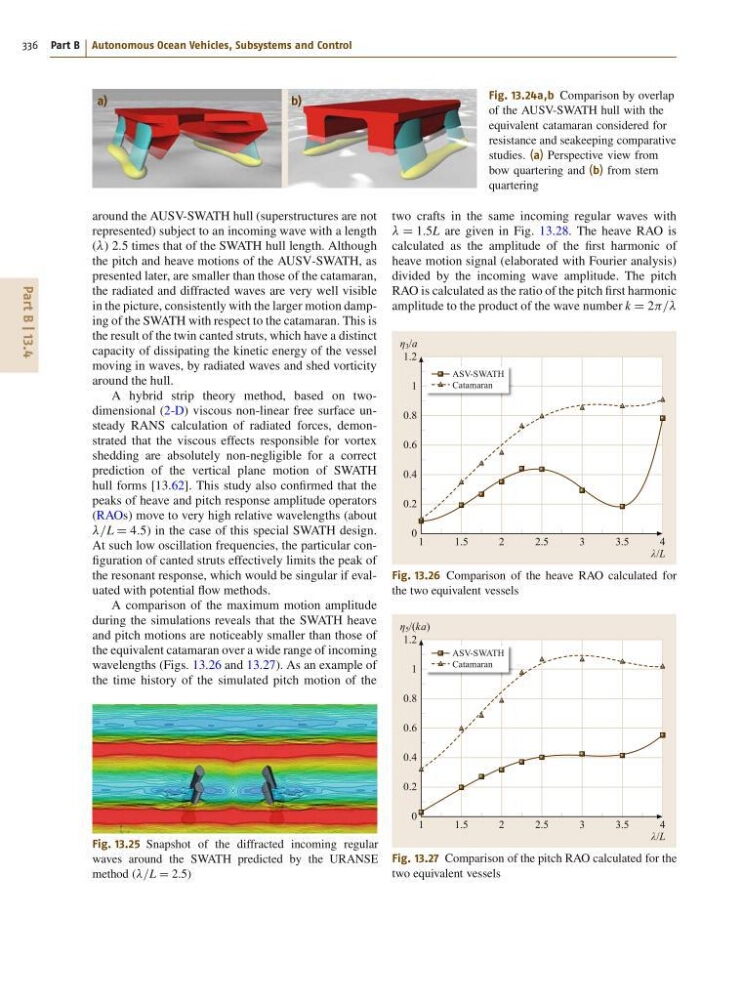
A comparison of the maximum motion amplitude
during the simulations reveals that the SWATH heave
and pitch motions are noticeably smaller than those of
the equivalent catamaran over a wide range of incoming
wavelengths (Figs. 13.26 and 13.27). As an example of
the time history of the simulated pitch motion of the
Fig. 13.25 Snapshot of the diffracted incoming regular
waves around the SWATH predicted by the URANSE
method (=L D 2:5)
two crafts in the same incoming regular waves with
D 1:5L are given in Fig. 13.28. The heave RAO is
calculated as the amplitude of the first harmonic of
heave motion signal (elaborated with Fourier analysis)
divided by the incoming wave amplitude. The pitch
RAO is calculated as the ratio of the pitch first harmonic
amplitude to the product of the wave number k D 2==
ASV-SWATH
Catamaran
1
1.5
2
2.5
3
3.5
4
η 3 /a
λ/L
1.2
1
0.8
0.6
0.4
0.2
0
Fig. 13.26 Comparison of the heave RAO calculated for
the two equivalent vessels
ASV-SWATH
Catamaran
1
1.5
2
2.5
3
3.5
4
η 5 /(ka)
λ/L
1.2
1
0.8
0.6
0.4
0.2
0
Fig. 13.27 Comparison of the pitch RAO calculated for the
two equivalent vessels
336 Part B Autonomous Ocean Vehicles, Subsystems and Control
a)
b)
Fig. 13.24a,b Comparison by overlap
of the AUSV-SWATH hull with the
equivalent catamaran considered for
resistance and seakeeping comparative
studies. (a) Perspective view from
bow quartering and (b) from stern
quartering
around the AUSV-SWATH hull (superstructures are not
represented) subject to an incoming wave with a length
() 2.5 times that of the SWATH hull length. Although
the pitch and heave motions of the AUSV-SWATH, as
presented later, are smaller than those of the catamaran,
the radiated and diffracted waves are very well visible
in the picture, consistently with the larger motion damping of the SWATH with respect to the catamaran. This is
the result of the twin canted struts, which have a distinct
capacity of dissipating the kinetic energy of the vessel
moving in waves, by radiated waves and shed vorticity
around the hull.
A hybrid strip theory method, based on twodimensional (2-D) viscous non-linear free surface unsteady RANS calculation of radiated forces, demonstrated that the viscous effects responsible for vortex
shedding are absolutely non-negligible for a correct
prediction of the vertical plane motion of SWATH
hull forms [13.62]. This study also confirmed that the
peaks of heave and pitch response amplitude operators
(RAOs) move to very high relative wavelengths (about
=L D 4:5) in the case of this special SWATH design.
At such low oscillation frequencies, the particular configuration of canted struts effectively limits the peak of
the resonant response, which would be singular if evaluated with potential flow methods.
A comparison of the maximum motion amplitude
during the simulations reveals that the SWATH heave
and pitch motions are noticeably smaller than those of
the equivalent catamaran over a wide range of incoming
wavelengths (Figs. 13.26 and 13.27). As an example of
the time history of the simulated pitch motion of the
Fig. 13.25 Snapshot of the diffracted incoming regular
waves around the SWATH predicted by the URANSE
method (=L D 2:5)
two crafts in the same incoming regular waves with
D 1:5L are given in Fig. 13.28. The heave RAO is
calculated as the amplitude of the first harmonic of
heave motion signal (elaborated with Fourier analysis)
divided by the incoming wave amplitude. The pitch
RAO is calculated as the ratio of the pitch first harmonic
amplitude to the product of the wave number k D 2==
ASV-SWATH
Catamaran
1
1.5
2
2.5
3
3.5
4
η 3 /a
λ/L
1.2
1
0.8
0.6
0.4
0.2
0
Fig. 13.26 Comparison of the heave RAO calculated for
the two equivalent vessels
ASV-SWATH
Catamaran
1
1.5
2
2.5
3
3.5
4
η 5 /(ka)
λ/L
1.2
1
0.8
0.6
0.4
0.2
0
Fig. 13.27 Comparison of the pitch RAO calculated for the
two equivalent vessels