

Autonomous Sea Surface Vehicles 13.4 Optimized Class of Autonomous Unmanned Surface Vehicles 335
Part B | 13.4
4
5
6
7
8
9
10
11
12
Brake power (kW)
Speed (kn)
40
35
30
25
20
15
10
5
0
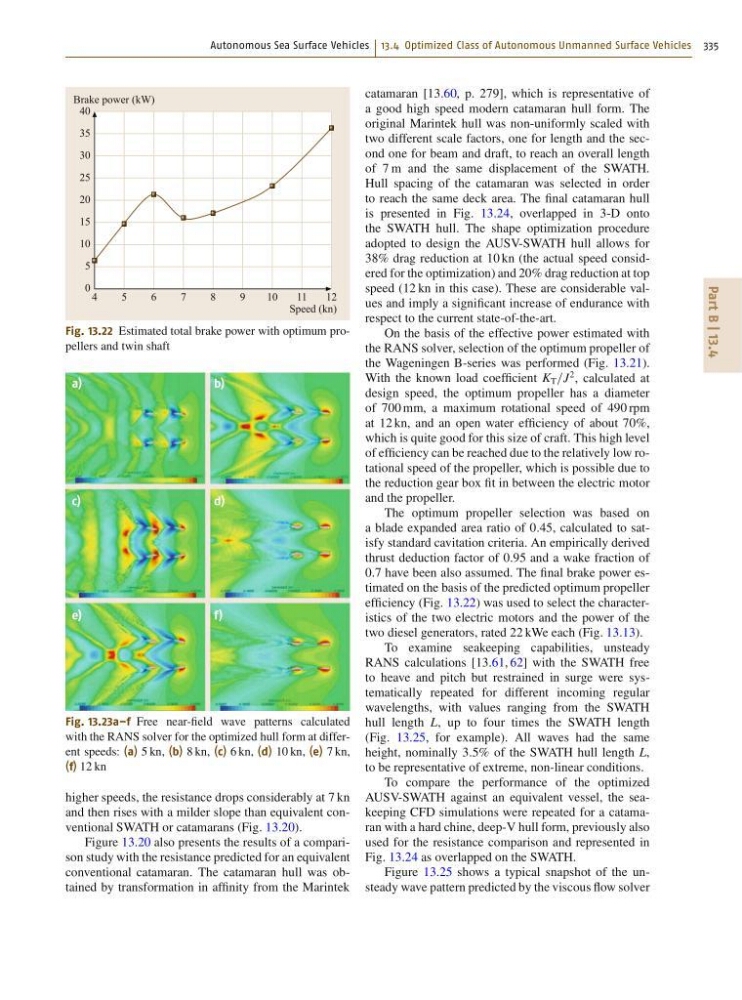
Fig. 13.22 Estimated total brake power with optimum propellers and twin shaft
a)
b)
c)
d)
e)
f)
Fig. 13.23a–f Free near-field wave patterns calculated
with the RANS solver for the optimized hull form at different speeds: (a) 5 kn, (b) 8 kn, (c) 6 kn, (d) 10 kn, (e) 7 kn,
(f) 12 kn
higher speeds, the resistance drops considerably at 7 kn
and then rises with a milder slope than equivalent conventional SWATH or catamarans (Fig. 13.20).
Figure 13.20 also presents the results of a comparison study with the resistance predicted for an equivalent
conventional catamaran. The catamaran hull was obtained by transformation in affinity from the Marintek
catamaran [13.60, p. 279], which is representative of
a good high speed modern catamaran hull form. The
original Marintek hull was non-uniformly scaled with
two different scale factors, one for length and the second one for beam and draft, to reach an overall length
of 7 m and the same displacement of the SWATH.
Hull spacing of the catamaran was selected in order
to reach the same deck area. The final catamaran hull
is presented in Fig. 13.24, overlapped in 3-D onto
the SWATH hull. The shape optimization procedure
adopted to design the AUSV-SWATH hull allows for
38% drag reduction at 10 kn (the actual speed considered for the optimization) and 20% drag reduction at top
speed (12 kn in this case). These are considerable values and imply a significant increase of endurance with
respect to the current state-of-the-art.
On the basis of the effective power estimated with
the RANS solver, selection of the optimum propeller of
the Wageningen B-series was performed (Fig. 13.21).
With the known load coefficient K T =J
2 , calculated at
design speed, the optimum propeller has a diameter
of 700 mm, a maximum rotational speed of 490 rpm
at 12 kn, and an open water efficiency of about 70%,
which is quite good for this size of craft. This high level
of efficiency can be reached due to the relatively low rotational speed of the propeller, which is possible due to
the reduction gear box fit in between the electric motor
and the propeller.
The optimum propeller selection was based on
a blade expanded area ratio of 0:45, calculated to satisfy standard cavitation criteria. An empirically derived
thrust deduction factor of 0.95 and a wake fraction of
0.7 have been also assumed. The final brake power estimated on the basis of the predicted optimum propeller
efficiency (Fig. 13.22) was used to select the characteristics of the two electric motors and the power of the
two diesel generators, rated 22 kWe each (Fig. 13.13).
To examine seakeeping capabilities, unsteady
RANS calculations [13.61, 62] with the SWATH free
to heave and pitch but restrained in surge were systematically repeated for different incoming regular
wavelengths, with values ranging from the SWATH
hull length L, up to four times the SWATH length
(Fig. 13.25, for example). All waves had the same
height, nominally 3:5% of the SWATH hull length L,
to be representative of extreme, non-linear conditions.
To compare the performance of the optimized
AUSV-SWATH against an equivalent vessel, the seakeeping CFD simulations were repeated for a catamaran with a hard chine, deep-V hull form, previously also
used for the resistance comparison and represented in
Fig. 13.24 as overlapped on the SWATH.
Figure 13.25 shows a typical snapshot of the unsteady wave pattern predicted by the viscous flow solver
Part B | 13.4
4
5
6
7
8
9
10
11
12
Brake power (kW)
Speed (kn)
40
35
30
25
20
15
10
5
0
Fig. 13.22 Estimated total brake power with optimum propellers and twin shaft
a)
b)
c)
d)
e)
f)
Fig. 13.23a–f Free near-field wave patterns calculated
with the RANS solver for the optimized hull form at different speeds: (a) 5 kn, (b) 8 kn, (c) 6 kn, (d) 10 kn, (e) 7 kn,
(f) 12 kn
higher speeds, the resistance drops considerably at 7 kn
and then rises with a milder slope than equivalent conventional SWATH or catamarans (Fig. 13.20).
Figure 13.20 also presents the results of a comparison study with the resistance predicted for an equivalent
conventional catamaran. The catamaran hull was obtained by transformation in affinity from the Marintek
catamaran [13.60, p. 279], which is representative of
a good high speed modern catamaran hull form. The
original Marintek hull was non-uniformly scaled with
two different scale factors, one for length and the second one for beam and draft, to reach an overall length
of 7 m and the same displacement of the SWATH.
Hull spacing of the catamaran was selected in order
to reach the same deck area. The final catamaran hull
is presented in Fig. 13.24, overlapped in 3-D onto
the SWATH hull. The shape optimization procedure
adopted to design the AUSV-SWATH hull allows for
38% drag reduction at 10 kn (the actual speed considered for the optimization) and 20% drag reduction at top
speed (12 kn in this case). These are considerable values and imply a significant increase of endurance with
respect to the current state-of-the-art.
On the basis of the effective power estimated with
the RANS solver, selection of the optimum propeller of
the Wageningen B-series was performed (Fig. 13.21).
With the known load coefficient K T =J
2 , calculated at
design speed, the optimum propeller has a diameter
of 700 mm, a maximum rotational speed of 490 rpm
at 12 kn, and an open water efficiency of about 70%,
which is quite good for this size of craft. This high level
of efficiency can be reached due to the relatively low rotational speed of the propeller, which is possible due to
the reduction gear box fit in between the electric motor
and the propeller.
The optimum propeller selection was based on
a blade expanded area ratio of 0:45, calculated to satisfy standard cavitation criteria. An empirically derived
thrust deduction factor of 0.95 and a wake fraction of
0.7 have been also assumed. The final brake power estimated on the basis of the predicted optimum propeller
efficiency (Fig. 13.22) was used to select the characteristics of the two electric motors and the power of the
two diesel generators, rated 22 kWe each (Fig. 13.13).
To examine seakeeping capabilities, unsteady
RANS calculations [13.61, 62] with the SWATH free
to heave and pitch but restrained in surge were systematically repeated for different incoming regular
wavelengths, with values ranging from the SWATH
hull length L, up to four times the SWATH length
(Fig. 13.25, for example). All waves had the same
height, nominally 3:5% of the SWATH hull length L,
to be representative of extreme, non-linear conditions.
To compare the performance of the optimized
AUSV-SWATH against an equivalent vessel, the seakeeping CFD simulations were repeated for a catamaran with a hard chine, deep-V hull form, previously also
used for the resistance comparison and represented in
Fig. 13.24 as overlapped on the SWATH.
Figure 13.25 shows a typical snapshot of the unsteady wave pattern predicted by the viscous flow solver