

Autonomous Sea Surface Vehicles 13.4 Optimized Class of Autonomous Unmanned Surface Vehicles 331
Part B | 13.4
by the bow, typical of high speed SWATHs, and
withstand realistic shift of loads.
The ability to serve as a launch, recovery, and
recharging platform for unmanned aerial vehicles.
Transportability inside a standard container (ISO
LWH 12:2 2:44 2:59).
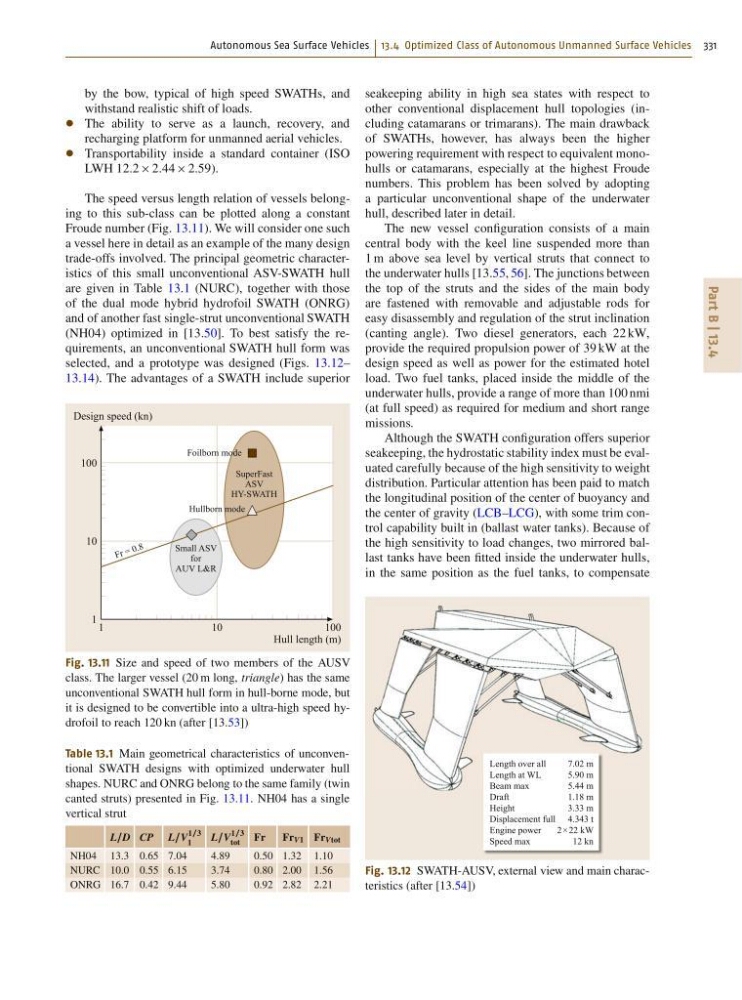
The speed versus length relation of vessels belonging to this sub-class can be plotted along a constant
Froude number (Fig. 13.11). We will consider one such
a vessel here in detail as an example of the many design
trade-offs involved. The principal geometric characteristics of this small unconventional ASV-SWATH hull
are given in Table 13.1 (NURC), together with those
of the dual mode hybrid hydrofoil SWATH (ONRG)
and of another fast single-strut unconventional SWATH
(NH04) optimized in [13.50]. To best satisfy the requirements, an unconventional SWATH hull form was
selected, and a prototype was designed (Figs. 13.12–
13.14). The advantages of a SWATH include superior
1
1 0
Small ASV
for
AUV L&R
F r = 0 .8
SuperFast
ASV
HY-SWATH
Foilborn mode
Hullborn mode
100
Design speed (kn)
Hull length (m)
100
10
1
Fig. 13.11 Size and speed of two members of the AUSV
class. The larger vessel (20 m long, triangle) has the same
unconventional SWATH hull form in hull-borne mode, but
it is designed to be convertible into a ultra-high speed hydrofoil to reach 120 kn (after [13.53])
Table 13.1 Main geometrical characteristics of unconventional SWATH designs with optimized underwater hull
shapes. NURC and ONRG belong to the same family (twin
canted struts) presented in Fig. 13.11. NH04 has a single
vertical strut
L=D CP L=V
1=3
1
L=V
1=3
tot
Fr
Fr V1 Fr Vtot
NH04 13.3 0.65 7.04
4.89
0.50 1.32 1.10
NURC 10.0 0.55 6.15
3.74
0.80 2.00 1.56
ONRG 16.7 0.42 9.44
5.80
0.92 2.82 2.21
seakeeping ability in high sea states with respect to
other conventional displacement hull topologies (including catamarans or trimarans). The main drawback
of SWATHs, however, has always been the higher
powering requirement with respect to equivalent monohulls or catamarans, especially at the highest Froude
numbers. This problem has been solved by adopting
a particular unconventional shape of the underwater
hull, described later in detail.
The new vessel configuration consists of a main
central body with the keel line suspended more than
1 m above sea level by vertical struts that connect to
the underwater hulls [13.55, 56]. The junctions between
the top of the struts and the sides of the main body
are fastened with removable and adjustable rods for
easy disassembly and regulation of the strut inclination
(canting angle). Two diesel generators, each 22 kW,
provide the required propulsion power of 39 kW at the
design speed as well as power for the estimated hotel
load. Two fuel tanks, placed inside the middle of the
underwater hulls, provide a range of more than 100 nmi
(at full speed) as required for medium and short range
missions.
Although the SWATH configuration offers superior
seakeeping, the hydrostatic stability index must be evaluated carefully because of the high sensitivity to weight
distribution. Particular attention has been paid to match
the longitudinal position of the center of buoyancy and
the center of gravity (LCB–LCG), with some trim control capability built in (ballast water tanks). Because of
the high sensitivity to load changes, two mirrored ballast tanks have been fitted inside the underwater hulls,
in the same position as the fuel tanks, to compensate
Length over all
7.02 m
Length at WL
5.90 m
Beam max
5.44 m
Draft
1.18 m
Height
3.33 m
Displacement full 4.343 t
Engine power
2 × 22 kW
Speed max
12 kn
Fig. 13.12 SWATH-AUSV, external view and main characteristics (after [13.54])
Part B | 13.4
by the bow, typical of high speed SWATHs, and
withstand realistic shift of loads.
The ability to serve as a launch, recovery, and
recharging platform for unmanned aerial vehicles.
Transportability inside a standard container (ISO
LWH 12:2 2:44 2:59).
The speed versus length relation of vessels belonging to this sub-class can be plotted along a constant
Froude number (Fig. 13.11). We will consider one such
a vessel here in detail as an example of the many design
trade-offs involved. The principal geometric characteristics of this small unconventional ASV-SWATH hull
are given in Table 13.1 (NURC), together with those
of the dual mode hybrid hydrofoil SWATH (ONRG)
and of another fast single-strut unconventional SWATH
(NH04) optimized in [13.50]. To best satisfy the requirements, an unconventional SWATH hull form was
selected, and a prototype was designed (Figs. 13.12–
13.14). The advantages of a SWATH include superior
1
1 0
Small ASV
for
AUV L&R
F r = 0 .8
SuperFast
ASV
HY-SWATH
Foilborn mode
Hullborn mode
100
Design speed (kn)
Hull length (m)
100
10
1
Fig. 13.11 Size and speed of two members of the AUSV
class. The larger vessel (20 m long, triangle) has the same
unconventional SWATH hull form in hull-borne mode, but
it is designed to be convertible into a ultra-high speed hydrofoil to reach 120 kn (after [13.53])
Table 13.1 Main geometrical characteristics of unconventional SWATH designs with optimized underwater hull
shapes. NURC and ONRG belong to the same family (twin
canted struts) presented in Fig. 13.11. NH04 has a single
vertical strut
L=D CP L=V
1=3
1
L=V
1=3
tot
Fr
Fr V1 Fr Vtot
NH04 13.3 0.65 7.04
4.89
0.50 1.32 1.10
NURC 10.0 0.55 6.15
3.74
0.80 2.00 1.56
ONRG 16.7 0.42 9.44
5.80
0.92 2.82 2.21
seakeeping ability in high sea states with respect to
other conventional displacement hull topologies (including catamarans or trimarans). The main drawback
of SWATHs, however, has always been the higher
powering requirement with respect to equivalent monohulls or catamarans, especially at the highest Froude
numbers. This problem has been solved by adopting
a particular unconventional shape of the underwater
hull, described later in detail.
The new vessel configuration consists of a main
central body with the keel line suspended more than
1 m above sea level by vertical struts that connect to
the underwater hulls [13.55, 56]. The junctions between
the top of the struts and the sides of the main body
are fastened with removable and adjustable rods for
easy disassembly and regulation of the strut inclination
(canting angle). Two diesel generators, each 22 kW,
provide the required propulsion power of 39 kW at the
design speed as well as power for the estimated hotel
load. Two fuel tanks, placed inside the middle of the
underwater hulls, provide a range of more than 100 nmi
(at full speed) as required for medium and short range
missions.
Although the SWATH configuration offers superior
seakeeping, the hydrostatic stability index must be evaluated carefully because of the high sensitivity to weight
distribution. Particular attention has been paid to match
the longitudinal position of the center of buoyancy and
the center of gravity (LCB–LCG), with some trim control capability built in (ballast water tanks). Because of
the high sensitivity to load changes, two mirrored ballast tanks have been fitted inside the underwater hulls,
in the same position as the fuel tanks, to compensate
Length over all
7.02 m
Length at WL
5.90 m
Beam max
5.44 m
Draft
1.18 m
Height
3.33 m
Displacement full 4.343 t
Engine power
2 × 22 kW
Speed max
12 kn
Fig. 13.12 SWATH-AUSV, external view and main characteristics (after [13.54])