

Part B | 13.4
330 Part B Autonomous Ocean Vehicles, Subsystems and Control
0
0.25
0.5
Submarines
Hull friction
H y d r o f o i l s
P l a n i n g h u l l s
D e s tr o y e r ty p e
Destroyers
Fast cargo
Bulk
carriers
Full disp lacem ent
0.75
1
1.25
1.5
1.75
EHP (ton)
Fr L
70
60
50
40
30
20
10
0
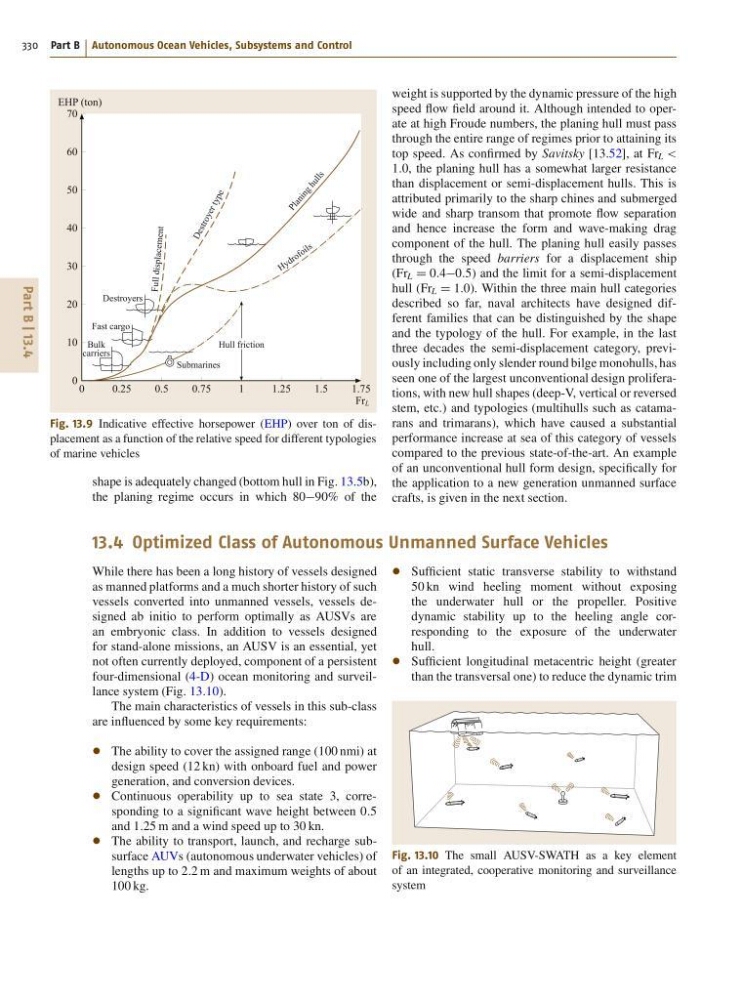
Fig. 13.9 Indicative effective horsepower (EHP) over ton of displacement as a function of the relative speed for different typologies
of marine vehicles
shape is adequately changed (bottom hull in Fig. 13.5b),
the planing regime occurs in which 8090% of the
weight is supported by the dynamic pressure of the high
speed flow field around it. Although intended to operate at high Froude numbers, the planing hull must pass
through the entire range of regimes prior to attaining its
top speed. As confirmed by Savitsky [13.52], at Fr L <
1:0, the planing hull has a somewhat larger resistance
than displacement or semi-displacement hulls. This is
attributed primarily to the sharp chines and submerged
wide and sharp transom that promote flow separation
and hence increase the form and wave-making drag
component of the hull. The planing hull easily passes
through the speed barriers for a displacement ship
(Fr L D 0:40:5) and the limit for a semi-displacement
hull (Fr L D 1:0). Within the three main hull categories
described so far, naval architects have designed different families that can be distinguished by the shape
and the typology of the hull. For example, in the last
three decades the semi-displacement category, previously including only slender round bilge monohulls, has
seen one of the largest unconventional design proliferations, with new hull shapes (deep-V, vertical or reversed
stem, etc.) and typologies (multihulls such as catamarans and trimarans), which have caused a substantial
performance increase at sea of this category of vessels
compared to the previous state-of-the-art. An example
of an unconventional hull form design, specifically for
the application to a new generation unmanned surface
crafts, is given in the next section.
13.4 Optimized Class of Autonomous Unmanned Surface Vehicles
While there has been a long history of vessels designed
as manned platforms and a much shorter history of such
vessels converted into unmanned vessels, vessels designed ab initio to perform optimally as AUSVs are
an embryonic class. In addition to vessels designed
for stand-alone missions, an AUSV is an essential, yet
not often currently deployed, component of a persistent
four-dimensional (4-D) ocean monitoring and surveillance system (Fig. 13.10).
The main characteristics of vessels in this sub-class
are influenced by some key requirements:
The ability to cover the assigned range (100 nmi) at
design speed (12 kn) with onboard fuel and power
generation, and conversion devices.
Continuous operability up to sea state 3, corresponding to a significant wave height between 0:5
and 1:25 m and a wind speed up to 30 kn.
The ability to transport, launch, and recharge subsurface AUVs (autonomous underwater vehicles) of
lengths up to 2:2 m and maximum weights of about
100 kg.
Sufficient static transverse stability to withstand
50 kn wind heeling moment without exposing
the underwater hull or the propeller. Positive
dynamic stability up to the heeling angle corresponding to the exposure of the underwater
hull.
Sufficient longitudinal metacentric height (greater
than the transversal one) to reduce the dynamic trim
Fig. 13.10 The small AUSV-SWATH as a key element
of an integrated, cooperative monitoring and surveillance
system
330 Part B Autonomous Ocean Vehicles, Subsystems and Control
0
0.25
0.5
Submarines
Hull friction
H y d r o f o i l s
P l a n i n g h u l l s
D e s tr o y e r ty p e
Destroyers
Fast cargo
Bulk
carriers
Full disp lacem ent
0.75
1
1.25
1.5
1.75
EHP (ton)
Fr L
70
60
50
40
30
20
10
0
Fig. 13.9 Indicative effective horsepower (EHP) over ton of displacement as a function of the relative speed for different typologies
of marine vehicles
shape is adequately changed (bottom hull in Fig. 13.5b),
the planing regime occurs in which 8090% of the
weight is supported by the dynamic pressure of the high
speed flow field around it. Although intended to operate at high Froude numbers, the planing hull must pass
through the entire range of regimes prior to attaining its
top speed. As confirmed by Savitsky [13.52], at Fr L <
1:0, the planing hull has a somewhat larger resistance
than displacement or semi-displacement hulls. This is
attributed primarily to the sharp chines and submerged
wide and sharp transom that promote flow separation
and hence increase the form and wave-making drag
component of the hull. The planing hull easily passes
through the speed barriers for a displacement ship
(Fr L D 0:40:5) and the limit for a semi-displacement
hull (Fr L D 1:0). Within the three main hull categories
described so far, naval architects have designed different families that can be distinguished by the shape
and the typology of the hull. For example, in the last
three decades the semi-displacement category, previously including only slender round bilge monohulls, has
seen one of the largest unconventional design proliferations, with new hull shapes (deep-V, vertical or reversed
stem, etc.) and typologies (multihulls such as catamarans and trimarans), which have caused a substantial
performance increase at sea of this category of vessels
compared to the previous state-of-the-art. An example
of an unconventional hull form design, specifically for
the application to a new generation unmanned surface
crafts, is given in the next section.
13.4 Optimized Class of Autonomous Unmanned Surface Vehicles
While there has been a long history of vessels designed
as manned platforms and a much shorter history of such
vessels converted into unmanned vessels, vessels designed ab initio to perform optimally as AUSVs are
an embryonic class. In addition to vessels designed
for stand-alone missions, an AUSV is an essential, yet
not often currently deployed, component of a persistent
four-dimensional (4-D) ocean monitoring and surveillance system (Fig. 13.10).
The main characteristics of vessels in this sub-class
are influenced by some key requirements:
The ability to cover the assigned range (100 nmi) at
design speed (12 kn) with onboard fuel and power
generation, and conversion devices.
Continuous operability up to sea state 3, corresponding to a significant wave height between 0:5
and 1:25 m and a wind speed up to 30 kn.
The ability to transport, launch, and recharge subsurface AUVs (autonomous underwater vehicles) of
lengths up to 2:2 m and maximum weights of about
100 kg.
Sufficient static transverse stability to withstand
50 kn wind heeling moment without exposing
the underwater hull or the propeller. Positive
dynamic stability up to the heeling angle corresponding to the exposure of the underwater
hull.
Sufficient longitudinal metacentric height (greater
than the transversal one) to reduce the dynamic trim
Fig. 13.10 The small AUSV-SWATH as a key element
of an integrated, cooperative monitoring and surveillance
system