

Highly Maneuverable Biorobotic Underwater Vehicles 11.3 Description of Biology-Inspired Vehicles of Emergent Maturity 295
Part B | 11.3
Spin
Slosh
0
0.1
0.2
0.3
0.4
0.5
c) Thrust (N)
a)
b)
θ
φ
Frequency (Hz)
2
1.5
1
0.5
0
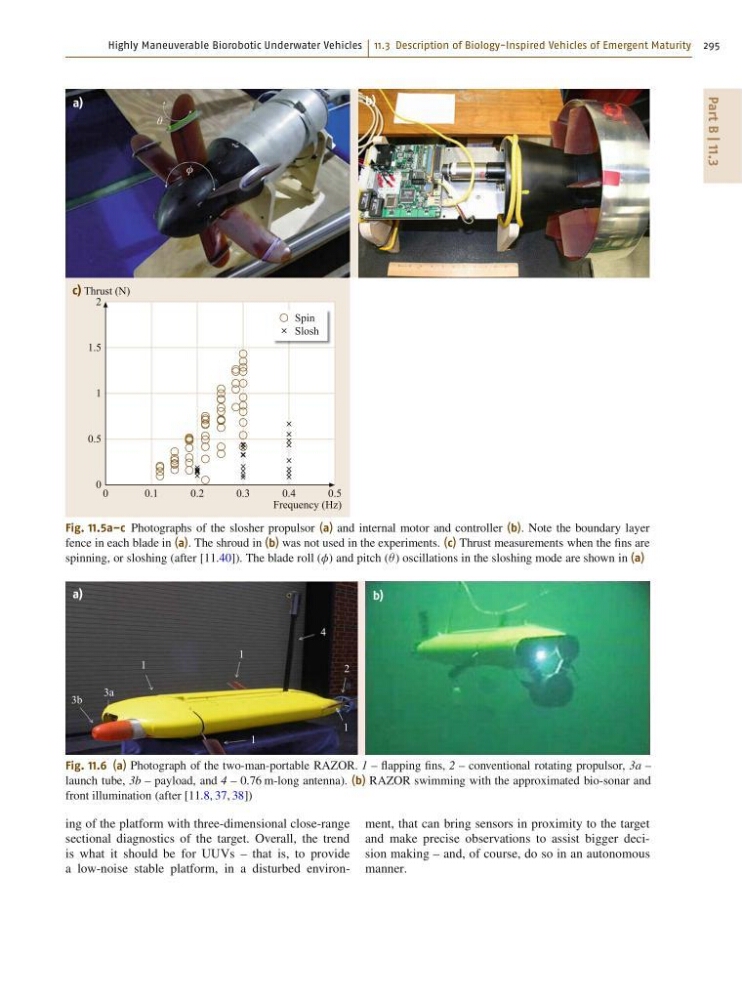
Fig. 11.5a–c Photographs of the slosher propulsor (a) and internal motor and controller (b). Note the boundary layer
fence in each blade in (a). The shroud in (b) was not used in the experiments. (c) Thrust measurements when the fins are
spinning, or sloshing (after [11.40]). The blade roll () and pitch (Â) oscillations in the sloshing mode are shown in (a)
a)
b)
1
1
4
2
1
1
3a
3b
Fig. 11.6 (a) Photograph of the two-man-portable RAZOR. 1 – flapping fins, 2 – conventional rotating propulsor, 3a –
launch tube, 3b – payload, and 4 – 0:76 m-long antenna). (b) RAZOR swimming with the approximated bio-sonar and
front illumination (after [11.8, 37, 38])
ing of the platform with three-dimensional close-range
sectional diagnostics of the target. Overall, the trend
is what it should be for UUVs – that is, to provide
a low-noise stable platform, in a disturbed environment, that can bring sensors in proximity to the target
and make precise observations to assist bigger decision making – and, of course, do so in an autonomous
manner.
Part B | 11.3
Spin
Slosh
0
0.1
0.2
0.3
0.4
0.5
c) Thrust (N)
a)
b)
θ
φ
Frequency (Hz)
2
1.5
1
0.5
0
Fig. 11.5a–c Photographs of the slosher propulsor (a) and internal motor and controller (b). Note the boundary layer
fence in each blade in (a). The shroud in (b) was not used in the experiments. (c) Thrust measurements when the fins are
spinning, or sloshing (after [11.40]). The blade roll () and pitch (Â) oscillations in the sloshing mode are shown in (a)
a)
b)
1
1
4
2
1
1
3a
3b
Fig. 11.6 (a) Photograph of the two-man-portable RAZOR. 1 – flapping fins, 2 – conventional rotating propulsor, 3a –
launch tube, 3b – payload, and 4 – 0:76 m-long antenna). (b) RAZOR swimming with the approximated bio-sonar and
front illumination (after [11.8, 37, 38])
ing of the platform with three-dimensional close-range
sectional diagnostics of the target. Overall, the trend
is what it should be for UUVs – that is, to provide
a low-noise stable platform, in a disturbed environment, that can bring sensors in proximity to the target
and make precise observations to assist bigger decision making – and, of course, do so in an autonomous
manner.