

Part B | 11.5
296 Part B Autonomous Ocean Vehicles, Subsystems and Control
11.4 Reliability, Low Power Consumption, and Disturbance Rejection
of Bio-Inspired Propulsion
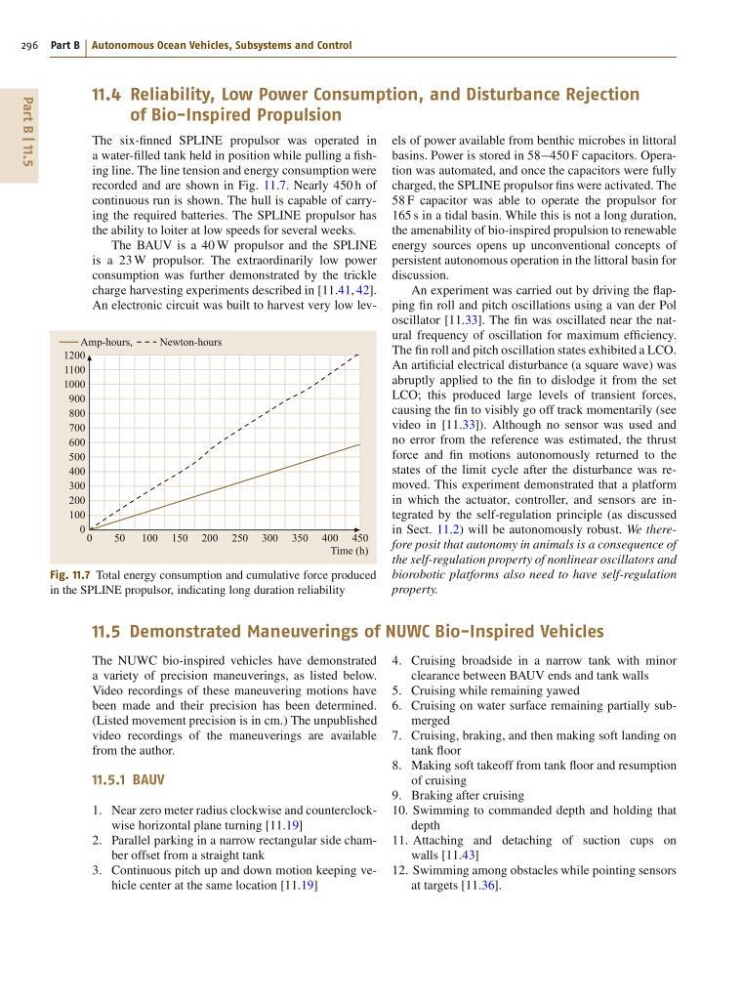
The six-finned SPLINE propulsor was operated in
a water-filled tank held in position while pulling a fishing line. The line tension and energy consumption were
recorded and are shown in Fig. 11.7. Nearly 450 h of
continuous run is shown. The hull is capable of carrying the required batteries. The SPLINE propulsor has
the ability to loiter at low speeds for several weeks.
The BAUV is a 40 W propulsor and the SPLINE
is a 23 W propulsor. The extraordinarily low power
consumption was further demonstrated by the trickle
charge harvesting experiments described in [11.41, 42].
An electronic circuit was built to harvest very low lev0
50
100 150 200 250 300 350 400 450
Amp-hours,
Newton-hours
Time (h)
1200
1100
1000
900
800
700
600
500
400
300
200
100
0
Fig. 11.7 Total energy consumption and cumulative force produced
in the SPLINE propulsor, indicating long duration reliability
els of power available from benthic microbes in littoral
basins. Power is stored in 58450 F capacitors. Operation was automated, and once the capacitors were fully
charged, the SPLINE propulsor fins were activated. The
58 F capacitor was able to operate the propulsor for
165 s in a tidal basin. While this is not a long duration,
the amenability of bio-inspired propulsion to renewable
energy sources opens up unconventional concepts of
persistent autonomous operation in the littoral basin for
discussion.
An experiment was carried out by driving the flapping fin roll and pitch oscillations using a van der Pol
oscillator [11.33]. The fin was oscillated near the natural frequency of oscillation for maximum efficiency.
The fin roll and pitch oscillation states exhibited a LCO.
An artificial electrical disturbance (a square wave) was
abruptly applied to the fin to dislodge it from the set
LCO; this produced large levels of transient forces,
causing the fin to visibly go off track momentarily (see
video in [11.33]). Although no sensor was used and
no error from the reference was estimated, the thrust
force and fin motions autonomously returned to the
states of the limit cycle after the disturbance was removed. This experiment demonstrated that a platform
in which the actuator, controller, and sensors are integrated by the self-regulation principle (as discussed
in Sect. 11.2) will be autonomously robust. We therefore posit that autonomy in animals is a consequence of
the self-regulation property of nonlinear oscillators and
biorobotic platforms also need to have self-regulation
property.
11.5 Demonstrated Maneuverings of NUWC Bio-Inspired Vehicles
The NUWC bio-inspired vehicles have demonstrated
a variety of precision maneuverings, as listed below.
Video recordings of these maneuvering motions have
been made and their precision has been determined.
(Listed movement precision is in cm.) The unpublished
video recordings of the maneuverings are available
from the author.
11.5.1 BAUV
1. Near zero meter radius clockwise and counterclockwise horizontal plane turning [11.19]
2. Parallel parking in a narrow rectangular side chamber offset from a straight tank
3. Continuous pitch up and down motion keeping vehicle center at the same location [11.19]
4. Cruising broadside in a narrow tank with minor
clearance between BAUV ends and tank walls
5. Cruising while remaining yawed
6. Cruising on water surface remaining partially submerged
7. Cruising, braking, and then making soft landing on
tank floor
8. Making soft takeoff from tank floor and resumption
of cruising
9. Braking after cruising
10. Swimming to commanded depth and holding that
depth
11. Attaching and detaching of suction cups on
walls [11.43]
12. Swimming among obstacles while pointing sensors
at targets [11.36].
296 Part B Autonomous Ocean Vehicles, Subsystems and Control
11.4 Reliability, Low Power Consumption, and Disturbance Rejection
of Bio-Inspired Propulsion
The six-finned SPLINE propulsor was operated in
a water-filled tank held in position while pulling a fishing line. The line tension and energy consumption were
recorded and are shown in Fig. 11.7. Nearly 450 h of
continuous run is shown. The hull is capable of carrying the required batteries. The SPLINE propulsor has
the ability to loiter at low speeds for several weeks.
The BAUV is a 40 W propulsor and the SPLINE
is a 23 W propulsor. The extraordinarily low power
consumption was further demonstrated by the trickle
charge harvesting experiments described in [11.41, 42].
An electronic circuit was built to harvest very low lev0
50
100 150 200 250 300 350 400 450
Amp-hours,
Newton-hours
Time (h)
1200
1100
1000
900
800
700
600
500
400
300
200
100
0
Fig. 11.7 Total energy consumption and cumulative force produced
in the SPLINE propulsor, indicating long duration reliability
els of power available from benthic microbes in littoral
basins. Power is stored in 58450 F capacitors. Operation was automated, and once the capacitors were fully
charged, the SPLINE propulsor fins were activated. The
58 F capacitor was able to operate the propulsor for
165 s in a tidal basin. While this is not a long duration,
the amenability of bio-inspired propulsion to renewable
energy sources opens up unconventional concepts of
persistent autonomous operation in the littoral basin for
discussion.
An experiment was carried out by driving the flapping fin roll and pitch oscillations using a van der Pol
oscillator [11.33]. The fin was oscillated near the natural frequency of oscillation for maximum efficiency.
The fin roll and pitch oscillation states exhibited a LCO.
An artificial electrical disturbance (a square wave) was
abruptly applied to the fin to dislodge it from the set
LCO; this produced large levels of transient forces,
causing the fin to visibly go off track momentarily (see
video in [11.33]). Although no sensor was used and
no error from the reference was estimated, the thrust
force and fin motions autonomously returned to the
states of the limit cycle after the disturbance was removed. This experiment demonstrated that a platform
in which the actuator, controller, and sensors are integrated by the self-regulation principle (as discussed
in Sect. 11.2) will be autonomously robust. We therefore posit that autonomy in animals is a consequence of
the self-regulation property of nonlinear oscillators and
biorobotic platforms also need to have self-regulation
property.
11.5 Demonstrated Maneuverings of NUWC Bio-Inspired Vehicles
The NUWC bio-inspired vehicles have demonstrated
a variety of precision maneuverings, as listed below.
Video recordings of these maneuvering motions have
been made and their precision has been determined.
(Listed movement precision is in cm.) The unpublished
video recordings of the maneuverings are available
from the author.
11.5.1 BAUV
1. Near zero meter radius clockwise and counterclockwise horizontal plane turning [11.19]
2. Parallel parking in a narrow rectangular side chamber offset from a straight tank
3. Continuous pitch up and down motion keeping vehicle center at the same location [11.19]
4. Cruising broadside in a narrow tank with minor
clearance between BAUV ends and tank walls
5. Cruising while remaining yawed
6. Cruising on water surface remaining partially submerged
7. Cruising, braking, and then making soft landing on
tank floor
8. Making soft takeoff from tank floor and resumption
of cruising
9. Braking after cruising
10. Swimming to commanded depth and holding that
depth
11. Attaching and detaching of suction cups on
walls [11.43]
12. Swimming among obstacles while pointing sensors
at targets [11.36].