

Part B | 11.3
294 Part B Autonomous Ocean Vehicles, Subsystems and Control
P
C
S
0
8 0
p
r = 11 m
r = 9 m
r = 10 m
59
7
44
40
1
1
1
90
100
d) Latitudinal distance (m)
a)
b)
c)
Longitudinal distance (m)
130
120
110
100
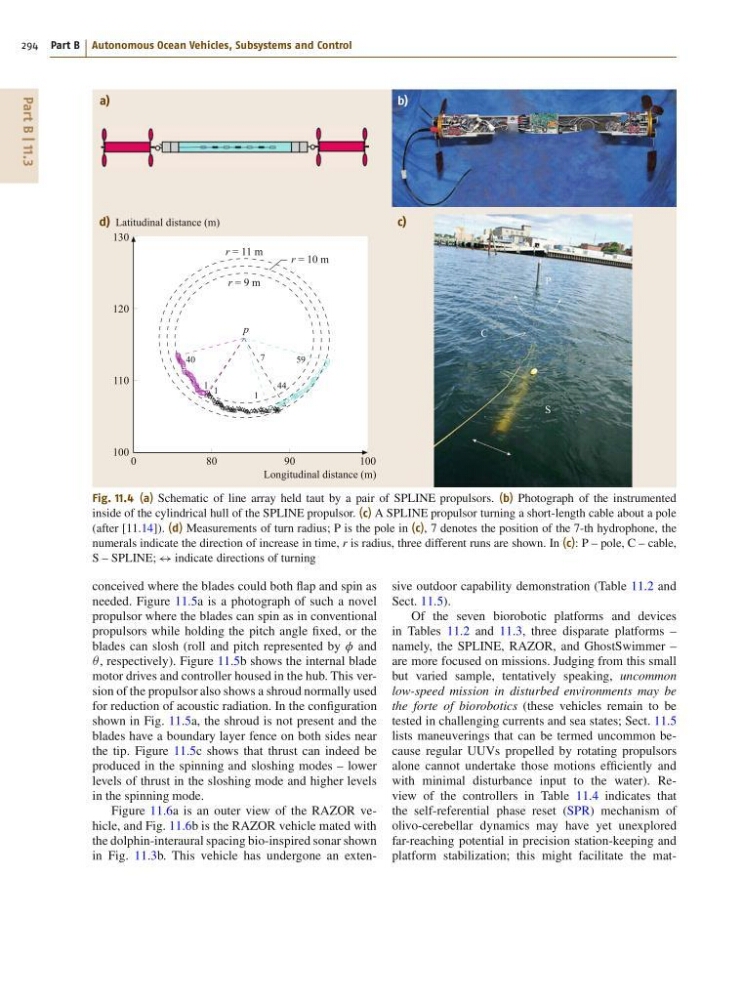
Fig. 11.4 (a) Schematic of line array held taut by a pair of SPLINE propulsors. (b) Photograph of the instrumented
inside of the cylindrical hull of the SPLINE propulsor. (c) A SPLINE propulsor turning a short-length cable about a pole
(after [11.14]). (d) Measurements of turn radius; P is the pole in (c), 7 denotes the position of the 7-th hydrophone, the
numerals indicate the direction of increase in time, r is radius, three different runs are shown. In (c): P – pole, C – cable,
S – SPLINE; $ indicate directions of turning
conceived where the blades could both flap and spin as
needed. Figure 11.5a is a photograph of such a novel
propulsor where the blades can spin as in conventional
propulsors while holding the pitch angle fixed, or the
blades can slosh (roll and pitch represented by and
 , respectively). Figure 11.5b shows the internal blade
motor drives and controller housed in the hub. This version of the propulsor also shows a shroud normally used
for reduction of acoustic radiation. In the configuration
shown in Fig. 11.5a, the shroud is not present and the
blades have a boundary layer fence on both sides near
the tip. Figure 11.5c shows that thrust can indeed be
produced in the spinning and sloshing modes – lower
levels of thrust in the sloshing mode and higher levels
in the spinning mode.
Figure 11.6a is an outer view of the RAZOR vehicle, and Fig. 11.6b is the RAZOR vehicle mated with
the dolphin-interaural spacing bio-inspired sonar shown
in Fig. 11.3b. This vehicle has undergone an extensive outdoor capability demonstration (Table 11.2 and
Sect. 11.5).
Of the seven biorobotic platforms and devices
in Tables 11.2 and 11.3, three disparate platforms –
namely, the SPLINE, RAZOR, and GhostSwimmer –
are more focused on missions. Judging from this small
but varied sample, tentatively speaking, uncommon
low-speed mission in disturbed environments may be
the forte of biorobotics (these vehicles remain to be
tested in challenging currents and sea states; Sect. 11.5
lists maneuverings that can be termed uncommon because regular UUVs propelled by rotating propulsors
alone cannot undertake those motions efficiently and
with minimal disturbance input to the water). Review of the controllers in Table 11.4 indicates that
the self-referential phase reset (SPR) mechanism of
olivo-cerebellar dynamics may have yet unexplored
far-reaching potential in precision station-keeping and
platform stabilization; this might facilitate the mat-
294 Part B Autonomous Ocean Vehicles, Subsystems and Control
P
C
S
0
8 0
p
r = 11 m
r = 9 m
r = 10 m
59
7
44
40
1
1
1
90
100
d) Latitudinal distance (m)
a)
b)
c)
Longitudinal distance (m)
130
120
110
100
Fig. 11.4 (a) Schematic of line array held taut by a pair of SPLINE propulsors. (b) Photograph of the instrumented
inside of the cylindrical hull of the SPLINE propulsor. (c) A SPLINE propulsor turning a short-length cable about a pole
(after [11.14]). (d) Measurements of turn radius; P is the pole in (c), 7 denotes the position of the 7-th hydrophone, the
numerals indicate the direction of increase in time, r is radius, three different runs are shown. In (c): P – pole, C – cable,
S – SPLINE; $ indicate directions of turning
conceived where the blades could both flap and spin as
needed. Figure 11.5a is a photograph of such a novel
propulsor where the blades can spin as in conventional
propulsors while holding the pitch angle fixed, or the
blades can slosh (roll and pitch represented by and
 , respectively). Figure 11.5b shows the internal blade
motor drives and controller housed in the hub. This version of the propulsor also shows a shroud normally used
for reduction of acoustic radiation. In the configuration
shown in Fig. 11.5a, the shroud is not present and the
blades have a boundary layer fence on both sides near
the tip. Figure 11.5c shows that thrust can indeed be
produced in the spinning and sloshing modes – lower
levels of thrust in the sloshing mode and higher levels
in the spinning mode.
Figure 11.6a is an outer view of the RAZOR vehicle, and Fig. 11.6b is the RAZOR vehicle mated with
the dolphin-interaural spacing bio-inspired sonar shown
in Fig. 11.3b. This vehicle has undergone an extensive outdoor capability demonstration (Table 11.2 and
Sect. 11.5).
Of the seven biorobotic platforms and devices
in Tables 11.2 and 11.3, three disparate platforms –
namely, the SPLINE, RAZOR, and GhostSwimmer –
are more focused on missions. Judging from this small
but varied sample, tentatively speaking, uncommon
low-speed mission in disturbed environments may be
the forte of biorobotics (these vehicles remain to be
tested in challenging currents and sea states; Sect. 11.5
lists maneuverings that can be termed uncommon because regular UUVs propelled by rotating propulsors
alone cannot undertake those motions efficiently and
with minimal disturbance input to the water). Review of the controllers in Table 11.4 indicates that
the self-referential phase reset (SPR) mechanism of
olivo-cerebellar dynamics may have yet unexplored
far-reaching potential in precision station-keeping and
platform stabilization; this might facilitate the mat-