

Highly Maneuverable Biorobotic Underwater Vehicles 11.3 Description of Biology-Inspired Vehicles of Emergent Maturity 293
Part B | 11.3
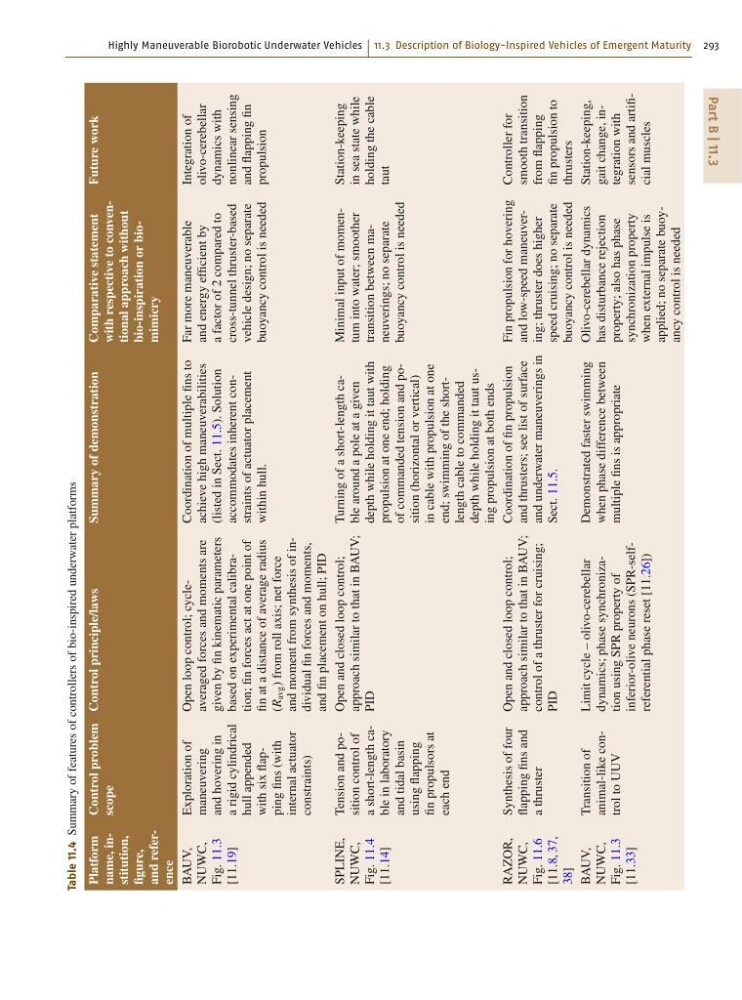
Table 11.4
Summary of features of controllers of bio-inspired underwater platforms
Platform
name, institution,
figure,
and reference
Control problem
scope
Control principle/laws
Summary of demonstration
Comparative statement
with respective to conventional approach without
bio-inspiration or biomimicry
Future work
BAUV,
NUWC,
Fig. 11.3
[11.19]
Exploration of
maneuvering
and hovering in
a rigid cylindrical
hull appended
with six flapping fins (with
internal actuator
constraints)
Open loop control; cycleaveraged forces and moments are
given by fin kinematic parameters
based on experimental calibration; fin forces act at one point of
fin at a distance of average radius
(R
avg ) from roll axis; net force
and moment from synthesis of individual fin forces and moments,
and fin placement on hull; PID
Coordination of multiple fins to
achieve high maneuverabilities
(listed in Sect. 11.5). Solution
accommodates inherent constraints of actuator placement
within hull.
Far more maneuverable
and energy efficient by
a factor of 2 compared to
cross-tunnel thruster-based
vehicle design; no separate
buoyancy control is needed
Integration of
olivo-cerebellar
dynamics with
nonlinear sensing
and flapping fin
propulsion
SPLINE,
NUWC,
Fig. 11.4
[11.14]
Tension and position control of
a short-length cable in laboratory
and tidal basin
using flapping
fin propulsors at
each end
Open and closed loop control;
approach similar to that in BAUV;
PID
Turning of a short-length cable around a pole at a given
depth while holding it taut with
propulsion at one end; holding
of commanded tension and position (horizontal or vertical)
in cable with propulsion at one
end; swimming of the shortlength cable to commanded
depth while holding it taut using propulsion at both ends
Minimal input of momentum into water; smoother
transition between maneuverings; no separate
buoyancy control is needed
Station-keeping
in sea state while
holding the cable
taut
RAZOR,
NUWC,
Fig. 11.6
[11.8, 37,
38]
Synthesis of four
flapping fins and
a thruster
Open and closed loop control;
approach similar to that in BAUV;
control of a thruster for cruising;
PID
Coordination of fin propulsion
and thrusters; see list of surface
and underwater maneuverings in
Sect. 11.5.
Fin propulsion for hovering
and low-speed maneuvering; thruster does higher
speed cruising; no separate
buoyancy control is needed
Controller for
smooth transition
from flapping
fin propulsion to
thrusters
BAUV,
NUWC,
Fig. 11.3
[11.33]
Transition of
animal-like control to UUV
Limit cycle – olivo-cerebellar
dynamics; phase synchronization using SPR property of
inferior-olive neurons (SPR-selfreferential phase reset [11.26])
Demonstrated faster swimming
when phase difference between
multiple fins is appropriate
Olivo-cerebellar dynamics
has disturbance rejection
property; also has phase
synchronization property
when external impulse is
applied; no separate buoyancy control is needed
Station-keeping,
gait change, integration with
sensors and artificial muscles
Part B | 11.3
Table 11.4
Summary of features of controllers of bio-inspired underwater platforms
Platform
name, institution,
figure,
and reference
Control problem
scope
Control principle/laws
Summary of demonstration
Comparative statement
with respective to conventional approach without
bio-inspiration or biomimicry
Future work
BAUV,
NUWC,
Fig. 11.3
[11.19]
Exploration of
maneuvering
and hovering in
a rigid cylindrical
hull appended
with six flapping fins (with
internal actuator
constraints)
Open loop control; cycleaveraged forces and moments are
given by fin kinematic parameters
based on experimental calibration; fin forces act at one point of
fin at a distance of average radius
(R
avg ) from roll axis; net force
and moment from synthesis of individual fin forces and moments,
and fin placement on hull; PID
Coordination of multiple fins to
achieve high maneuverabilities
(listed in Sect. 11.5). Solution
accommodates inherent constraints of actuator placement
within hull.
Far more maneuverable
and energy efficient by
a factor of 2 compared to
cross-tunnel thruster-based
vehicle design; no separate
buoyancy control is needed
Integration of
olivo-cerebellar
dynamics with
nonlinear sensing
and flapping fin
propulsion
SPLINE,
NUWC,
Fig. 11.4
[11.14]
Tension and position control of
a short-length cable in laboratory
and tidal basin
using flapping
fin propulsors at
each end
Open and closed loop control;
approach similar to that in BAUV;
PID
Turning of a short-length cable around a pole at a given
depth while holding it taut with
propulsion at one end; holding
of commanded tension and position (horizontal or vertical)
in cable with propulsion at one
end; swimming of the shortlength cable to commanded
depth while holding it taut using propulsion at both ends
Minimal input of momentum into water; smoother
transition between maneuverings; no separate
buoyancy control is needed
Station-keeping
in sea state while
holding the cable
taut
RAZOR,
NUWC,
Fig. 11.6
[11.8, 37,
38]
Synthesis of four
flapping fins and
a thruster
Open and closed loop control;
approach similar to that in BAUV;
control of a thruster for cruising;
PID
Coordination of fin propulsion
and thrusters; see list of surface
and underwater maneuverings in
Sect. 11.5.
Fin propulsion for hovering
and low-speed maneuvering; thruster does higher
speed cruising; no separate
buoyancy control is needed
Controller for
smooth transition
from flapping
fin propulsion to
thrusters
BAUV,
NUWC,
Fig. 11.3
[11.33]
Transition of
animal-like control to UUV
Limit cycle – olivo-cerebellar
dynamics; phase synchronization using SPR property of
inferior-olive neurons (SPR-selfreferential phase reset [11.26])
Demonstrated faster swimming
when phase difference between
multiple fins is appropriate
Olivo-cerebellar dynamics
has disturbance rejection
property; also has phase
synchronization property
when external impulse is
applied; no separate buoyancy control is needed
Station-keeping,
gait change, integration with
sensors and artificial muscles