

Part B | 11.3
290 Part B Autonomous Ocean Vehicles, Subsystems and Control
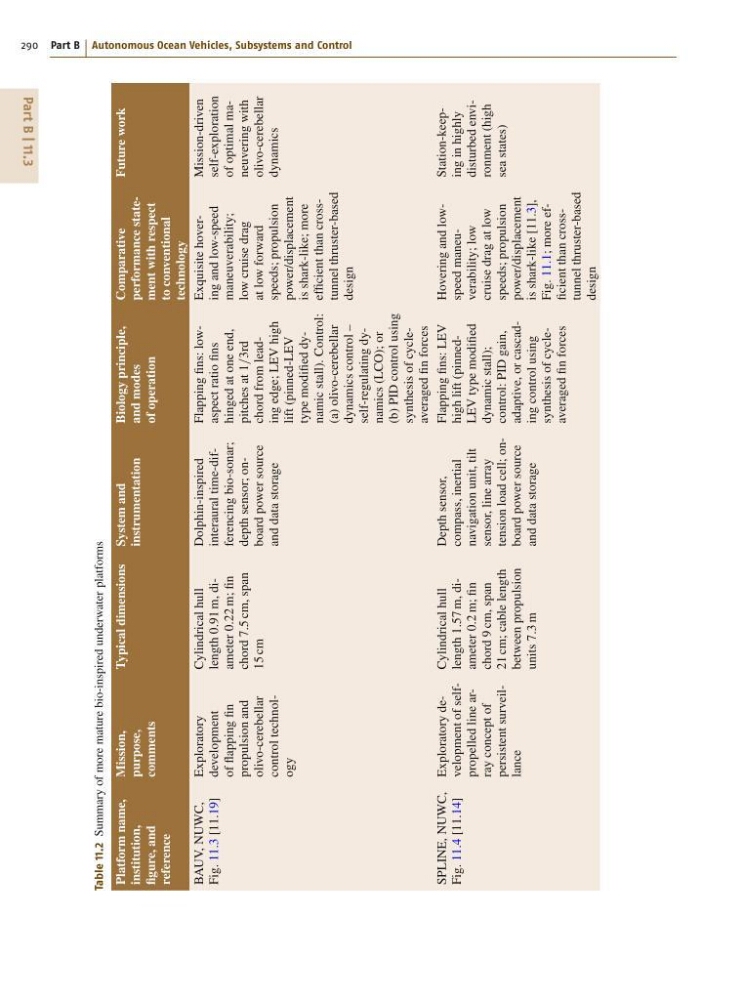
Table 11.2
Summary of more mature bio-inspired underwater platforms
Platform name,
institution,
figure, and
reference
Mission,
purpose,
comments
Typical dimensions System and
instrumentation
Biology principle,
and modes
of operation
Comparative
performance statement with respect
to conventional
technology
Future work
BAUV, NUWC,
Fig. 11.3 [11.19]
Exploratory
development
of flapping fin
propulsion and
olivo-cerebellar
control technology
Cylindrical hull
length 0:91 m, diameter 0:22 m; fin
chord 7:5 cm, span
15 cm
Dolphin-inspired
interaural time-differencing bio-sonar;
depth sensor; onboard power source
and data storage
Flapping fins: lowaspect ratio fins
hinged at one end,
pitches at 1=3rd
chord from leading edge; LEV high
lift (pinned-LEV
type modified dynamic stall). Control:
(a) olivo-cerebellar
dynamics control –
self-regulating dynamics (LCO); or
(b) PID control using
synthesis of cycleaveraged fin forces
Exquisite hovering and low-speed
maneuverability;
low cruise drag
at low forward
speeds; propulsion
power/displacement
is shark-like; more
efficient than crosstunnel thruster-based
design
Mission-driven
self-exploration
of optimal maneuvering with
olivo-cerebellar
dynamics
SPLINE, NUWC,
Fig. 11.4 [11.14]
Exploratory development of selfpropelled line array concept of
persistent surveillance
Cylindrical hull
length 1:57 m, diameter 0:2 m; fin
chord 9 cm, span
21 cm; cable length
between propulsion
units 7:3 m
Depth sensor,
compass, inertial
navigation unit, tilt
sensor, line array
tension load cell; onboard power source
and data storage
Flapping fins: LEV
high lift (pinnedLEV type modified
dynamic stall);
control: PID gain,
adaptive, or cascading control using
synthesis of cycleaveraged fin forces
Hovering and lowspeed maneuverability; low
cruise drag at low
speeds; propulsion
power/displacement
is shark-like [11.3],
Fig. 11.1; more efficient than crosstunnel thruster-based
design
Station-keeping in highly
disturbed environment (high
sea states)
290 Part B Autonomous Ocean Vehicles, Subsystems and Control
Table 11.2
Summary of more mature bio-inspired underwater platforms
Platform name,
institution,
figure, and
reference
Mission,
purpose,
comments
Typical dimensions System and
instrumentation
Biology principle,
and modes
of operation
Comparative
performance statement with respect
to conventional
technology
Future work
BAUV, NUWC,
Fig. 11.3 [11.19]
Exploratory
development
of flapping fin
propulsion and
olivo-cerebellar
control technology
Cylindrical hull
length 0:91 m, diameter 0:22 m; fin
chord 7:5 cm, span
15 cm
Dolphin-inspired
interaural time-differencing bio-sonar;
depth sensor; onboard power source
and data storage
Flapping fins: lowaspect ratio fins
hinged at one end,
pitches at 1=3rd
chord from leading edge; LEV high
lift (pinned-LEV
type modified dynamic stall). Control:
(a) olivo-cerebellar
dynamics control –
self-regulating dynamics (LCO); or
(b) PID control using
synthesis of cycleaveraged fin forces
Exquisite hovering and low-speed
maneuverability;
low cruise drag
at low forward
speeds; propulsion
power/displacement
is shark-like; more
efficient than crosstunnel thruster-based
design
Mission-driven
self-exploration
of optimal maneuvering with
olivo-cerebellar
dynamics
SPLINE, NUWC,
Fig. 11.4 [11.14]
Exploratory development of selfpropelled line array concept of
persistent surveillance
Cylindrical hull
length 1:57 m, diameter 0:2 m; fin
chord 9 cm, span
21 cm; cable length
between propulsion
units 7:3 m
Depth sensor,
compass, inertial
navigation unit, tilt
sensor, line array
tension load cell; onboard power source
and data storage
Flapping fins: LEV
high lift (pinnedLEV type modified
dynamic stall);
control: PID gain,
adaptive, or cascading control using
synthesis of cycleaveraged fin forces
Hovering and lowspeed maneuverability; low
cruise drag at low
speeds; propulsion
power/displacement
is shark-like [11.3],
Fig. 11.1; more efficient than crosstunnel thruster-based
design
Station-keeping in highly
disturbed environment (high
sea states)