

Control Theory and Applications 10.5 Course-Keeping Autopilots 269
Part A | 10.5
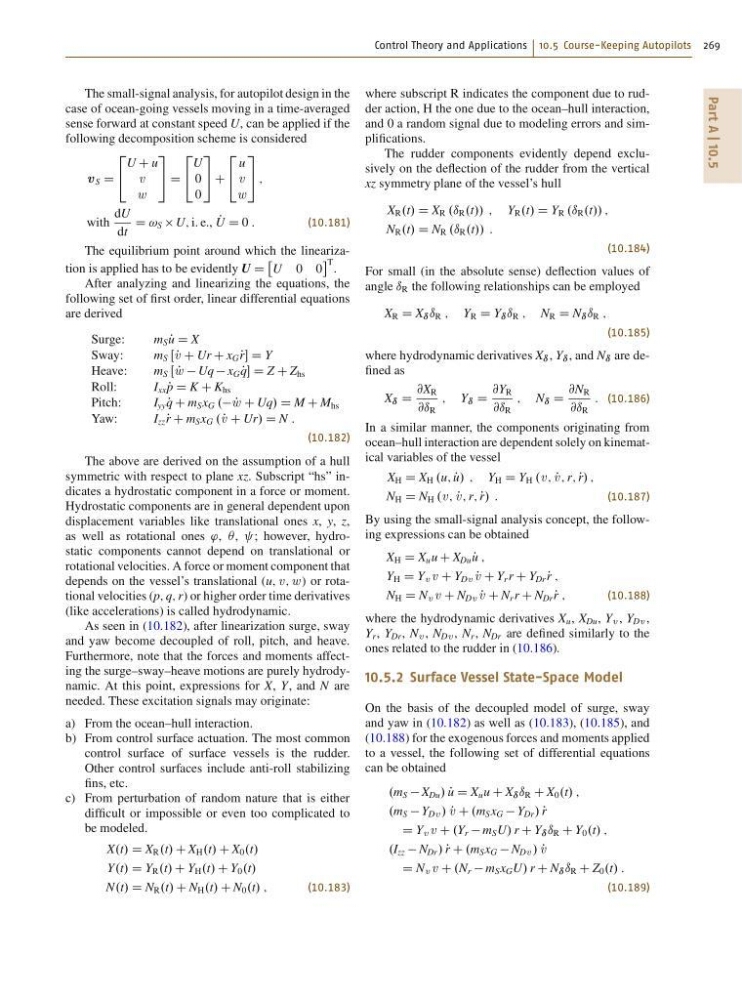
The small-signal analysis, for autopilot design in the
case of ocean-going vessels moving in a time-averaged
sense forward at constant speed U, can be applied if the
following decomposition scheme is considered
v S D
2
4
U C u
v
w
3
5 D
2
4
U
0
0
3
5 C
2
4
u
v
w
3
5 ;
with
dU
dt
D ! S U; i. e., P
U D 0 :
(10.181)
The equilibrium point around which the linearization is applied has to be evidently U D
U 0 0
T .
After analyzing and linearizing the equations, the
following set of first order, linear differential equations
are derived
Surge:
m S P
u D X
Sway:
m S ΠP
v C Ur C x G P
r D Y
Heave:
m S ΠP
w Uq x G P
q D Z C Z hs
Roll:
I xx P
p D K C K hs
Pitch:
I yy P
q C m S x G . P
w C Uq/ D M C M hs
Yaw:
I zz P
r C m S x G . P
v C Ur/ D N :
(10.182)
The above are derived on the assumption of a hull
symmetric with respect to plane xz. Subscript “hs” indicates a hydrostatic component in a force or moment.
Hydrostatic components are in general dependent upon
displacement variables like translational ones x, y, z,
as well as rotational ones ', Â , ; however, hydrostatic components cannot depend on translational or
rotational velocities. A force or moment component that
depends on the vessel’s translational (u; v ; w ) or rotational velocities (p; q; r) or higher order time derivatives
(like accelerations) is called hydrodynamic.
As seen in (10.182), after linearization surge, sway
and yaw become decoupled of roll, pitch, and heave.
Furthermore, note that the forces and moments affecting the surge–sway–heave motions are purely hydrodynamic. At this point, expressions for X, Y, and N are
needed. These excitation signals may originate:
a) From the ocean–hull interaction.
b) From control surface actuation. The most common
control surface of surface vessels is the rudder.
Other control surfaces include anti-roll stabilizing
fins, etc.
c) From perturbation of random nature that is either
difficult or impossible or even too complicated to
be modeled.
X.t/ D X R .t/ C X H .t/ C X 0 .t/
Y.t/ D Y R .t/ C Y H .t/ C Y 0 .t/
N.t/ D N R .t/ C N H .t/ C N 0 .t/ ;
(10.183)
where subscript R indicates the component due to rudder action, H the one due to the ocean–hull interaction,
and 0 a random signal due to modeling errors and simplifications.
The rudder components evidently depend exclusively on the deflection of the rudder from the vertical
xz symmetry plane of the vessel’s hull
X R .t/ D X R .ı R .t// ; Y R .t/ D Y R .ı R .t// ;
N R .t/ D N R .ı R .t// :
(10.184)
For small (in the absolute sense) deflection values of
angle ı R the following relationships can be employed
X R D X ı ı R ; Y R D Y ı ı R ; N R D N ı ı R ;
(10.185)
where hydrodynamic derivatives X ı , Y ı , and N ı are defined as
X ı D
@X R
@ı R
; Y ı D
@Y R
@ı R
; N ı D
@N R
@ı R
: (10.186)
In a similar manner, the components originating from
ocean–hull interaction are dependent solely on kinematical variables of the vessel
X H D X H .u; P
u/ ; Y H D Y H .v ; P
v ; r; P
r/ ;
N H D N H .v ; P
v ; r; P
r/ :
(10.187)
By using the small-signal analysis concept, the following expressions can be obtained
X H D X u u C X Du P
u ;
Y H D Y v v C Y Dv P
v C Y r r C Y Dr P
r ;
N H D N v v C N Dv P
v C N r r C N Dr P
r ;
(10.188)
where the hydrodynamic derivatives X u , X Du , Y v , Y Dv ,
Y r , Y Dr , N v , N Dv , N r , N Dr are defined similarly to the
ones related to the rudder in (10.186).
10.5.2 Surface Vessel State-Space Model
On the basis of the decoupled model of surge, sway
and yaw in (10.182) as well as (10.183), (10.185), and
(10.188) for the exogenous forces and moments applied
to a vessel, the following set of differential equations
can be obtained
.m S X Du / P
u D X u u C X ı ı R C X 0 .t/ ;
.m S Y Dv / P
v C .m S x G Y Dr / P
r
D Y v v C .Y r m S U/ r C Y ı ı R C Y 0 .t/ ;
.I zz N Dr / P
r C .m S x G N Dv / P
v
D N v v C .N r m S x G U/ r C N ı ı R C Z 0 .t/ :
(10.189)
Part A | 10.5
The small-signal analysis, for autopilot design in the
case of ocean-going vessels moving in a time-averaged
sense forward at constant speed U, can be applied if the
following decomposition scheme is considered
v S D
2
4
U C u
v
w
3
5 D
2
4
U
0
0
3
5 C
2
4
u
v
w
3
5 ;
with
dU
dt
D ! S U; i. e., P
U D 0 :
(10.181)
The equilibrium point around which the linearization is applied has to be evidently U D
U 0 0
T .
After analyzing and linearizing the equations, the
following set of first order, linear differential equations
are derived
Surge:
m S P
u D X
Sway:
m S ΠP
v C Ur C x G P
r D Y
Heave:
m S ΠP
w Uq x G P
q D Z C Z hs
Roll:
I xx P
p D K C K hs
Pitch:
I yy P
q C m S x G . P
w C Uq/ D M C M hs
Yaw:
I zz P
r C m S x G . P
v C Ur/ D N :
(10.182)
The above are derived on the assumption of a hull
symmetric with respect to plane xz. Subscript “hs” indicates a hydrostatic component in a force or moment.
Hydrostatic components are in general dependent upon
displacement variables like translational ones x, y, z,
as well as rotational ones ', Â , ; however, hydrostatic components cannot depend on translational or
rotational velocities. A force or moment component that
depends on the vessel’s translational (u; v ; w ) or rotational velocities (p; q; r) or higher order time derivatives
(like accelerations) is called hydrodynamic.
As seen in (10.182), after linearization surge, sway
and yaw become decoupled of roll, pitch, and heave.
Furthermore, note that the forces and moments affecting the surge–sway–heave motions are purely hydrodynamic. At this point, expressions for X, Y, and N are
needed. These excitation signals may originate:
a) From the ocean–hull interaction.
b) From control surface actuation. The most common
control surface of surface vessels is the rudder.
Other control surfaces include anti-roll stabilizing
fins, etc.
c) From perturbation of random nature that is either
difficult or impossible or even too complicated to
be modeled.
X.t/ D X R .t/ C X H .t/ C X 0 .t/
Y.t/ D Y R .t/ C Y H .t/ C Y 0 .t/
N.t/ D N R .t/ C N H .t/ C N 0 .t/ ;
(10.183)
where subscript R indicates the component due to rudder action, H the one due to the ocean–hull interaction,
and 0 a random signal due to modeling errors and simplifications.
The rudder components evidently depend exclusively on the deflection of the rudder from the vertical
xz symmetry plane of the vessel’s hull
X R .t/ D X R .ı R .t// ; Y R .t/ D Y R .ı R .t// ;
N R .t/ D N R .ı R .t// :
(10.184)
For small (in the absolute sense) deflection values of
angle ı R the following relationships can be employed
X R D X ı ı R ; Y R D Y ı ı R ; N R D N ı ı R ;
(10.185)
where hydrodynamic derivatives X ı , Y ı , and N ı are defined as
X ı D
@X R
@ı R
; Y ı D
@Y R
@ı R
; N ı D
@N R
@ı R
: (10.186)
In a similar manner, the components originating from
ocean–hull interaction are dependent solely on kinematical variables of the vessel
X H D X H .u; P
u/ ; Y H D Y H .v ; P
v ; r; P
r/ ;
N H D N H .v ; P
v ; r; P
r/ :
(10.187)
By using the small-signal analysis concept, the following expressions can be obtained
X H D X u u C X Du P
u ;
Y H D Y v v C Y Dv P
v C Y r r C Y Dr P
r ;
N H D N v v C N Dv P
v C N r r C N Dr P
r ;
(10.188)
where the hydrodynamic derivatives X u , X Du , Y v , Y Dv ,
Y r , Y Dr , N v , N Dv , N r , N Dr are defined similarly to the
ones related to the rudder in (10.186).
10.5.2 Surface Vessel State-Space Model
On the basis of the decoupled model of surge, sway
and yaw in (10.182) as well as (10.183), (10.185), and
(10.188) for the exogenous forces and moments applied
to a vessel, the following set of differential equations
can be obtained
.m S X Du / P
u D X u u C X ı ı R C X 0 .t/ ;
.m S Y Dv / P
v C .m S x G Y Dr / P
r
D Y v v C .Y r m S U/ r C Y ı ı R C Y 0 .t/ ;
.I zz N Dr / P
r C .m S x G N Dv / P
v
D N v v C .N r m S x G U/ r C N ı ı R C Z 0 .t/ :
(10.189)