

Part A | 9.5
222 Part A Fundamentals
following FIR one with memory M
O
H FIR .z
1
/ D
M
X
nD0
h.n/z
n
:
(9.118)
Using the approximation above, (9.116) yields
y.n/ D
M
X
kD0
h.k/x.n k/ C v .n/ :
(9.119)
Furthermore, assuming that the recording for waveform
y.t/ spans a finite interval Œ0; T, the identification problem can be reduced to determining the (M C 1) samples
of the impulse response, h.n/, 0 Ä n Ä M, of the unknown system so that the following (L C 1) equations
are satisfied
y.n/ D
M
X
kD0
h.k/x.n k/ C v .n/; 0 Ä n Ä L
and L D
T
T s
:
(9.120)
It is noted here that containing the recording of signal y.t/ within interval Œ0; T allows limiting the need
to record signal x.t/ also in the finite interval ŒMT s ;
CLT s .
In effect, the (.L C 1/ .M C 1/) set of algebraic (9.120) can be put in the following matrix form
y D R
X h C v :
(9.121)
In the above, vectors y and v are defined as follows
y D Œy.0/ y.1/ y.L/
T
v D Œv .0/ v .1/ v .L/
T
:
(9.122)
Vector h is defined as follows
h D Œh.0/ h.1/ h.M/
T
:
(9.123)
G (s)
H (s)
Instrument
dynamics
(known)
Noisy
instrument
response
w (t)
Clean
instrument
response
u (t)
Unknown
waveform
estimate
y (t)
Unknown
waveform
x (t)
Additive
measurement
noise
v (t)
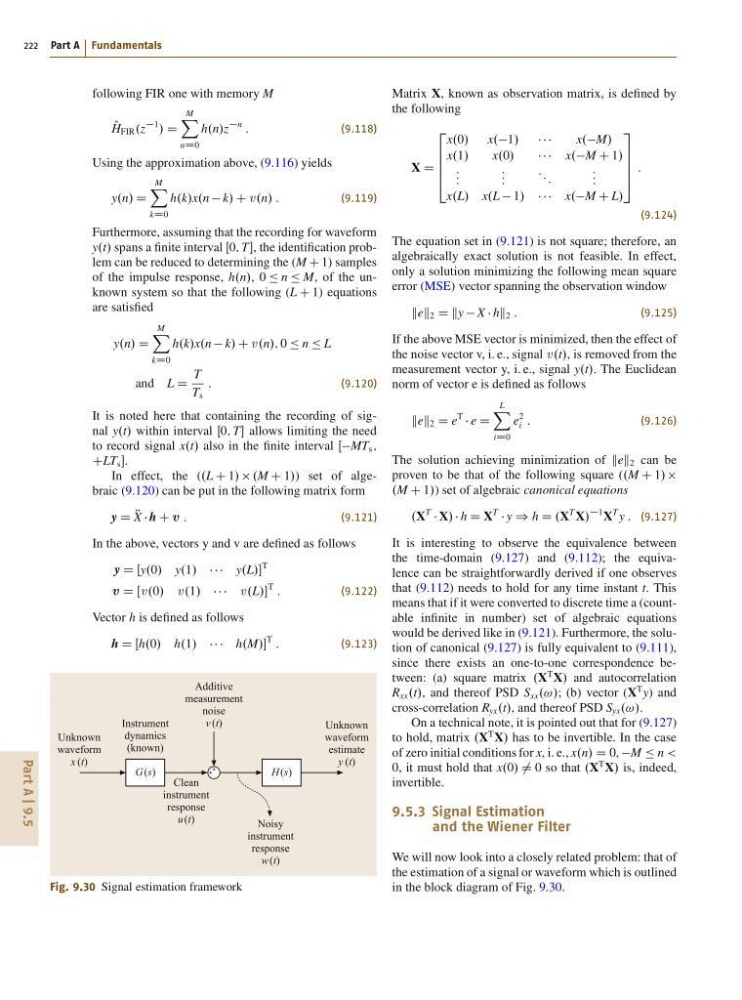
Fig. 9.30 Signal estimation framework
Matrix X, known as observation matrix, is defined by
the following
X D
2
6
6
6
4
x.0/ x.1/
x.M/
x.1/
x.0/
x.M C 1/
: : :
: : :
: : :
: : :
x.L/ x.L 1/ x.M C L/
3
7
7
7
5
:
(9.124)
The equation set in (9.121) is not square; therefore, an
algebraically exact solution is not feasible. In effect,
only a solution minimizing the following mean square
error (MSE) vector spanning the observation window
kek 2 D ky X hk 2 :
(9.125)
If the above MSE vector is minimized, then the effect of
the noise vector v, i. e., signal v .t/, is removed from the
measurement vector y, i. e., signal y.t/. The Euclidean
norm of vector e is defined as follows
kek 2 D e
T
e D
L
X
iD0
e
2
i :
(9.126)
The solution achieving minimization of kek 2 can be
proven to be that of the following square (.M C 1/
.M C 1/) set of algebraic canonical equations
.X
T
X/ h D X
T
y ) h D .X
T X/
1 X
T y : (9.127)
It is interesting to observe the equivalence between
the time-domain (9.127) and (9.112); the equivalence can be straightforwardly derived if one observes
that (9.112) needs to hold for any time instant t. This
means that if it were converted to discrete time a (countable infinite in number) set of algebraic equations
would be derived like in (9.121). Furthermore, the solution of canonical (9.127) is fully equivalent to (9.111),
since there exists an one-to-one correspondence between: (a) square matrix .X
T X/ and autocorrelation
R xx .t/, and thereof PSD S xx .!/; (b) vector (X
T y) and
cross-correlation R yx .t/, and thereof PSD S yx .!/.
On a technical note, it is pointed out that for (9.127)
to hold, matrix .X
T X/ has to be invertible. In the case
of zero initial conditions for x, i. e., x.n/ D 0, M Ä n <
0, it must hold that x.0/ ¤ 0 so that .X
T X/ is, indeed,
invertible.
9.5.3 Signal Estimation
and the Wiener Filter
We will now look into a closely related problem: that of
the estimation of a signal or waveform which is outlined
in the block diagram of Fig. 9.30.
222 Part A Fundamentals
following FIR one with memory M
O
H FIR .z
1
/ D
M
X
nD0
h.n/z
n
:
(9.118)
Using the approximation above, (9.116) yields
y.n/ D
M
X
kD0
h.k/x.n k/ C v .n/ :
(9.119)
Furthermore, assuming that the recording for waveform
y.t/ spans a finite interval Œ0; T, the identification problem can be reduced to determining the (M C 1) samples
of the impulse response, h.n/, 0 Ä n Ä M, of the unknown system so that the following (L C 1) equations
are satisfied
y.n/ D
M
X
kD0
h.k/x.n k/ C v .n/; 0 Ä n Ä L
and L D
T
T s
:
(9.120)
It is noted here that containing the recording of signal y.t/ within interval Œ0; T allows limiting the need
to record signal x.t/ also in the finite interval ŒMT s ;
CLT s .
In effect, the (.L C 1/ .M C 1/) set of algebraic (9.120) can be put in the following matrix form
y D R
X h C v :
(9.121)
In the above, vectors y and v are defined as follows
y D Œy.0/ y.1/ y.L/
T
v D Œv .0/ v .1/ v .L/
T
:
(9.122)
Vector h is defined as follows
h D Œh.0/ h.1/ h.M/
T
:
(9.123)
G (s)
H (s)
Instrument
dynamics
(known)
Noisy
instrument
response
w (t)
Clean
instrument
response
u (t)
Unknown
waveform
estimate
y (t)
Unknown
waveform
x (t)
Additive
measurement
noise
v (t)
Fig. 9.30 Signal estimation framework
Matrix X, known as observation matrix, is defined by
the following
X D
2
6
6
6
4
x.0/ x.1/
x.M/
x.1/
x.0/
x.M C 1/
: : :
: : :
: : :
: : :
x.L/ x.L 1/ x.M C L/
3
7
7
7
5
:
(9.124)
The equation set in (9.121) is not square; therefore, an
algebraically exact solution is not feasible. In effect,
only a solution minimizing the following mean square
error (MSE) vector spanning the observation window
kek 2 D ky X hk 2 :
(9.125)
If the above MSE vector is minimized, then the effect of
the noise vector v, i. e., signal v .t/, is removed from the
measurement vector y, i. e., signal y.t/. The Euclidean
norm of vector e is defined as follows
kek 2 D e
T
e D
L
X
iD0
e
2
i :
(9.126)
The solution achieving minimization of kek 2 can be
proven to be that of the following square (.M C 1/
.M C 1/) set of algebraic canonical equations
.X
T
X/ h D X
T
y ) h D .X
T X/
1 X
T y : (9.127)
It is interesting to observe the equivalence between
the time-domain (9.127) and (9.112); the equivalence can be straightforwardly derived if one observes
that (9.112) needs to hold for any time instant t. This
means that if it were converted to discrete time a (countable infinite in number) set of algebraic equations
would be derived like in (9.121). Furthermore, the solution of canonical (9.127) is fully equivalent to (9.111),
since there exists an one-to-one correspondence between: (a) square matrix .X
T X/ and autocorrelation
R xx .t/, and thereof PSD S xx .!/; (b) vector (X
T y) and
cross-correlation R yx .t/, and thereof PSD S yx .!/.
On a technical note, it is pointed out that for (9.127)
to hold, matrix .X
T X/ has to be invertible. In the case
of zero initial conditions for x, i. e., x.n/ D 0, M Ä n <
0, it must hold that x.0/ ¤ 0 so that .X
T X/ is, indeed,
invertible.
9.5.3 Signal Estimation
and the Wiener Filter
We will now look into a closely related problem: that of
the estimation of a signal or waveform which is outlined
in the block diagram of Fig. 9.30.