

Part A | 8.8
194 Part A Fundamentals
45°E
90°E
135°E
180°
135°W
90°W
45°W
0°
45°E
90°E
45°E
90°E
135°E
180°
135°W
90°W
45°W
0°
45°E
90°E
75°N
60°N
30°N
30°S
60°S
0°
75°N
60°N
30°N
30°S
60°S
0°
Fig. 8.12 The global distribution of Jerlov water types
(after [8.1])
depth and between different regions of the world’s
oceans.
Laboratory measurements of the attenuation, absorption, and scattering coefficients of pure or clear seawater have been reviewed and tabulated [8.16]. The diffuse attenuation coefficients in pure seawater are plotted
in Fig. 8.11, and includes water absorption and a small
amount of scattering from sea salts. The estimated accuracy of this data is reported to be within C25 and 5%
for wavelengths between 300 and 480 nm, and 10 and
5% from 480 to 800 nm. Below 300 nm the data is considered to be no better than an educated estimate [8.16].
The region of minimum attenuation between 400 and
500 nm is called the blue–green window, and has been
the subject of many investigations to engineer underwater communication and detection systems [8.15, 18].
The seminal work of Jerlov produced a classification method for characterizing the optical properties of
the world’s oceans. Based on the measured irradiance
Clear seawater
Water typ I
Water typ IA
Water typ IB
Water typ II
Water typ III
Water typ 1
200
300
400
500
600
700
800
Downward diffuse attenuation coefficient (m
–1 )
Wavelength λ (nm)
10
1
0.1
0.01
Fig. 8.13 Diffuse attenuation coefficient for Jerlov water types (after [8.17])
transmissivity in the upper 10 m of the water, the oceans
are categorized as Type I to III, with a subsequent subdivision of Type I into IA and IB. Coastal waters are
divided into types ranging from 1 to 9. These water clarity classifications account not only for the absorption
and scattering of pure seawater, but also included the
effects of the suspended organic and inorganic particles
as described above. A map of the global distribution of
Jerlov water types is shown in Fig. 8.12 [8.1, p. 584].
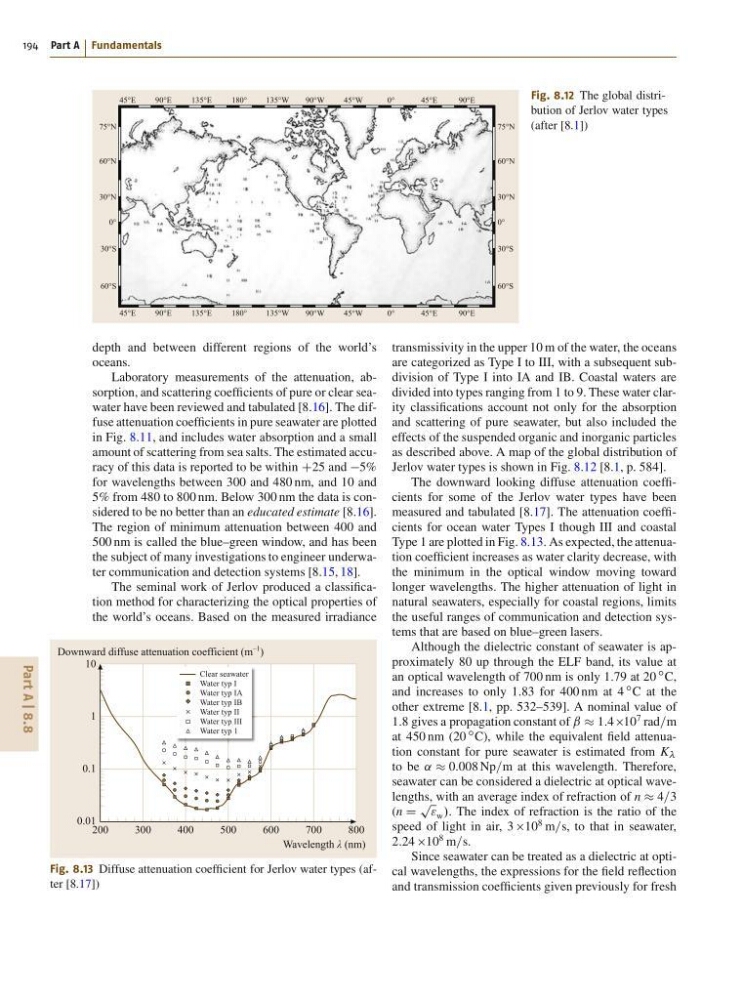
The downward looking diffuse attenuation coefficients for some of the Jerlov water types have been
measured and tabulated [8.17]. The attenuation coefficients for ocean water Types I though III and coastal
Type 1 are plotted in Fig. 8.13. As expected, the attenuation coefficient increases as water clarity decrease, with
the minimum in the optical window moving toward
longer wavelengths. The higher attenuation of light in
natural seawaters, especially for coastal regions, limits
the useful ranges of communication and detection systems that are based on blue–green lasers.
Although the dielectric constant of seawater is approximately 80 up through the ELF band, its value at
an optical wavelength of 700 nm is only 1:79 at 20
ı C,
and increases to only 1:83 for 400 nm at 4
ı C at the
other extreme [8.1, pp. 532–539]. A nominal value of
1:8 gives a propagation constant of ˇ 1:4 10
7 rad=m
at 450 nm (20
ı C), while the equivalent field attenuation constant for pure seawater is estimated from K
to be ˛ 0:008 Np=m at this wavelength. Therefore,
seawater can be considered a dielectric at optical wavelengths, with an average index of refraction of n 4=3
(n D
p
" w /. The index of refraction is the ratio of the
speed of light in air, 3 10
8 m=s, to that in seawater,
2:24 10
8 m=s.
Since seawater can be treated as a dielectric at optical wavelengths, the expressions for the field reflection
and transmission coefficients given previously for fresh
194 Part A Fundamentals
45°E
90°E
135°E
180°
135°W
90°W
45°W
0°
45°E
90°E
45°E
90°E
135°E
180°
135°W
90°W
45°W
0°
45°E
90°E
75°N
60°N
30°N
30°S
60°S
0°
75°N
60°N
30°N
30°S
60°S
0°
Fig. 8.12 The global distribution of Jerlov water types
(after [8.1])
depth and between different regions of the world’s
oceans.
Laboratory measurements of the attenuation, absorption, and scattering coefficients of pure or clear seawater have been reviewed and tabulated [8.16]. The diffuse attenuation coefficients in pure seawater are plotted
in Fig. 8.11, and includes water absorption and a small
amount of scattering from sea salts. The estimated accuracy of this data is reported to be within C25 and 5%
for wavelengths between 300 and 480 nm, and 10 and
5% from 480 to 800 nm. Below 300 nm the data is considered to be no better than an educated estimate [8.16].
The region of minimum attenuation between 400 and
500 nm is called the blue–green window, and has been
the subject of many investigations to engineer underwater communication and detection systems [8.15, 18].
The seminal work of Jerlov produced a classification method for characterizing the optical properties of
the world’s oceans. Based on the measured irradiance
Clear seawater
Water typ I
Water typ IA
Water typ IB
Water typ II
Water typ III
Water typ 1
200
300
400
500
600
700
800
Downward diffuse attenuation coefficient (m
–1 )
Wavelength λ (nm)
10
1
0.1
0.01
Fig. 8.13 Diffuse attenuation coefficient for Jerlov water types (after [8.17])
transmissivity in the upper 10 m of the water, the oceans
are categorized as Type I to III, with a subsequent subdivision of Type I into IA and IB. Coastal waters are
divided into types ranging from 1 to 9. These water clarity classifications account not only for the absorption
and scattering of pure seawater, but also included the
effects of the suspended organic and inorganic particles
as described above. A map of the global distribution of
Jerlov water types is shown in Fig. 8.12 [8.1, p. 584].
The downward looking diffuse attenuation coefficients for some of the Jerlov water types have been
measured and tabulated [8.17]. The attenuation coefficients for ocean water Types I though III and coastal
Type 1 are plotted in Fig. 8.13. As expected, the attenuation coefficient increases as water clarity decrease, with
the minimum in the optical window moving toward
longer wavelengths. The higher attenuation of light in
natural seawaters, especially for coastal regions, limits
the useful ranges of communication and detection systems that are based on blue–green lasers.
Although the dielectric constant of seawater is approximately 80 up through the ELF band, its value at
an optical wavelength of 700 nm is only 1:79 at 20
ı C,
and increases to only 1:83 for 400 nm at 4
ı C at the
other extreme [8.1, pp. 532–539]. A nominal value of
1:8 gives a propagation constant of ˇ 1:4 10
7 rad=m
at 450 nm (20
ı C), while the equivalent field attenuation constant for pure seawater is estimated from K
to be ˛ 0:008 Np=m at this wavelength. Therefore,
seawater can be considered a dielectric at optical wavelengths, with an average index of refraction of n 4=3
(n D
p
" w /. The index of refraction is the ratio of the
speed of light in air, 3 10
8 m=s, to that in seawater,
2:24 10
8 m=s.
Since seawater can be treated as a dielectric at optical wavelengths, the expressions for the field reflection
and transmission coefficients given previously for fresh