

Ocean Electromagnetics 8.8 Electromagnetic Propagation in the Ocean at Optical Wavelengths 193
Part A | 8.8
Table 8.7 can be used for the four dipole types. The
corresponding subsurface-to-subsurface magnetic field
equations are listed in Table 8.8. These Cartesian formulations are re-arrangements of the cylindrical forms
found in Table 3–16 of [8.13].
The propagation path described by the formulations
in Tables 8.7 and 8.8 is quite unique. Since 1 jj,
the fields that travel directly from the source to the
observation point or reflected off the sea-surface are
significantly attenuated. Instead, the dominated propagation path is vertical to the surface, along the water–air
interface, and then directly down to the observation
point. The fields are attenuated in this up-over-anddown path only over the vertical distances between the
source and surface, and from the surface to the observation point.
There are many other special cases in which analytic propagation equations can be used instead of
numerically evaluating the Sommerfeld formulations.
Many of the asymptotic conditions has been tabulated
in [8.13]. In addition, the region between the quasi-DC
and asymptotic conditions have been subdivided into
ranges for which analytic formulations are been produced using modified image theory [8.14].
8.8 Electromagnetic Propagation in the Ocean at Optical Wavelengths
The electromagnetic constitutive parameters of seawater are not constant at microwave frequencies and
higher. Indeed, if the nominal seawater ELF constitutive parameters are used to determine the electromagnetic attenuation at an optical frequency of visible
blue–green light (6 10
14 Hz), a value of 731 dB=m
is computed. And yet, experimental measurements of
blue–green light attenuation in clear seawater shows
only 0:15 dB=m [8.15]. Obviously, the interaction of
electromagnetic waves with the ocean at optical wavelengths is quite different than at low frequencies.
Although the physics of light transmission through
seawater is quite involved, the discussion here will be
at the engineering level, and confined to the apparent
optical properties (AOP) of the ocean. The AOP for
seawater is applicable to many problems in ocean engineering and, with the appropriate equipment, they can
be measured in situ. Here, the in air optical wavelengths
of interest cover the visible range from about 400 nm for
violet colors to 700 nm for red.
The primary electromagnetic parameter of interest at optical wavelengths is the specular irradiance.
The specular irradiance, designated by the term E 0 ,
is the band-limited power per unit area, with units of
W m
2 nm
1 . This is a measure of the scalar power
density of an electromagnetic wave. The scalar power
density or specular irradiance is proportional to the
square of the electric or magnetic field presented in the
previous sections of this chapter.
An important ocean engineering AOP is the attenuation coefficient for the specular irradiance as the light
propagates through the sea. The equation describing the
attenuation of optical irradiance from point r 1 to r is
given by
E 0 .r/ D E 0 .r 1 /e
K .rr1/
;
(8.137)
where K is the diffuse attenuation coefficient, which
is a function of wavelength. Equation (8.137) is similar
to that of a plane wave given in Sect. 8.3, and in fact,
does not account for any spatial spreading of the light
energy. The major difference is that (8.134) describes
the attenuation of power instead of field amplitude, and
the attenuation coefficient K is quite different from the
ELF values given previously for the field attenuation
constant ˛.
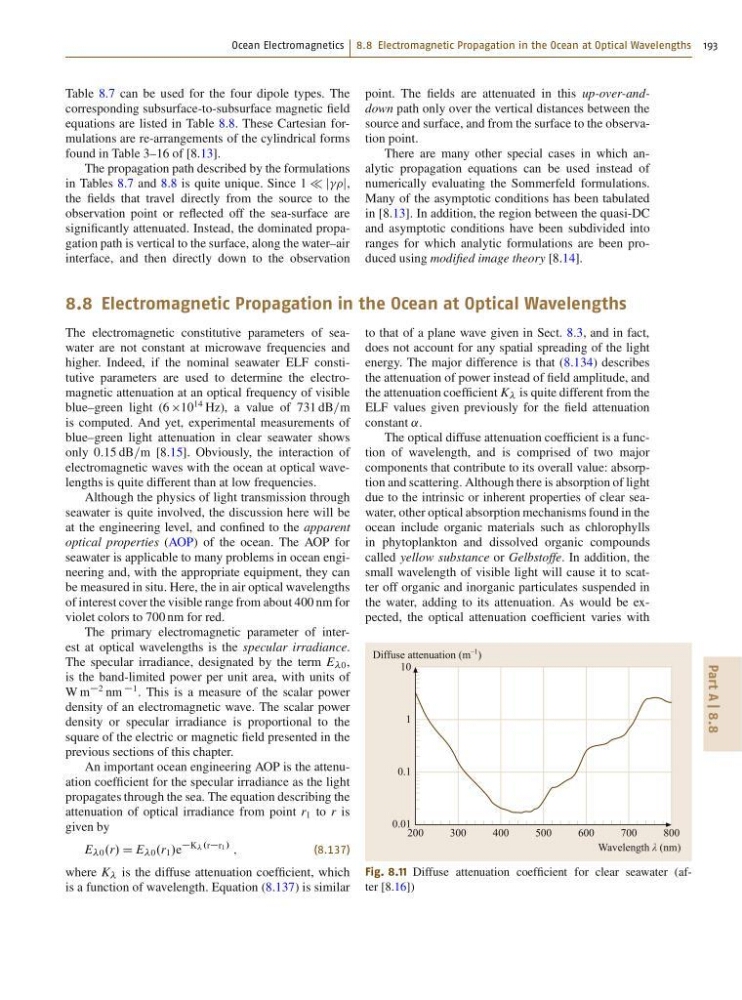
The optical diffuse attenuation coefficient is a function of wavelength, and is comprised of two major
components that contribute to its overall value: absorption and scattering. Although there is absorption of light
due to the intrinsic or inherent properties of clear seawater, other optical absorption mechanisms found in the
ocean include organic materials such as chlorophylls
in phytoplankton and dissolved organic compounds
called yellow substance or Gelbstoffe. In addition, the
small wavelength of visible light will cause it to scatter off organic and inorganic particulates suspended in
the water, adding to its attenuation. As would be expected, the optical attenuation coefficient varies with
200
300
400
500
600
700
800
Diffuse attenuation (m
–1 )
Wavelength λ (nm)
10
1
0.1
0.01
Fig. 8.11 Diffuse attenuation coefficient for clear seawater (after [8.16])
Part A | 8.8
Table 8.7 can be used for the four dipole types. The
corresponding subsurface-to-subsurface magnetic field
equations are listed in Table 8.8. These Cartesian formulations are re-arrangements of the cylindrical forms
found in Table 3–16 of [8.13].
The propagation path described by the formulations
in Tables 8.7 and 8.8 is quite unique. Since 1 jj,
the fields that travel directly from the source to the
observation point or reflected off the sea-surface are
significantly attenuated. Instead, the dominated propagation path is vertical to the surface, along the water–air
interface, and then directly down to the observation
point. The fields are attenuated in this up-over-anddown path only over the vertical distances between the
source and surface, and from the surface to the observation point.
There are many other special cases in which analytic propagation equations can be used instead of
numerically evaluating the Sommerfeld formulations.
Many of the asymptotic conditions has been tabulated
in [8.13]. In addition, the region between the quasi-DC
and asymptotic conditions have been subdivided into
ranges for which analytic formulations are been produced using modified image theory [8.14].
8.8 Electromagnetic Propagation in the Ocean at Optical Wavelengths
The electromagnetic constitutive parameters of seawater are not constant at microwave frequencies and
higher. Indeed, if the nominal seawater ELF constitutive parameters are used to determine the electromagnetic attenuation at an optical frequency of visible
blue–green light (6 10
14 Hz), a value of 731 dB=m
is computed. And yet, experimental measurements of
blue–green light attenuation in clear seawater shows
only 0:15 dB=m [8.15]. Obviously, the interaction of
electromagnetic waves with the ocean at optical wavelengths is quite different than at low frequencies.
Although the physics of light transmission through
seawater is quite involved, the discussion here will be
at the engineering level, and confined to the apparent
optical properties (AOP) of the ocean. The AOP for
seawater is applicable to many problems in ocean engineering and, with the appropriate equipment, they can
be measured in situ. Here, the in air optical wavelengths
of interest cover the visible range from about 400 nm for
violet colors to 700 nm for red.
The primary electromagnetic parameter of interest at optical wavelengths is the specular irradiance.
The specular irradiance, designated by the term E 0 ,
is the band-limited power per unit area, with units of
W m
2 nm
1 . This is a measure of the scalar power
density of an electromagnetic wave. The scalar power
density or specular irradiance is proportional to the
square of the electric or magnetic field presented in the
previous sections of this chapter.
An important ocean engineering AOP is the attenuation coefficient for the specular irradiance as the light
propagates through the sea. The equation describing the
attenuation of optical irradiance from point r 1 to r is
given by
E 0 .r/ D E 0 .r 1 /e
K .rr1/
;
(8.137)
where K is the diffuse attenuation coefficient, which
is a function of wavelength. Equation (8.137) is similar
to that of a plane wave given in Sect. 8.3, and in fact,
does not account for any spatial spreading of the light
energy. The major difference is that (8.134) describes
the attenuation of power instead of field amplitude, and
the attenuation coefficient K is quite different from the
ELF values given previously for the field attenuation
constant ˛.
The optical diffuse attenuation coefficient is a function of wavelength, and is comprised of two major
components that contribute to its overall value: absorption and scattering. Although there is absorption of light
due to the intrinsic or inherent properties of clear seawater, other optical absorption mechanisms found in the
ocean include organic materials such as chlorophylls
in phytoplankton and dissolved organic compounds
called yellow substance or Gelbstoffe. In addition, the
small wavelength of visible light will cause it to scatter off organic and inorganic particulates suspended in
the water, adding to its attenuation. As would be expected, the optical attenuation coefficient varies with
200
300
400
500
600
700
800
Diffuse attenuation (m
–1 )
Wavelength λ (nm)
10
1
0.1
0.01
Fig. 8.11 Diffuse attenuation coefficient for clear seawater (after [8.16])