

Part A | 8.5
184 Part A Fundamentals
Perpendicular polarization
Parallel polarization
0
1 0
ε w = 80.1
20
40
30
50
60
70
80
83.63°
Brewster
angle
90
Incident angle (deg)
Reflection coefficient magnitude
1
0.8
0.6
0.4
0.2
0
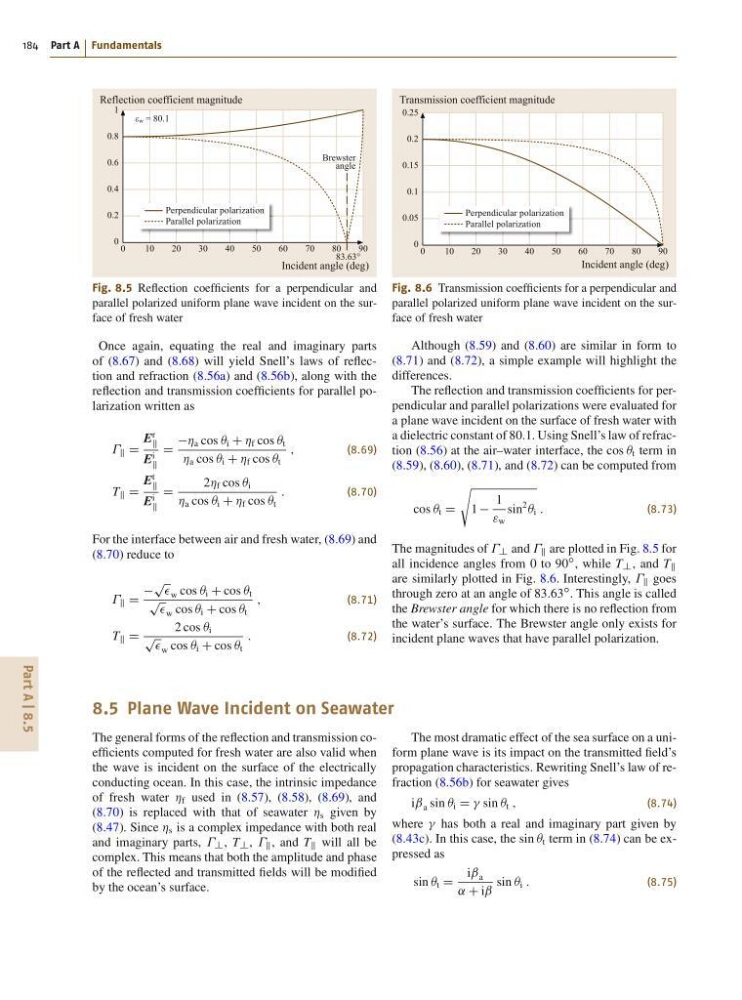
Fig. 8.5 Reflection coefficients for a perpendicular and
parallel polarized uniform plane wave incident on the surface of fresh water
Once again, equating the real and imaginary parts
of (8.67) and (8.68) will yield Snell’s laws of reflection and refraction (8.56a) and (8.56b), along with the
reflection and transmission coefficients for parallel polarization written as
k D
E
r
k
E
i
k
D
Á a cos  i C Á f cos  t
Á a cos  i C Á f cos  t
;
(8.69)
T k D
E
t
k
E
i
k
D
2Á f cos  i
Á a cos  i C Á f cos  t
:
(8.70)
For the interface between air and fresh water, (8.69) and
(8.70) reduce to
k D
p w cos  i C cos  t
p w cos  i C cos  t
;
(8.71)
T k D
2 cos  i
p w cos  i C cos  t
:
(8.72)
Perpendicular polarization
Parallel polarization
0
1 0
2 0
4 0
30
50
60
70
80
90
Incident angle (deg)
Transmission coefficient magnitude
0.25
0.2
0.15
0.1
0.05
0
Fig. 8.6 Transmission coefficients for a perpendicular and
parallel polarized uniform plane wave incident on the surface of fresh water
Although (8.59) and (8.60) are similar in form to
(8.71) and (8.72), a simple example will highlight the
differences.
The reflection and transmission coefficients for perpendicular and parallel polarizations were evaluated for
a plane wave incident on the surface of fresh water with
a dielectric constant of 80.1. Using Snell’s law of refraction (8.56) at the air–water interface, the cos  t term in
(8.59), (8.60), (8.71), and (8.72) can be computed from
cos  t D
s
1
1
" w
sin
2
 i :
(8.73)
The magnitudes of ? and k are plotted in Fig. 8.5 for
all incidence angles from 0 to 90
ı , while T ? , and T k
are similarly plotted in Fig. 8.6. Interestingly, k goes
through zero at an angle of 83:63
ı . This angle is called
the Brewster angle for which there is no reflection from
the water’s surface. The Brewster angle only exists for
incident plane waves that have parallel polarization.
8.5 Plane Wave Incident on Seawater
The general forms of the reflection and transmission coefficients computed for fresh water are also valid when
the wave is incident on the surface of the electrically
conducting ocean. In this case, the intrinsic impedance
of fresh water Á f used in (8.57), (8.58), (8.69), and
(8.70) is replaced with that of seawater Á s given by
(8.47). Since Á s is a complex impedance with both real
and imaginary parts, ? , T ? , k , and T k will all be
complex. This means that both the amplitude and phase
of the reflected and transmitted fields will be modified
by the ocean’s surface.
The most dramatic effect of the sea surface on a uniform plane wave is its impact on the transmitted field’s
propagation characteristics. Rewriting Snell’s law of refraction (8.56b) for seawater gives
iˇ a sin  i D sin  t ;
(8.74)
where has both a real and imaginary part given by
(8.43c). In this case, the sin  t term in (8.74) can be expressed as
sin  t D
iˇ a
˛ C iˇ
sin  i :
(8.75)
184 Part A Fundamentals
Perpendicular polarization
Parallel polarization
0
1 0
ε w = 80.1
20
40
30
50
60
70
80
83.63°
Brewster
angle
90
Incident angle (deg)
Reflection coefficient magnitude
1
0.8
0.6
0.4
0.2
0
Fig. 8.5 Reflection coefficients for a perpendicular and
parallel polarized uniform plane wave incident on the surface of fresh water
Once again, equating the real and imaginary parts
of (8.67) and (8.68) will yield Snell’s laws of reflection and refraction (8.56a) and (8.56b), along with the
reflection and transmission coefficients for parallel polarization written as
k D
E
r
k
E
i
k
D
Á a cos  i C Á f cos  t
Á a cos  i C Á f cos  t
;
(8.69)
T k D
E
t
k
E
i
k
D
2Á f cos  i
Á a cos  i C Á f cos  t
:
(8.70)
For the interface between air and fresh water, (8.69) and
(8.70) reduce to
k D
p w cos  i C cos  t
p w cos  i C cos  t
;
(8.71)
T k D
2 cos  i
p w cos  i C cos  t
:
(8.72)
Perpendicular polarization
Parallel polarization
0
1 0
2 0
4 0
30
50
60
70
80
90
Incident angle (deg)
Transmission coefficient magnitude
0.25
0.2
0.15
0.1
0.05
0
Fig. 8.6 Transmission coefficients for a perpendicular and
parallel polarized uniform plane wave incident on the surface of fresh water
Although (8.59) and (8.60) are similar in form to
(8.71) and (8.72), a simple example will highlight the
differences.
The reflection and transmission coefficients for perpendicular and parallel polarizations were evaluated for
a plane wave incident on the surface of fresh water with
a dielectric constant of 80.1. Using Snell’s law of refraction (8.56) at the air–water interface, the cos  t term in
(8.59), (8.60), (8.71), and (8.72) can be computed from
cos  t D
s
1
1
" w
sin
2
 i :
(8.73)
The magnitudes of ? and k are plotted in Fig. 8.5 for
all incidence angles from 0 to 90
ı , while T ? , and T k
are similarly plotted in Fig. 8.6. Interestingly, k goes
through zero at an angle of 83:63
ı . This angle is called
the Brewster angle for which there is no reflection from
the water’s surface. The Brewster angle only exists for
incident plane waves that have parallel polarization.
8.5 Plane Wave Incident on Seawater
The general forms of the reflection and transmission coefficients computed for fresh water are also valid when
the wave is incident on the surface of the electrically
conducting ocean. In this case, the intrinsic impedance
of fresh water Á f used in (8.57), (8.58), (8.69), and
(8.70) is replaced with that of seawater Á s given by
(8.47). Since Á s is a complex impedance with both real
and imaginary parts, ? , T ? , k , and T k will all be
complex. This means that both the amplitude and phase
of the reflected and transmitted fields will be modified
by the ocean’s surface.
The most dramatic effect of the sea surface on a uniform plane wave is its impact on the transmitted field’s
propagation characteristics. Rewriting Snell’s law of refraction (8.56b) for seawater gives
iˇ a sin  i D sin  t ;
(8.74)
where has both a real and imaginary part given by
(8.43c). In this case, the sin  t term in (8.74) can be expressed as
sin  t D
iˇ a
˛ C iˇ
sin  i :
(8.75)