

Ocean Electromagnetics 8.4 Reflection and Transmission of a Plane Wave at the Surface of Fresh Water 183
Part A | 8.4
are set to zero. Applying these boundary conditions to
(8.48)–(8.53) at z D 0 gives
e
iˇax sin Âi
C ? e
iˇax sin Âr
D T ? e
iˇfx sin Ât
; (8.54)
1
Á a
cos  i e
iˇax sin Âi
C cos  r ? e
iˇax sin Âr
Á
D D
T ?
Á f
cos  t e
iˇfx sin Ât :
(8.55)
Equations (8.54) and (8.55) are sufficient to solve for
 r ,  t , ? , and T ? .
Breaking (8.54) and (8.55) into their real and imaginary parts will produce four equations with which to
solve for the four unknowns. Following this procedure
results in the relationships between the incident, reflected, and transmission angles given by
 r D  i ;
(8.56a)
ˇ a sin  i D ˇ f sin  t :
(8.56b)
Equations (8.56a) and (8.56b) are called Snell’s laws of
reflection and refraction, respectively. Placing (8.56a)
and (8.56b) into (8.54) and (8.55) and solving for the
reflection and transmission coefficients produces the
expressions
? D
E
r
?
E
i
?
D
Á f cos  i Á a cos  t
Á f cos  i C Á a cos  t
;
(8.57)
T ? D
E
t
?
E
i
?
D
2Á f cos  i
Á f cos  i C Á a cos  t
:
(8.58)
Because air and water are both nonmagnetic (8.57) and
(8.58) can be reduced to
? D
cos  i
p
" w cos t
cos  i C
p
" w cos  t
;
(8.59)
T ? D
2 cos  i
cos  i C
p
" w cos  t
;
(8.60)
where " w is the dielectric constant of water defined previously as 80.1.
A similar procedure is used to obtain the reflection
and transmission coefficients for a uniform plane wave
that has a parallel polarization incident on the surface
of fresh water. A wave of this type also referred to as
having a vertical polarization has an electric field that
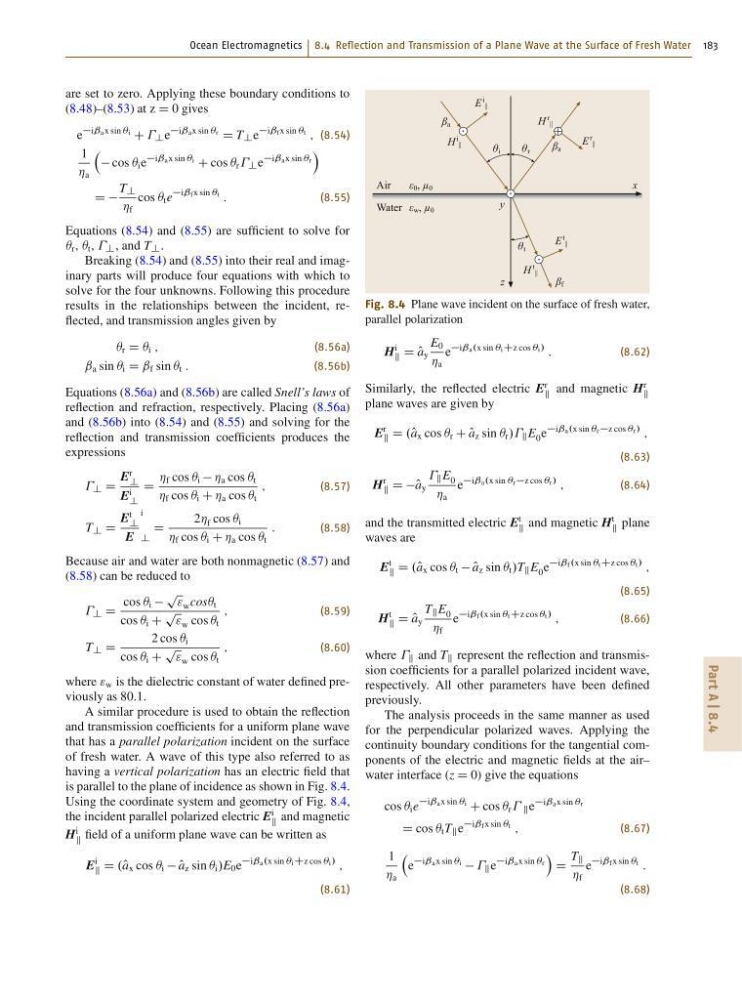
is parallel to the plane of incidence as shown in Fig. 8.4.
Using the coordinate system and geometry of Fig. 8.4,
the incident parallel polarized electric E
i
k
and magnetic
H
i
k
field of a uniform plane wave can be written as
E
i
k D .O a x cos  i O
a z sin  i /E 0 e
iˇa.x sin ÂiCz cos Âi/
;
(8.61)
x
y
z
Air
ε 0 , μ 0
Water ε w , μ 0
E
i
E
r
E
t
H
i
H
r
H
t
θ i
θ r
θ t
β f
β a
β a
Fig. 8.4 Plane wave incident on the surface of fresh water,
parallel polarization
H
i
k D O
a y
E 0
Á a
e
iˇa.x sin ÂiCz cos Âi/
:
(8.62)
Similarly, the reflected electric E
r
k
and magnetic H
r
k
plane waves are given by
E
r
k D .O a x cos  r C O
a z sin  r // k E 0 e
iˇa.x sin Ârz cos Âr/
;
(8.63)
H
r
k D DO a y
k E 0
Á a
e
iˇa.x sin Ârz cos Âr/
;
(8.64)
and the transmitted electric E
t
k
and magnetic H
t
k
plane
waves are
E
t
k D .O a x cos  t O
a z sin  t /T k E 0 e
iˇf.x sin ÂtCz cos Ât/
;
(8.65)
H
t
k D O
a y
T k E 0
Á f
e
iˇf.x sin ÂtCz cos Ât/
;
(8.66)
where k and T k represent the reflection and transmission coefficients for a parallel polarized incident wave,
respectively. All other parameters have been defined
previously.
The analysis proceeds in the same manner as used
for the perpendicular polarized waves. Applying the
continuity boundary conditions for the tangential components of the electric and magnetic fields at the air–
water interface (z D 0) give the equations
cos  i e
iˇax sin Âi C cos  r k e
iˇax sin Âr
D cos  t T k e
iˇfx sin Ât
;
(8.67)
1
Á a
e
iˇax sin Âi
k e
iˇax sin Âr
Á
D
T k
Á f
e
iˇfx sin Ât
:
(8.68)
Part A | 8.4
are set to zero. Applying these boundary conditions to
(8.48)–(8.53) at z D 0 gives
e
iˇax sin Âi
C ? e
iˇax sin Âr
D T ? e
iˇfx sin Ât
; (8.54)
1
Á a
cos  i e
iˇax sin Âi
C cos  r ? e
iˇax sin Âr
Á
D D
T ?
Á f
cos  t e
iˇfx sin Ât :
(8.55)
Equations (8.54) and (8.55) are sufficient to solve for
 r ,  t , ? , and T ? .
Breaking (8.54) and (8.55) into their real and imaginary parts will produce four equations with which to
solve for the four unknowns. Following this procedure
results in the relationships between the incident, reflected, and transmission angles given by
 r D  i ;
(8.56a)
ˇ a sin  i D ˇ f sin  t :
(8.56b)
Equations (8.56a) and (8.56b) are called Snell’s laws of
reflection and refraction, respectively. Placing (8.56a)
and (8.56b) into (8.54) and (8.55) and solving for the
reflection and transmission coefficients produces the
expressions
? D
E
r
?
E
i
?
D
Á f cos  i Á a cos  t
Á f cos  i C Á a cos  t
;
(8.57)
T ? D
E
t
?
E
i
?
D
2Á f cos  i
Á f cos  i C Á a cos  t
:
(8.58)
Because air and water are both nonmagnetic (8.57) and
(8.58) can be reduced to
? D
cos  i
p
" w cos t
cos  i C
p
" w cos  t
;
(8.59)
T ? D
2 cos  i
cos  i C
p
" w cos  t
;
(8.60)
where " w is the dielectric constant of water defined previously as 80.1.
A similar procedure is used to obtain the reflection
and transmission coefficients for a uniform plane wave
that has a parallel polarization incident on the surface
of fresh water. A wave of this type also referred to as
having a vertical polarization has an electric field that
is parallel to the plane of incidence as shown in Fig. 8.4.
Using the coordinate system and geometry of Fig. 8.4,
the incident parallel polarized electric E
i
k
and magnetic
H
i
k
field of a uniform plane wave can be written as
E
i
k D .O a x cos  i O
a z sin  i /E 0 e
iˇa.x sin ÂiCz cos Âi/
;
(8.61)
x
y
z
Air
ε 0 , μ 0
Water ε w , μ 0
E
i
E
r
E
t
H
i
H
r
H
t
θ i
θ r
θ t
β f
β a
β a
Fig. 8.4 Plane wave incident on the surface of fresh water,
parallel polarization
H
i
k D O
a y
E 0
Á a
e
iˇa.x sin ÂiCz cos Âi/
:
(8.62)
Similarly, the reflected electric E
r
k
and magnetic H
r
k
plane waves are given by
E
r
k D .O a x cos  r C O
a z sin  r // k E 0 e
iˇa.x sin Ârz cos Âr/
;
(8.63)
H
r
k D DO a y
k E 0
Á a
e
iˇa.x sin Ârz cos Âr/
;
(8.64)
and the transmitted electric E
t
k
and magnetic H
t
k
plane
waves are
E
t
k D .O a x cos  t O
a z sin  t /T k E 0 e
iˇf.x sin ÂtCz cos Ât/
;
(8.65)
H
t
k D O
a y
T k E 0
Á f
e
iˇf.x sin ÂtCz cos Ât/
;
(8.66)
where k and T k represent the reflection and transmission coefficients for a parallel polarized incident wave,
respectively. All other parameters have been defined
previously.
The analysis proceeds in the same manner as used
for the perpendicular polarized waves. Applying the
continuity boundary conditions for the tangential components of the electric and magnetic fields at the air–
water interface (z D 0) give the equations
cos  i e
iˇax sin Âi C cos  r k e
iˇax sin Âr
D cos  t T k e
iˇfx sin Ât
;
(8.67)
1
Á a
e
iˇax sin Âi
k e
iˇax sin Âr
Á
D
T k
Á f
e
iˇfx sin Ât
:
(8.68)